Please evaluate my day hiking kit

myright

Gold Member
Joined
Jan 31, 2008
Messages
5,178
Hey everyone,
Until joining this site I would pretty much just jam my pockets and pack with things I thought I would need. Now I actually have a kit together and would like for everyone to pick it apart and get my up to par.

Here's the stats on my hiking. Always day hikes and 99% of the time I have the dog with me and 50% of the time my wife is with me also. I am not allergic to bees but have a VERY bad reaction that will leave my entire arm swollen if I were to get stung on the finger. I do not normally stop to make a fire and/or cook. I'll bring a protien bar and some other snacks to get me through. My hikes rarely go over 4-5 hours.

Oh - and a detail I forgot - I am in the Mid-Atlantic region.

What are you suggestions?

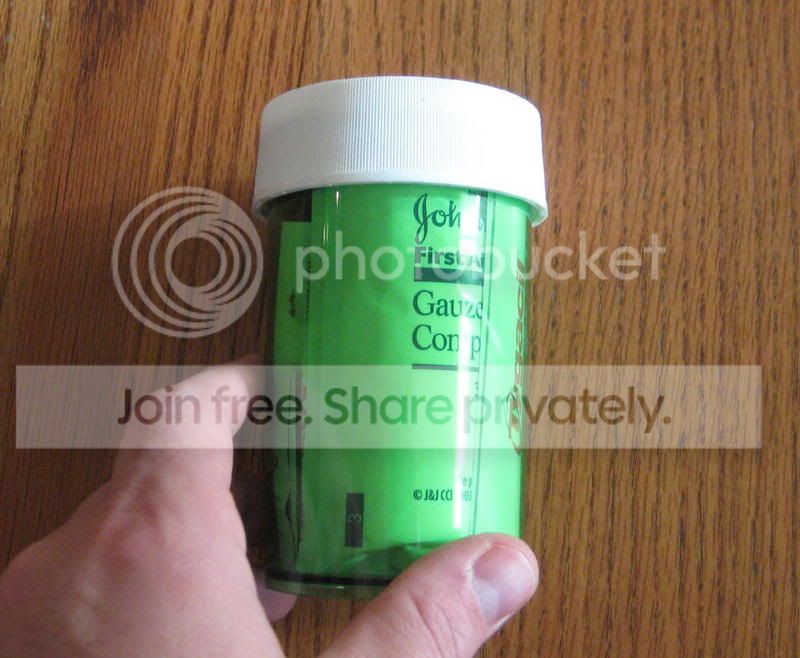
I picked a Nalgene bottle to store all this in, it can also double as a cup in a pinch. Always with me would be a SAK and now a Spyderco Delica. Sometimes a small fixed blade depending on where I am - I'd have a flashlight also.

Kit_1.jpg


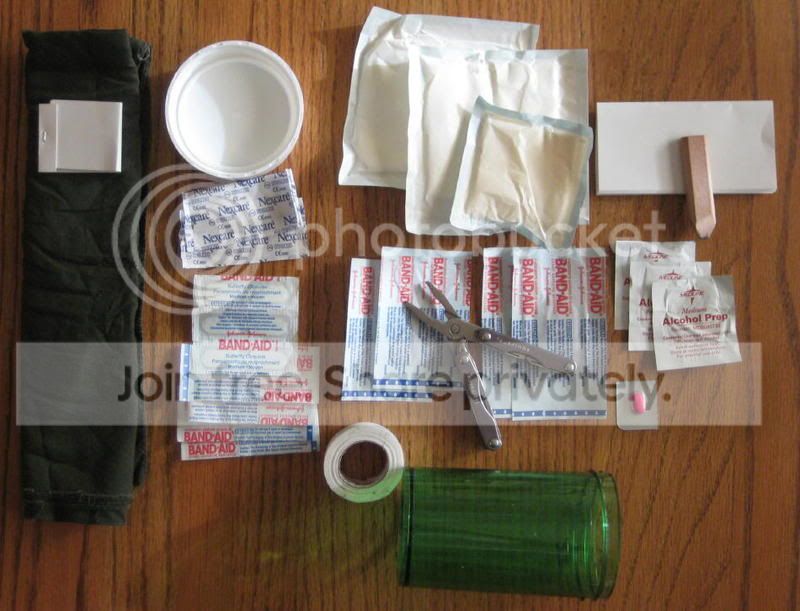
Bandana on the left with a pack of matches. The gauze I figured could double as some tinder if I needed it to.

Kit_2.jpg
 
Looks like a good little FAK (first aid kit), but I must ask do you bring a bottle of water along? A couple of Katadyn purification tablets (taste much better than iodine) would easily fit and be able to give you an extra quart or so of water if needed; the bandana would make a good pre-strainer/filter for larger debris.

How about a whistle? If you're immobilized and injured it would be huge signaling asset.

Sun-screen and insect repellant...can be really big assets. My wife didn't put any sun-screen on a couple days ago on our bouldering/hike...it was sunny but only 70 degrees and she's badly burned on the shoulders.

Sliver Grippers or other tweezers...used to pull cactus thorns out or getting ticks off.

A little bit of cord...I like 550 cord; just carry enough to replace your shoe/boot laces for a pocket kit.

I have a key chain with a whistle, small firesteel, peanut (Zippo fuel) lighter and Sliver Grippers on it. As for a fire starting kit; well a simple Bic Lighter will suffice, just consider tinder. A fire is only essential for cold/wet conditions but can just as equally important if you’re stranded overnight and need a signal fire; and don't forget the psychological boost as well.

A small role of dental floss can be used for multiple needs. A few needles can help fix a rip in the shirt or pants. Some 100mph tape (duct tape) on a flat role in the back pocket (about 6-10 feet) can be used for several repairs as well.

Don't forget a good walking stick/pole. Good for assisting in difficult crossings, aiding in balance and gives you some good stand-off for self defense.

ROCK6
 
You asked. And everyone will have an opinion. I would say to go get the book 98.6 degrees by Cody Lundin. Then put your PSK together. Just my 2 cents
 
Looks like a good little FAK (first aid kit), but I must ask do you bring a bottle of water along? A couple of Katadyn purification tablets (taste much better than iodine) would easily fit and be able to give you an extra quart or so of water if needed; the bandana would make a good pre-strainer/filter for larger debris.

How about a whistle? If you're immobilized and injured it would be huge signaling asset.

Sun-screen and insect repellant...can be really big assets. My wife didn't put any sun-screen on a couple days ago on our bouldering/hike...it was sunny but only 70 degrees and she's badly burned on the shoulders.

Sliver Grippers or other tweezers...used to pull cactus thorns out or getting ticks off.

A little bit of cord...I like 550 cord; just carry enough to replace your shoe/boot laces for a pocket kit.

I have a key chain with a whistle, small firesteel, peanut (Zippo fuel) lighter and Sliver Grippers on it. As for a fire starting kit; well a simple Bic Lighter will suffice, just consider tinder. A fire is only essential for cold/wet conditions but can just as equally important if you’re stranded overnight and need a signal fire; and don't forget the psychological boost as well.

A small role of dental floss can be used for multiple needs. A few needles can help fix a rip in the shirt or pants. Some 100mph tape (duct tape) on a flat role in the back pocket (about 6-10 feet) can be used for several repairs as well.

Don't forget a good walking stick/pole. Good for assisting in difficult crossings, aiding in balance and gives you some good stand-off for self defense.

ROCK6

Thanks Rock.

I use either a lage Camelbak or my Kelty Day hike pack with a water bladder in it. Bot of which have 550 cord wrapped on the top handle, probably 7 feet of it or so.

I can't believe I forgot a whistle, especially since that was mandatory equipment when I was in the military - very good catch my friend. :D

I would have tweezers in my SAK and also have the small pliers on that small leatherman.

I was thinkig of wrapping that nalgen bottle in some layers of duct tape, but that flat roll sounds like a much better idea.

Sunscreen and bug spray would be in my bag with me as well.

Another good suggestion is the walking staff/pole - I do not own one as I usually have the dog's leash in one hand and don't want my other hand tied up by a pole.

Great suggestions Rock - Thanks!
 
You asked. And everyone will have an opinion. I would say to go get the book 98.6 degrees by Cody Lundin. Then put your PSK together. Just my 2 cents

Yes, I did ask for opinions and I know I will get a wide array of them. That's exactly why I asked. I'm sure a lot of people do a lot of different things, some of which I've probably never heard of.

I've never heard of that book - I'll have to check it out. Thanks.
 
Okay here are a few of my suggestions:

1) I would echo the suggestion for alternative fire starters. Matches are the worst of the ones available - they don't work when wet, they will degrade over time and not work, the striker can get clogged and not work, they run out quickly, sometimes before you get your first fire going. A firesteel and a little Bic lighter would be your best bet.

2) Small tube of vaseline. They sell them at the drug star for use as lib balm against chapped lips. But it also works great to facilitate tinder from being a flash tinder to a slow, long burn. Couple the vaseline with some of the gauze and hit with firesteel and you have about 1 min of flame to get your natural kindling going.

3) A small flashlight would be handy such as one of those keychain LED flashlights that don't take up room.

4) Your description of how you react to a bee sting sounds excactly like an allergic reaction to me. How do you know it isn't? One thing about allergies is that they get progressively worse every time you are subjected to the stimulous. What may have started off as hives may have now turned into a swollen arm and may next time lead to analphlaxis. Talk to your doctor and ask his advice. There are two surefire needed things for allergies in the wildnerness. 1) an epipen - try to get the double shot ones and 2) antihistamine pills. When you start getting the reaction, you hit your self with the epi-pen, then take the allergy pills. The hope is that the shot, which only lasts about 20 minutes, gives you enough time for the longer term pills to kick in. In the bush you are more than 2 h away from a hospital so you need longer term measures. This is why a 2nd shot is useful because the 1st one doesn't always get you through until the pills kick in. Sorry - I know this was a long lecture about this one, but if you are allergic this is the one thing that WILL save your life. Also, an epi-pen can be used on anyone you encounter with an allergic reaction - like your wife.

5) other drugs. I couldn't identy what your little pink pill was. Here is what I recommend: A) I always have immodium - about 6 pills for diarrhea. This stuff works like a charm. B) Dramamine (marketted in Canada as Gravol) is used as an anti-nausea pill. It helps with vomiting. I know in the U.S. they market it largely as anti-motion, but it works well for just plain old queasyness, mild food poisoning etc. C) Aspirin, I carry the low dose one (80 mg), you can swallow about 4 of them for use as a pain releiver. If you suspect yourself or someone around you is having a heartattack you can administer a single one. Aspirin acts as a blood thinner that can help during cardiac arrest.

6) Moleskin - this stuff works great for blisters.

7) I echo the suggestions of lashing material like parachord.

8) Little fishing kit. Not everyone sees this as applicable to them. However, the monofilament line can easily be configured into a snare for ground animals and others have indicated the ability to collected land animals by hook.

9) Sewing thread and needle. Small, lightweight, and very useful for repairs to clothing and packs.

10) Small compass, like a button compass.

11) Emergency blanket - sometimes called a space blanket, it folds into nothing and can be used for shelter or wrapped around your body for heat. Some people substitute or add large garbage bags for this purpose.

12) Two or three triangle bandages. These can be used to help stop excessive bleeding if needed; can be modifed into an arm sling, or used to tie up splints for a broken leg. Include about 4 medium to large safety pins with these.
 
Okay here are a few of my suggestions:

4) Your description of how you react to a bee sting sounds excactly like an allergic reaction to me. How do you know it isn't? One thing about allergies is that they get progressively worse every time you are subjected to the stimulous. What may have started off as hives may have now turned into a swollen arm and may next time lead to analphlaxis. Talk to your doctor and ask his advice. There are two surefire needed things for allergies in the wildnerness. 1) an epipen - try to get the double shot ones and 2) antihistamine pills. When you start getting the reaction, you hit your self with the epi-pen, then take the allergy pills. The hope is that the shot, which only lasts about 20 minutes, gives you enough time for the longer term pills to kick in. In the bush you are more than 2 h away from a hospital so you need longer term measures. This is why a 2nd shot is useful because the 1st one doesn't always get you through until the pills kick in. Sorry - I know this was a long lecture about this one, but if you are allergic this is the one thing that WILL save your life. Also, an epi-pen can be used on anyone you encounter with an allergic reaction - like your wife.

I went to an allergist and was tested and he said it's only a severe reaction and not an actual allergic reaction. He suggested Benadryl and a close eye on it incase it gets worse. The little pink pill is a Benadryl.

My wife is a critical care nurse, so I feel pretty good when out on hikes if anything were to happen.

Good idea about the imodium and dramamine.

A compass is next on my list, as well as a small fishing/sewing kit.

Thanks.
 
If the reaction can potentially be debilitating, you need to include a few more benadryl tabs.

Everyone is going to have a lot of opinions on what to include, so I will suggest some guidelines instead. Re-evaluate based on these thoughts, then come back to us about any changes you feel are neccesary.

1- Try to break down your situation into need-sets. This will simplify your gear list and tell you what's really important and what's not. An example of what I use: Water, shelter, first aid, basic tools, food, signaling/navigation, light.

2- Google 'the ten essentials'. This is a common estimate of the ten most important pieces of gear to keep with you, to keep you alive in case of the worst.

Ex/ http://en.wikipedia.org/wiki/Ten_Essentials
 
kdg reminded me about chapstick...I prefer Burt's Bees and if you ever get cracked, dried lips that start bleeding...you'll never forget chapstick again!

SpookyPistolero reminded me of a little post I made a while ago (when I was still in Iraq) on my choice for the "10+ essentials"...more of a frame of mind than any specific items...

"My Top 10 Essentials"

First, I must admit, I don’t think of my “essentials” as single items, but more of an area of importance and categories. For me (and my family), I make sure we cover the basics, and the concept of the basics is understood. The order really depends on your location and time of season. For some water will be one of their top priorities, whereas in a winter clime with unpredictable weather, shelter will be near the top as would the means to get a fire going. So, there’s been a ton of “essentials” lists posted, in magazines, on websites, etc, but in the end, only the individual heading out can identify his/her essential items needed to mitigate becoming a bad-ending survival story. These are “my” essentials, and some items will differ from a lot of other people out there. I just thought I would spell out my reasoning and categories for my “top 10” essentials.

1. Appropriate Clothing

Many essential lists have “layered” clothing, some list rain gear, etc. I know there are some regions where you can hike from snow to 90+ degree temperatures in one day (Wenatchee, WA comes to mind). So, given that most people are so spontaneous as to run out of the shower in their birthday suit directly out into the desert, swamps or mountains; most understand that you need to don appropriate clothing. In colder climates or times of the year, layers work best. Plus you’ll want to avoid cotton. In rainy seasons or parts of the country, a rain jacket is a wise addition. Likewise, if heading out in the blistering sun of Arizona or SW Texas, a good hat and long sleeves are prudent measures. So, other than “dressing for the occasion”, I still like to add some constant companions.

- Wind or rain jacket (I’ve become quite fond of the Soft Shells plus they’re light)
- Hat; handy for several reasons from retaining heat to protection from sunburn
- Gloves; prudent protection from the environment and keeping your digits protected
- Sunglasses; my eyes are important to my survival, I plan to keep them well protected
- Decent footwear; anything that provides adequate support and you can walk comfortably in
- Watch; it’s a just a part of my daily dress, so it’s something that I’ve included

2. Knife/Tool

For me, a knife is essential; however, I know there are many that would argue it’s not as important as shelter, water or fire; different strokes for different folks. I list knife AND tool and most of us would argue the advantages of a fixed bladed knife over a folder but not all scenarios or personalities lend themselves to this preferred carry. Having a knife or tool is the number one rule…whether it is a Swiss Army Knife, Leatherman or locking folder, having a knife (and of course the skill and knowledge to use it), is half the battle. Since this is more of a discussion on essentials, I don’t want to get bogged down in knife choices and selection, however for me, I typically carry a decent sized (4-5”) fixed blade, locking folder and a SAK or multi-tool of some type. I do believe in redundancy. Furthermore, a small razorblade or mini folder (such as Spyderco’s little Dragonfly or Gerber’s LST) in your Pocket Survival Kit is an additional level of security.

3. Water

Water is critical as our bodies just won’t function well after a few days without it. Water is an essential, but there are a couple of parts that I’ll identify for my concept of “water” in my essentials list.

- Water carrying. This may be anything from a water bottle to a Camelback.
- Acquiring water. If you have a water source and a small cup, water bottle or Ziploc bag, it’s relatively easy to acquire water. Of course, there are other methods such as using a couple of clear garbage bags (which I keep a few in my daypack) for transpiration-collection. After attempting a solar still once, I don’t think it’s worth the effort…as my Battalion Commander says, “the juice just isn’t worth the squeeze”.
- Water filtration/purification. This is an integral part of hydration. I’m a big believer in redundancy, but your activities will dictate what you can physically carry. You may not be able to carry a full sized filter, but a few Potable Aqua tablets or a few of the Katadyn chlorine tablets. If you’re in an area where there’s a lot of sediment and detritus in the water some type of prefilter is advisable, such as an ***-rag or coffee filters. Personally, even on day hikes, I will carry a filter; Polar Pure is my primary backup and I have about a dozen of Potable Aqua tablets in a small vial in my PSK. Purifying by boiling is another method; of course a container is quite helpful. I know you can improvise with a cotton duct hat or folded bark/woven leaves and hot rocks, but a simple steel or tin can goes a long ways to efficient collection and boiling. More to follow on the steel cup.

4. Fire

Fire can be both an essential life saver and major morale booster. Not only does it provide necessary heat in colder weather, it can act as a signal for rescue-searchers. I think most of us understand the importance, but I want to address the redundancy for fire making. Of course there is the ignition source, whether it’s a Bic lighter, fire-steel, match or even a magnifying lense and you need to make sure you carry a couple of different sources for backup. Next is the ignition fuel source. I know cottonballs and Vaseline are popular and one of my primary choices, but I also like the Sparklite tinder bundles, trioxane fuel bars, waxed paper and a piece of fatwood that I can make shavings from. Throw in a couple of tea light candles, and you have a decent fire-starting package. I mentioned redundancy, and if you go back to how you carry gear in “lines”, where Line One is your EDC and what you always have with you, I like to carry a lighter and a small ferro rod. In my PSK, I have a Sparklite and a few bundles of tinder along with a Fresnel lens. In my daypack, I’ll carry another lighter, matches and my Vaseline cottonballs along with a few bars of trioxane and a small candle or a few tea-light candles.

5. Shelter + Cordage

Part of my EDC is a few hanks of braided 550 paracord in my cargo pocket, so that’s always with me. Shelter can be made from a man made cover such as a tarp, garbage bag or could be constructed with vegetation (and some 550 paracord comes in handy for some shelter types). I usually keep my “shelter” and about 40-50 feet of 550 paracord together and it doesn’t take up much room. A simple large garbage bag is easy to add to a coat pocket or even a couple in a day pack. Inside my Camelback Talon, I have a couple of large garbage bags and a small Silicone impregnated nylon tarp with about 30 feet of 550 paracord.

6. Illumination/Signaling

I know most top ten essentials list a flashlight as a separate item. With the new LED flashlights with the various modes of operation, that illumination tool can easily double as a signaling tool. Given that your essentials are there for a significant purpose, I see the ability to signal in a survival situation as extremely important. There are visual and sound-based methods and devices, some geared for darkness (i.e. strobe) and some during sunlight hours (such as a signal mirror). Again, I like a little redundancy, but you can also have dual use items, such as a programmable LED light that has a strobe function. So, for my package of illumination and signaling, I have a couple of LED lights (Fenix, Novatac) that also incorporate a strobe function. A whistle and a signal mirror are excellent companions for the signaling group. More common additions are Walk-about FRS/GMRS radios and cell phones…both are great additions if traveling in groups or along, but don’t ever forget the basics.

7. First Aid Kit / Skin Protection

I don’t want to go into the whole First Aid kit composition, but most standard, small backpacking kits are more than adequate and as long as they leave a little room for additional times, such as prescription drugs, you are more prepared than most. I usually like the larger 2X3” Band-Aids, Burn-Gel, and extra mole skin. Although most kits are geared towards scrapes and minor burns, if you have room (and appropriate training), you can expand to cover more severe wounds. This is an essentials kit, so don’t make it so large that you leave it behind; it’s all about balance. A couple of additions to this category are items you sometimes see separately, and that’s sunscreen and Chapstick (I prefer Burt’s Bees). Both are essential in most areas if you’re planning on spending a lot of time out in the elements and a little tube of each is compact enough to throw in the kit.

8. Navigation

Depending on your activities, navigational tools may be much higher on your priority listing, although a map of your area and compass should always be an essential part if you’re planning anything outdoors. I personally keep an Suunto M9 wrist compass on me at all times, and if I’m doing any hiking, I’ll have a regular base-compass in a pocket. Maps are probably the most useful with a compass, but even a compass alone can keep one from going in circles, staying on track or help to dog-leg a non-passable area. I also like the GPS, but I don’t think you should dump the compass entirely…again, a little redundancy, but always think simplicity…the compass doesn’t use batteries.

9. Metal Cup

I like listing the metal cup as a separate item. I know it’s hard to think about throwing a cup in your pocket, but if you have a small waist pack or Camelback, it’s a simple process to use a snap link and attach one. I prefer stainless, but aluminum or titanium will work; avoid the double wall mugs as you can’t use them directly in the fire for boiling. I have several and there are several to choose from. A metal cup can be used to signal (preferably stainless steel), dig, boil/purify water, serves as container to collect nuts, berries, it can be used to cook in…there are a ton of uses for a good metal cup, hence, it’s in my “top-10” essentials.

10. Self-Defense/Protection

I’m a little torn for my number 10. I always bring trail snacks, even for day hikes, and I usually have a Clif-bar or two stashed in the bottom of my Camelback. For a 72-48 hour scenario, food isn’t really that critical, UNLESS, you’re in a severe climate where calories mean life or death. For most situations, shelter, water, a fire and appropriate clothing will get you through the first few days without too much harm. Hence, I’ve opted for something that is a little more important to me.

Survival can mean many things to many people and I’ve always felt comfortable with a self-defense item, whether it is a hiking stick, Mace or a CCW-firearm. This category isn’t a survival hunting weapon; this is something you have to provide yourself protection from both two-legged and four-legged critters. I’ve had my close calls and scares to where I’ve just accepted this category as one of my “top 10” essentials…I know some won’t agree, but then that’s why I called it “my” top-ten essentials. For me, a knife is more tool than weapon; sure it can be used effectively, but I like to keep threats at a distance and a hiking staff is an excellent choice. There are commercial versions or hand made versions. Not only does a hiking stick provide stability on rough trails or off-trail, it can be an effective weapon to keep snakes, dogs or other aggressive critters at bay. For a backup, I like a CCW, and it fills that niche well and can even be used to signal or hunt game if in a real dire situation. If you’re in an area where CCW is unauthorized and you’re trying to obey the idiotic laws, pepper spray is a good distance-weapon alternative. For any of the above, a little training goes a long way, even with a walking stick.

So, there’s my ramblings of the evening here in Iraq. I’ve seen posts come up on the ubiquitous “10 essentials” and most backpacking or outdoors websites and publications have there list…but this list is a very personal thing. The top 7-8 are pretty common, but there are always a couple that are very personal in nature and fill the need of that particular individual.

I thought of another area, but it’s not really part of my “essentials” I do have it as part of my EDC and in kit-form for my day pack. A repair kit; sure my PSK has some thread, dental floss, needles, small role of duct tape (and I carry a flat role in my back pocket as well), but it does need mentioning. So, a little Shoe-goo (or other silicone adhesive/sealant), sewing kit (needles, heavy thread, safety pins), duct/100mph tape and few zip-ties can be in a compact package in your waist pack, Camelback or day pack and can handle most of your field repair needs.

So, based on your own particular “needs”, season, location or activities, what are your top 10 essentials?

ROCK6

ROCK6
 
Yes, I did ask for opinions and I know I will get a wide array of them. That's exactly why I asked. I'm sure a lot of people do a lot of different things, some of which I've probably never heard of.

I've never heard of that book - I'll have to check it out. Thanks.

Hey Mrright, nice looking FAK you got there. Definitely expand from there though. FAK is a great place to start, I have a very large one but I have a lot of dumb friends who seem to get me hurt right along with them:D

Definitely grab Cody Lundin's "98.6 degrees - The Art of Keeping Your Ass Alive!'' As was suggested above. It's a very good read - Packed balls-deep with great information and just enough humor to make it not read like a typical 'survival manual'. He's a big believer in bare essentials too so If you are into packing light - he's got a great big huge section on making your own survival kit.

I got it last week and haven't put it down. Although if you want to learn about 'primitive skills' it really isn't the book for it. Its more focused on realistic survival situations, AKA = staying alive long enough and signaling well enough to get rescued ASAP.

Other than that, you can do a search and find similar threads on this subject, everyone has their own opinion but you really want to build a basic one, and then customize it based on what climate you are going to be in. What part of the Mid-Atlantic are you in? I'm in Maryland - maybe I could give you some tips
 
Your sensitivity to bee stings could develop into anaphylaxis out of the blue. I have seen patients of mine that have a sensitivity to something for years, and then all the sudden develop a severe alergic reaction to the trigger. I suggest packing more than one benadryl pill, like maybe 4, and look into getting an epi-pen just in case. Better to have it and never need it, then to need it and not have it.
 
Yeah I just recently watched a Search-and-rescue seminar online and the guy stressed how crucial having an epi-pen in your PSK is, if you are allergic to anything - or if anybody you are hiking with is.

If you go into "_________ shock''(can't remember the word off the top of my head) from being stung or consuming something you are very allergic to, an epi-pen is the ONLY thing that can save your life at that point. Its sort of a pain in the ass because you need to get a prescription(last I checked) to get one, but the doctor is very unlikely to deny you it. And it could save you or a friends' life.
 
My wife has an epi-pen for her allergy shots she gets.

Maybe I'll take a trip back to the allergist for just this reason. It would really suck to get stung while in the woods by myslef. Cell phone or not, no one is going to get there in time if it does get worse.

Hey Rock - thanks for posting the "top 10 essentials"
 
Hey Rock - thanks for posting the "top 10 essentials"

No problem, but you do know what's required of you now? Once you get your kit assembled, you'll have to post pictures...I think it's a mandatory requirement:D

ROCK6
 
Well, you've come to the right place to get good advice. I would say the whistle, signal mirror and at least 3 methods of starting a fire are mandatory.

Also a good LED light. You can get really small ones that weigh nothing, but I prefer the AAA ones over the photon variety. My personal one is a Fenix E1. Dead simple to operate, lasts forever, and shoves out a major amount of light for its size. Arc premiums are also very popular.

Another slightly larger alternative is the headlamp, which has a major benefit of leaving both your hands free while lighting up your way.

You might also consider a SAK One-hand Trekker. Personally I think the saw on it is the best small saw going, plus you get a really great locking blade and a couple of other useful tools into the bargain.
 
The guys gave good advice. Here's a few things I picked up on:
I don't carry Band-Aids. I carry a few rolls of gauze. You can make "Band-Aids" by cutting off a bit of gauze from the roll (so you don't have to use the pads you have on a small wound), folding it into a square and taping it in place.
Also get a small tube of Neosproin or generic equivalent. I'd also bring Motrin -- good pain reliever, anti-inflammatory and anti-pyretic. Definitely more Benadryl if you react to stings like that. You might be allergic to other stings and might be in trouble if you don't have it.

You NEED some kind of shelter. A lightweigth tarp to keep the rain off and at least one of the Adventure Medical heavy suty space blankets or bivy. They are small, light and fairly cheap. I know you said you usually only go out for 4-5 hours, but you can find plenty of posts where people got in serious trouble and/or dead because their afternoon walk turned into an unexpected overnighter.
 
A fire is only essential for cold/wet conditions but can just as equally important if you’re stranded overnight and need a signal fire; and don't forget the psychological boost as well.

Up here in the Pacific North Wet, it definately essential. and paper matches won't cut it. I like your suggestion of a Firesteel.
 
The guys gave good advice. Here's a few things I picked up on:
I don't carry Band-Aids. I carry a few rolls of gauze. You can make "Band-Aids" by cutting off a bit of gauze from the roll (so you don't have to use the pads you have on a small wound), folding it into a square and taping it in place.
Also get a small tube of Neosproin or generic equivalent. I'd also bring Motrin -- good pain reliever, anti-inflammatory and anti-pyretic. Definitely more Benadryl if you react to stings like that. You might be allergic to other stings and might be in trouble if you don't have it.

You NEED some kind of shelter. A lightweigth tarp to keep the rain off and at least one of the Adventure Medical heavy suty space blankets or bivy. They are small, light and fairly cheap. I know you said you usually only go out for 4-5 hours, but you can find plenty of posts where people got in serious trouble and/or dead because their afternoon walk turned into an unexpected overnighter.


I have an emergency blanket and will be adding some sort of light weight tarp that would be big enough for two in a pinch. Good call on the Neosporin also and I really like your idea about scrapping the band aids and just using gauze and tape. No point in carrying all of it - especially since some of it serves the same purpose.

Over the next few days I'm going to be getting it all together and hope to post some more pics. I'm heading south to TN to hike the Smokey Mountains so it'll come in handy..... well hopefully I won't need it at all.

Keep the input coming fellas!
 
One thing I always carry in my bag and haven't seen posted is a glow stick. They are waterproof, can give 12 hours of light, batteries never die/corrode.

+1 on butt wipes
 
Back
Top