
Please Share Your Hawkbill Experiences

Joined
Aug 5, 2011
Messages
11,445
Hi guys,

Aesthetically, I'm starting to really like the look of a few hawkbill models. I've never owned one, because I've always felt they are not, perhaps, the most utilitarian or easy to sharpen shapes. But those are based on looks alone. What I'm wondering, from actual hawkbill users, is there any reason to choose a hawkbill over another shape? Are there significant disadvantages?

I've always said "buy what you like" as, really, that's the most important reason to me, but in this case I like what I like based on the looks of it alone and it might not be the smartest choice. ;) Looking for some experienced opinions here. Thanks guys.
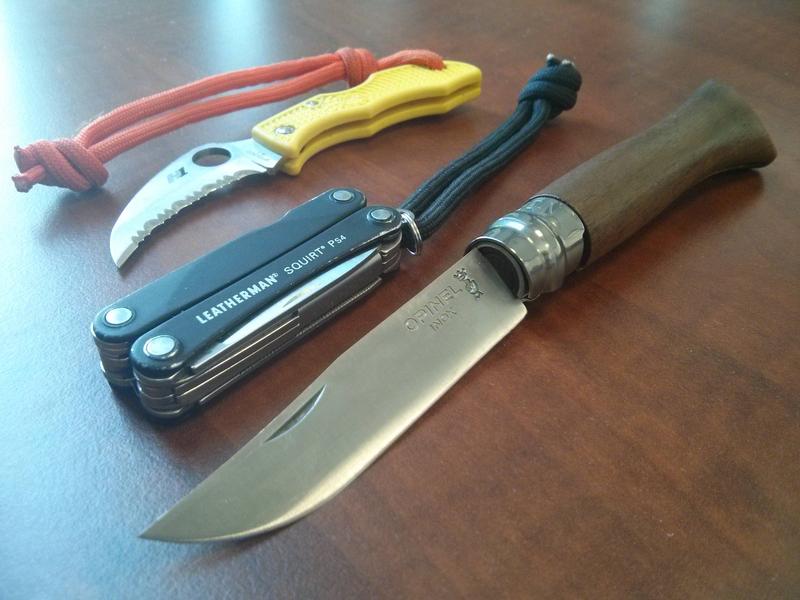
 
I have a Spyderco Ladybug 3 Hawkbill Salt in my EDC rotation, it's tiny but has a lot of cutting power for something that small. I mostly use it while fishing, the serrated hawkbill is very convenient for cutting line or rope, gives you a good control over fine cuts. It's also great for opening boxes or cutting open plastic packaging or zipties, and the size of it means it won't terrify bystanders like most full-sized hawkbills do. It's a bit more difficult to sharpen than a plain edge non-hawkbill blade, but the Spyderco Sharpmaker keeps it in good shape.
ykzXVG1.jpg
 
Thanks very much. That's a lot of what I do in my day-to-day tasks, so perhaps it would be a good choice blade shape after all.
 
No problem, glad to help. It's a good little blade. I'm probably going to get the Tasman Salt as well, but for now the Ladybug can handle pretty much anything I can throw at it, within reason.
 
For some months I carried and used a CQC-9 every day. Because of its grind it performed all my EDC tasks without any edge damage. My Microtech Hawk on the other hand was V ground, and experienced a few chips and rolls.
 
For some months I carried and used a CQC-9 every day. Because of its grind it performed all my EDC tasks without any edge damage. My Microtech Hawk on the other hand was V ground, and experienced a few chips and rolls.

Thanks. I'm looking at the Spydie Crossbill as an inexpensive entry into the blade shape, but I do not know what kind of grind it has.
 
Hawkbills are actually quite utilitarian. Once you get out of the realm of tacticool stuff, you'll find they're pretty commonly marketed and used as working knives. I carry one frequently.

One downside is that they aren't good for doing stuff like scraping stuff off flat-ish surfaces, like you might use a pronounced belly or even tanto-style point for. They also don't do inline stabbing all that well. But I rarely feel I have an inadequate tool when carrying a hawkbill.

What I find to be an interesting characteristic is that the blade shape seems to encourage safer handling. Since one can't really stab the usual way, the user has to position the blade in a way that makes accidental closure less an issue. And they excel at pull cuts. The curvature seems to aggressively encourage slicing action. And while inline stabbing is usually a non starter with the hawkbill, they often have fairly acute tips that will stab quite effectively, just in a direction that won't put it at risk of accidentally closing.

I have a Tasman Salt. There's a lot to like about it, but I rarely carry it. I find I carry ones that end up more traditional in shape. Pruning-type knives. They seem to be fairly modest in intended use, intended customer, and as a result, also in price. Usually slipjoint. One I carry has a fairly dramatic curvature of the cutting edge. The others are less so. But they're all pretty good workers. Sharpening is usually quick and dirty via diamond rod or even carbide scraper, which works out OK with low/small carbide steel. Super steels would do better with the diamond and/or ceramic rod to minimize tearing out of carbides.
 
Back
Top