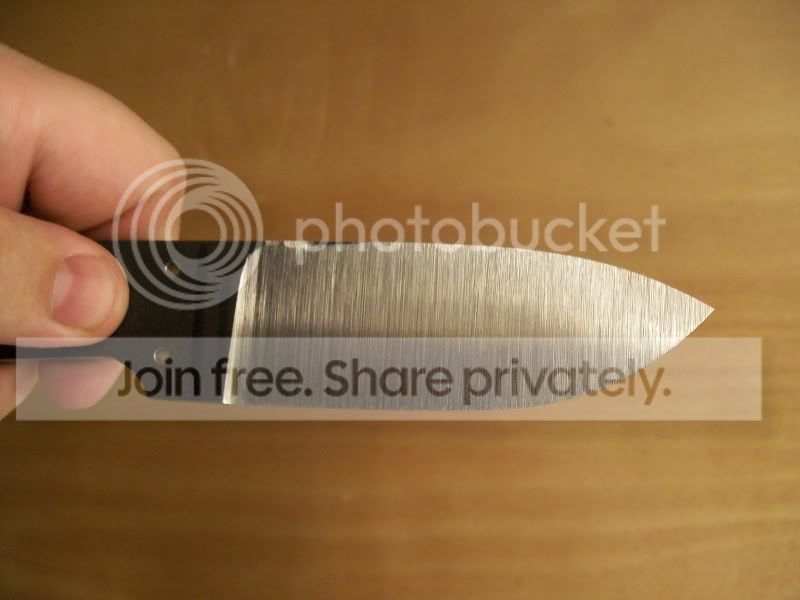
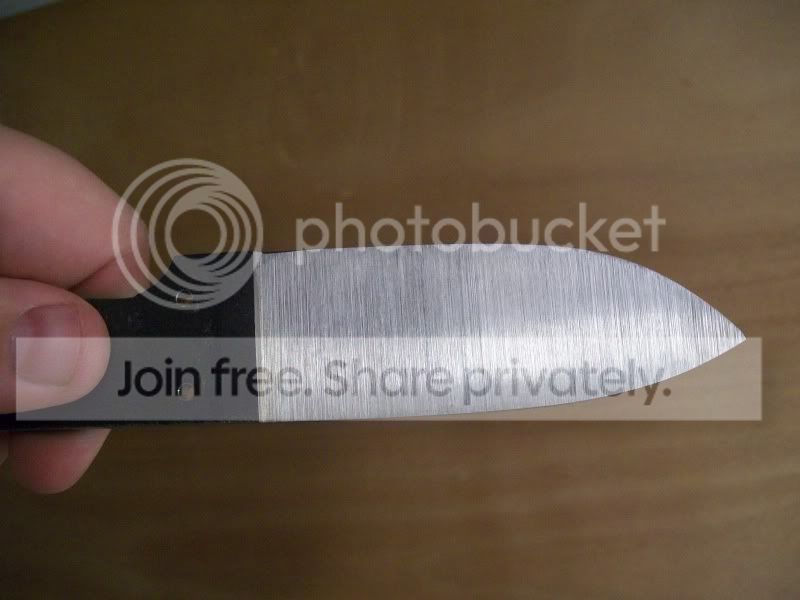
Please tell me that I don't have to junk this blade....

Joined
Jun 17, 2006
Messages
1,108
Just got my Coote set up, and this is the first blade that I have ground on it. It's my second attempt at bevel grinding so far. I was going for a Kephart styled thing here.

I'm pretty proud of one side of the blade....but the other one is breaking my heart at the moment. I have ground too far up and into the damn spine...

I have yet to work on my flats and I'm hoping that this will help take care of it. Looks pretty bad though.

Anyway....File 13 for this thing? Retire it as a pattern? Or keep going?
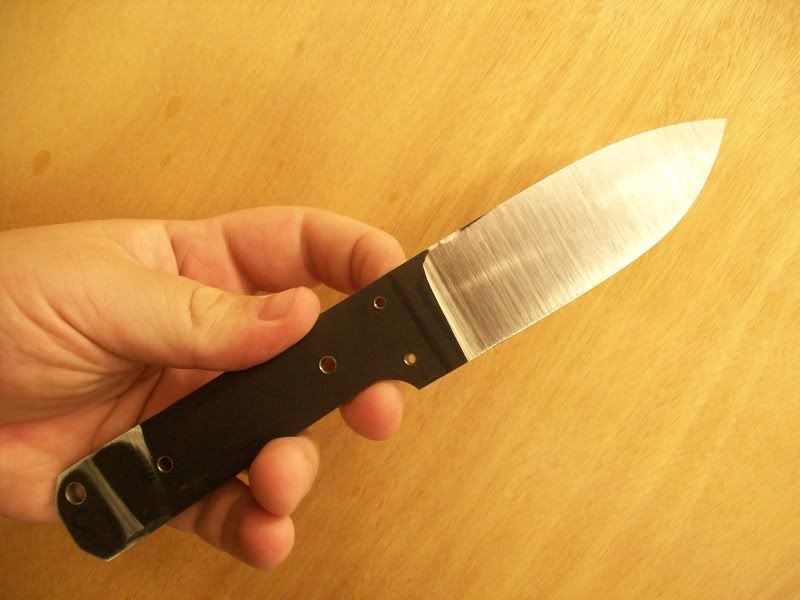


kephartcombat.jpg


kephartcombat3.jpg


kephartcombat4.jpg


here's how high up I went....That 50 grit belt sure can eat some steel.
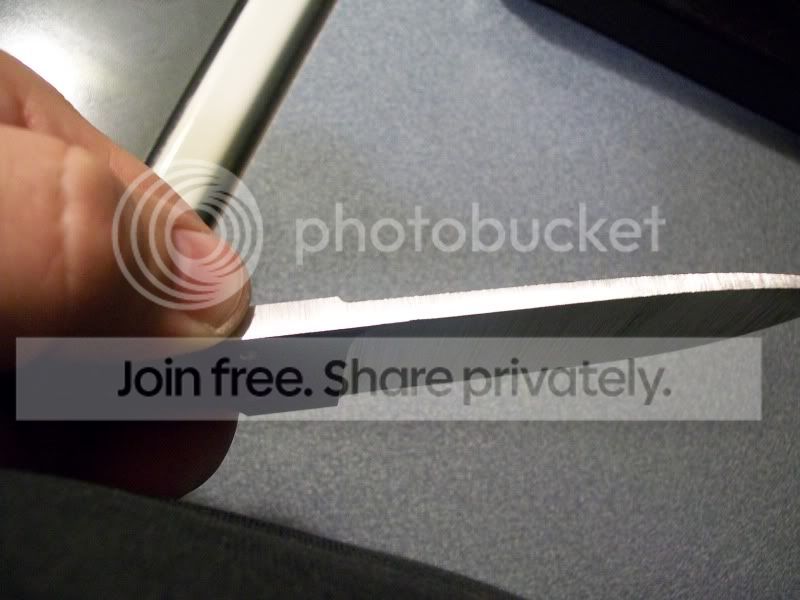
kephartcombat5.jpg


Epic fail?

kephartcombat6.jpg
 
I am no expert but that doesn't look good as is. If you have access to a surface grinder you could grind it down to the level to the of the bevel, but you would have to take the same amount off both sides and that could leave you too thin.
 
Thats what i was thinking.... The thing is, I ground the crap side with my strong hand. :(

Good pattern. This is twice now that this has happened to me. Did it on a thin piece of steel and thought the cure for that was heavier steel. Guess not.

Thats the #1 thing I need to break myself from......and to think, I havent even gotten into handles yet.
 
I've done that a few time. :rolleyes: I can see a couple options to salvage it. Not sure how grinding the tang works on a coote but if you can hold the piece vertically, you can thin the tang and regrind the bevel. You will have to have to sacrifice some of the width of the blade to get the grinds even though. It will end up being a wholly different knife but it could make a smaller edc type blade.
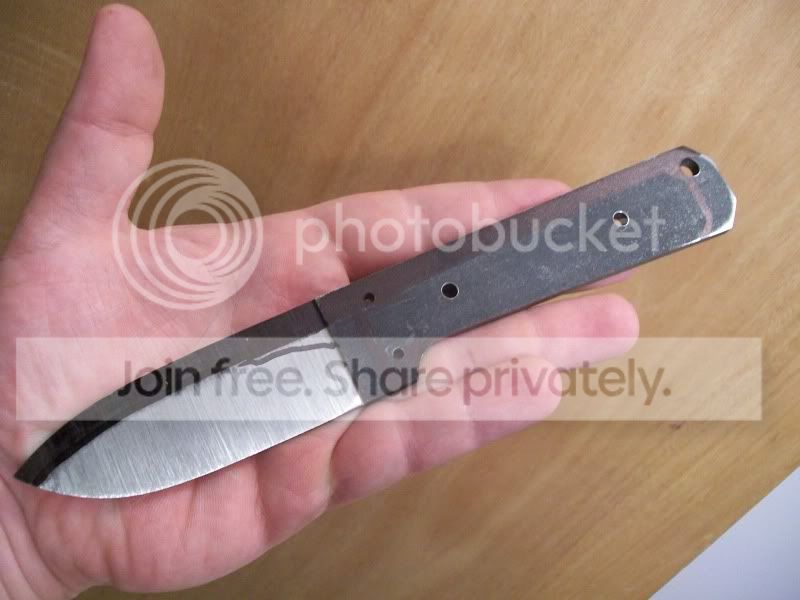
Had to do that myself last night. :p
 
I"m kinda drawing on it at the moment with a pencil to see what other style i could make.

damn. Already accepted it and traced the pattern. Maybe I'll try it again tomorrow. Just hate wasting a big piece of ats-34 like that.

The Coote is a world of difference compared to my old craftsman grinder. The platen is really large and flat. This is the first blade I've ground on it, so hopefully it's dead flat.
 
That sounds good actually.... be the same knife but not as wide. It would be easier to get the flats to help the bevels out too.

I'd have to re-work the handle a bit and maybe move the corby bolt placement a tad....i'll draw on it with a sharpie and see
 
Here we go....essentially the same Kephart style I was going for, but slimmed down a bit. I'm kinda actually thinking this will be more practical and useful

kephartcombat7.jpg
 
you could do the same thing to the other side ...maybe, but then it might be too thin
 
It looks to me like it would be a pretty thin knife if you take the sides down far enough to make up for grinding through the spine. If you drop the spine down towards the edge the problem is just going to get worse because the grind is tapered down towards the edge.

I like to start people out grinding on metal that can't be used to make a knife. That way they don't expect it to be one and the pain (and cost) when they screw up is less. The idea being to learn to grind not to make a knife. It is just different way of looking at the learning process, I guess.

A blade like this is a great education though and a good one to try out some things that might save the knife. If they don't work you haven't created a worse situation than you have now, have probably learned more about grinding, and might have learned something that will help you save another one later on. Try it, don't throw it away yet!

Just remember one of the most important rules of knife making is: "Never let anyone see your scrap box!" Good luck with it!
 
Have you considered grinding a swedge along the top? I don't know how that would work out, but it could help cover up the mistake (if you thinned the tang on the strong hand size)
 
Have you ever heard of the Concorde Fallacy? The Concorde, of course, was the supersonic jet that used to shuttle people back and forth between the east coast and Europe.

It cost a fortune to design and build, and a fortune to operate. The "fallacy" was the idea that the governments and investors had sunk tons of money into the concept, and that to get any kind of return on their investments, they had to sink even more money into the venture to keep it going.

The Concorde is no more, and the governments and investors would have been better off in the long run to just walk away from the deal, but they didn't.

So, how does this apply? This is your first knife on the new grinder. You learned some lessons, and now you can keep fiddling with it, wasting time and materials, or you can move on to the next new knife.
 
What kind of filework patterns could be used to cover the mistake? A nice zig-zag or something more exotic. It looks like only about an inch worth, grab some scraP and grind top to look the same and see what you can do.
 
Go to your local scrap yard. Buy enough junk steel ( appox. 3/16 x 1 1/4) to profile 20 to 30 blades and then grind,grind,grind. Tip: always start with your week side. It's easier to match the week side grind with your strong side. Hope that makes sense.

Michael
 
Go to your local scrap yard. Buy enough junk steel ( appox. 3/16 x 1 1/4) to profile 20 to 30 blades and then grind,grind,grind. Tip: always start with your week side. It's easier to match the week side grind with your strong side. Hope that makes sense.

Michael

Makes sense to me or you could just name the knife Dr. Jekyll and Mr. Hide. Bad thing about a grinder is mistakes happen quickly.
 
What kind of filework patterns could be used to cover the mistake?

I think it will always look like spine was ground too high. The question becomes do you want one of your knives out there with a mistake on it that you knew about ahead of time. To me, the value of the knife as it now stands is as something to learn from. Other than that I would have to agree with what NStricker said. Practice working on your plunge cuts on it. Grind one further back and then match it on the other side. Do this a few times and then let it go.

One other thing, I don't usully drill the holes for the pins or bolts until I have the blade ground and am satisfied with it. It keeps you from putting drill bits at risk on a blade that didn't work out and also saves you time. Just my $0.02 worth. :D
 
How do you like your Coote? What setup did you go with? We know it does a good job of removing material:-)
 
Thanks guys for all the feedback. I will just chalk this one up as experience and use it as a pattern in the future. I'm looking at the knife and can see what Mr. Matthews is saying. It's never going to get better if I grind the top edge down. Its gonna be the same thing.

Instead of wasting the life of my new expensive belts trying to fool with this "concorde", I'll just practice on some inexpensive steel. I'll try some 10 series carbon....because who knows....one of my practice runs could accidentally turn out to be a good blade.

The Coote is set up kinda ghetto actually.... You guys would laugh. everything is just temporary, just to see how the thing runs. I got it mounted on a small tool table with the belt running through a hole in the table down to the motor on the bottom. The motor is on a hinged piece of wood to keep belt tension. I'm using some of the norton 50 grit ceramic belts, and 400 grit gators.

I'm in the process of cutting some wood and remounting the thing. I cannot be mad or frustrated with any of this. For years now I've been dreaming about this every day, now I'm actually doing it.
 
I've had the piece of steel forever. I don't have it in front of me at the moment to measure and can't remember exactly what I ordered. Inch and a half wide and 3/16ths - 1/4 thick maybe. It's heavy stuff.
 
Back
Top