Plunge lines

I finally learned to do it the way that Ken Onion described. originally the late Ralph
Selvidio showed me how to do that. Despite everything, I have to admit to preferring to
do it by hand with a file guide.
 
Try mild steel and do it the way Ken Onion suggests with a bit of discipline it will build your confidence tenfold when you accomplish it. I don't know any knifemakers that haven't gone thru a tremendous amount of steel and belts in the learning curve. Good Luck. Ken.
 
I was struggling with this this morning. If you cut them in by hand with a round file, do you do that first and then blend the grind in?
 
I was struggling with this this morning. If you cut them in by hand with a round file, do you do that first and then blend the grind in?
My question has always been how do you file the plunge cuts without notching the spine of the blade? It seems to me that making little short strokes would take you a month of Sundays.
 
Joe, It's fussy work no matter whether purely by hand or with a file guide to take out the problem of sliding up on the ricasso... the fussy-ness of it is what drives a lot of people to learn how to do it on the grinder.

If you notch through the spine, sometimes it can be brought back by taking the ricasso down a little to the level of the notch... more fussy work... it's easy to get into chasing your tail...

Mike
 
I was struggling with this this morning. If you cut them in by hand with a round file, do you do that first and then blend the grind in?

PJ,

It's more of a clean-up... get bevel done with plunge positioned close to finish point, then push it straight and back to the ricasso line with a file. There are round-edge joint files (teeth only on edges) available... come in different thicknesses... the thicker they are the larger the radius. It's a tool & die file, or those are the catalogs I find them in mostly. Try Falcon Tool in a search. You can get a catalog sent free at the bottom of their home page... good place to get polishing stones, too.

Mike
 
I file them the same way I grind. Start a bevel and push it back. When I remember to file in the plunges, I do it before grinding. It only takes an extra 4 or 5 minutes and if you struggle with plunges, it's worth the time up front.

Having said that, I've gotten much better at matching plunges on the grinder and prefer to do it this way.
 
I guess the message I am getting is that the plunge lines are not easy to do. I am maybe expecting a bit too much to soon for myself. This knife making is a humbling deal that takes patients. I have 10 drop point hunters to get started on for a guy, soooo i gues I'll get the practice I need.
 
Smitty, this may sound silly but in trying to teach myself grinding (still), I do a lot of two things. One is to make myself stop, look and think after each pass across the belt. Before putting the blade back on the belt, I note what it is I figure is going to happen, then look to see if it did. Second is to get ready to make a pass, close my eyes for a couple of seconds, then open them and see if I am still holding the blade in the same position I want.

I adopted the first in self defense... too many times in too much of a hurry and too many difficult to impossible things to correct.

The second thing I started doing because I made so many passes that didn't do what I thought they would and I didn't know why. I picked up the idea of moving my feet in/out, left/right from AJ Martin's article in Blade's Knife Making book and applied it to everything... I found, if I could put my whole body into a "good" position, I made good passes.

Mike

 
Smitty, this may sound silly but in trying to teach myself grinding (still), I do a lot of two things. One is to make myself stop, look and think after each pass across the belt. Before putting the blade back on the belt, I note what it is I figure is going to happen, then look to see if it did. Second is to get ready to make a pass, close my eyes for a couple of seconds, then open them and see if I am still holding the blade in the same position I want.

I adopted the first in self defense... too many times in too much of a hurry and too many difficult to impossible things to correct.

The second thing I started doing because I made so many passes that didn't do what I thought they would and I didn't know why. I picked up the idea of moving my feet in/out, left/right from AJ Martin's article in Blade's Knife Making book and applied it to everything... I found, if I could put my whole body into a "good" position, I made good passes.

Mike

Mike,
Yours is a great post as to where i am at. I started 3 knives today, rough shaped them and started to grind the blade profile on the first one. I actually started to pause between passes and review what occured and then thought about what i wanted to accomplish on the next pass.

I also did focus on my feet and body position. I started to "lock in" my arms in a rigid postion and use my body to sway to make the grind. By have good body position and locking in my arms and getting my whole body into the grind, i started to improve. I still have a long way to go, but I am improving.

Your comments are spot on for where i am at in my development.
 
I've only ground a few blades at this point so I'll be the first to say that I'm a complete novice. I tried my first blade free handed, but was unhappy with the results so I took some .25x.75 304 and cut two 3" sections and popped some quarter inch bolts and lock wshers through them. My second blade came out much better! I'll admit, it's not very high tech..and may not last forever, but at about 2 bucks a pop, I think I could handle making a few as needed. I will admit that after reading this thread, my initial attempts at free handed grinding were without direction and you guys gave me a lot to think about. I'll definitely give it another go!
 
Mike,
Yours is a great post as to where i am at. I started 3 knives today, rough shaped them and started to grind the blade profile on the first one. I actually started to pause between passes and review what occured and then thought about what i wanted to accomplish on the next pass.

I also did focus on my feet and body position. I started to "lock in" my arms in a rigid postion and use my body to sway to make the grind. By have good body position and locking in my arms and getting my whole body into the grind, i started to improve. I still have a long way to go, but I am improving.

Your comments are spot on for where i am at in my development.

As it helps, that's good...

For me, a lot of grinding well seems to be in the picky part of holding the blade. Like is one end too high/low, too in or out... is the blade parallel to the flat I'm cutting. If my body (all parts) are in a neutral position and the blade lays like I want it, I about can't screw it up... :rolleyes:

Mike
 
I've only ground a few blades at this point so I'll be the first to say that I'm a complete novice. I tried my first blade free handed, but was unhappy with the results so I took some .25x.75 304 and cut two 3" sections and popped some quarter inch bolts and lock wshers through them. My second blade came out much better! I'll admit, it's not very high tech..and may not last forever, but at about 2 bucks a pop, I think I could handle making a few as needed. I will admit that after reading this thread, my initial attempts at free handed grinding were without direction and you guys gave me a lot to think about. I'll definitely give it another go!

mtredmon,

Would you mind explaining how you are using the tool you made... I'm not getting it.

Mike
 
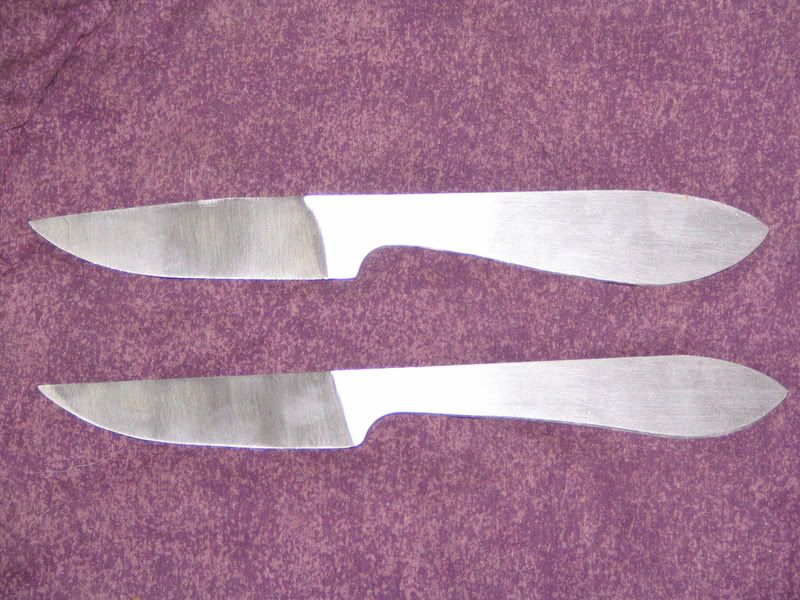
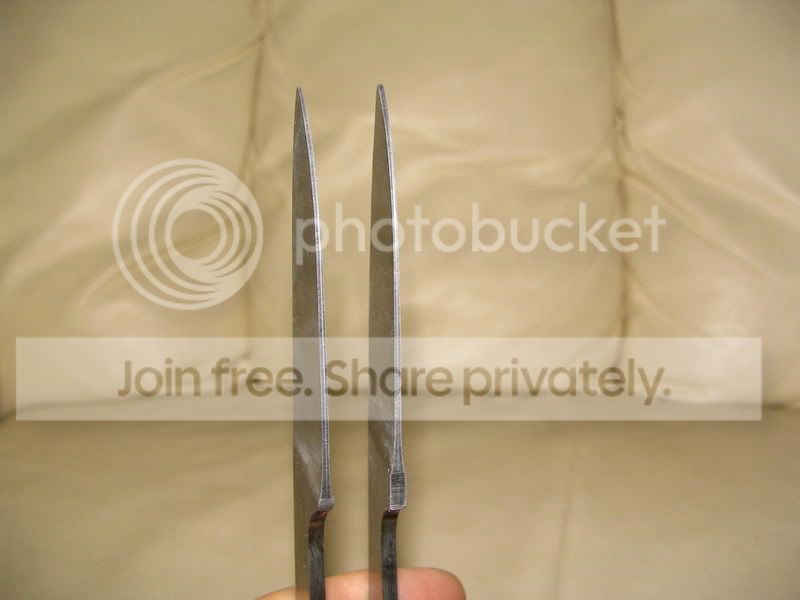
I appreciate the advice in this thread. I tried cleaning up the mistakes with a file guide and round file, but for some reason that just made things worse. I went back to the grinder and a 60 grit belt (I originally tried a 120 grit, and I think that was causing me problems) and here is what I came up with...hardly perfect, but I'm reasonably happy at this very early stage:

IMG_1009.jpg


IMG_1002.jpg


This is on a Craftsman 2x42 with standard platen (much wider than the belt), so I can't run the belt off the edge as I've read about doing. Hopefully when I install my ceramic platen liner things will improve.

Any advice and feedback would be appreciated, and I hope this isn't hijacking your thread Big Smitty...
 
I made mine, just place to pieces of steel about the right size together, clamp together and drill pin hole on each end for alignment, I just used 1/8 pins. The steel was 3/16 1095 and O1. Drill and tap for screws put the plates together and grind or file flat then ht. . I tempered the first set and they worked fine but did score on the belts a bit. the second set I did not temper and they do not have a scratch. I have used the first set for a year and still use them, thats pretty good for using scrap steel. I you need I can try to post a picture later.
 
You've still got a lot of room to bring those plunges in and work them out the way you want. One thing that you'll want to focus on is making the plunges deeper and having the even with the rest of the edge thickness. Leaving the thick at the base is a habit that is hard to get out of.
 
Also, I've never tried to file a plunge after grinding, I can see where it could make things worse.

I noticed you're using a single scribe line, if you have a double line, it may help with bringing the grinds in evenly. I know it helps me, I also know I'm at a good thickness when I meet both lines.
 
Back
Top