Plunge lines

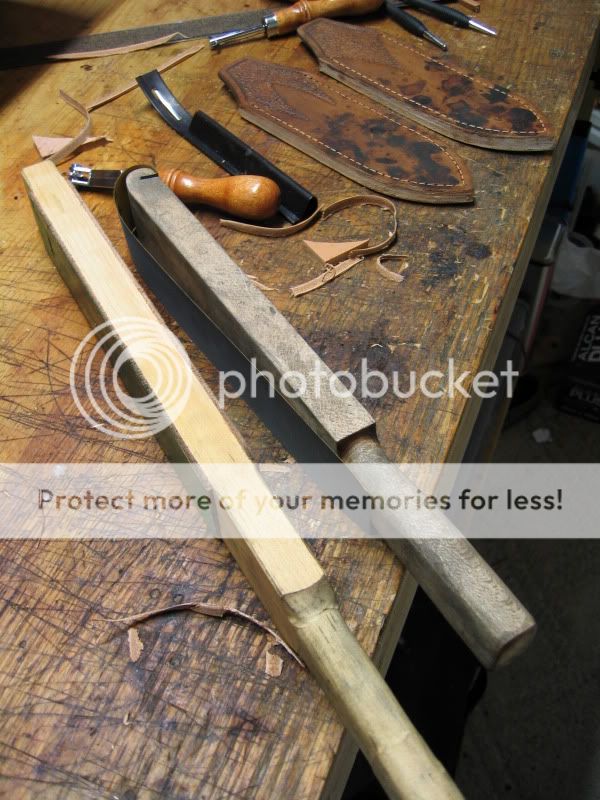
Make yourself a sanding paddle if you haven't.... radius one side and clean your plungelines up, easy-breezy.

stropbats.jpg

Rick
I LOVE your sanding paddle and would add that it makes finish sanding go a lot faster by having up to two feet of backed sandpaper to get rid of scratches. After seeing yours I made a version of sanding paddle without a handle. It is a two inch wide board cut just long enough to slip a 2X42, or 2X 72 belt over the rounded off ends.
BeltSandingBoardL656.jpg


I can flip the board and have a fresh piece of sand paper to use, or rotate the belt a little to bring a fresh piece into the work area.

- Paul Meske, Wisconsin
 
Last edited:
That is a great looking piece of kit, Paul.... and wise use of old belts, I would think.

Rick
 
That is a great looking piece of kit, Paul.... and wise use of old belts, I would think.

Rick

OLD belts?!?!?!

Au contraire, mon frère!

NEW belts!

Because my 2X42 is racing at the speed of light I use it mostly for rough grinding the bevels (80 grit). I don't have the finesse to finish up a blade on it with the higher numbered grits so the sanding paddle/board is my go-to implement of destruction to get rid of grind marks. I use new 180, 220, 400 and 600 grit belts on the board.

OK, OK, I admit, I DO use OLD belts on the board also.

- Paul Meske
 
I like plunge lines. Well, let's face it... I like any lines that help define a character for the knife. Personally, I find it easier to get sharp plunge lines using hand files than my 1x30 belt sander. Frankly, I gave up trying to use the belt sander for that. Files... that's the ticket for us cheapskates.
 
If you are going to keep making knives,buying a good grinder IS NOT throwing money.I used 1x30's and 2x42's for years and made a few decent knives,but getting a 2 x 72 made it SO much faster and easier.I wish i had gone into debt years ago,begged,borrowed ....well no,i wont go there,but yes,ill drag out the credit card if i need another grinder.In the meantime,yea,get the best belts possible.If they make flex belts for 1x30 you can run it off the platen a little and clean up your plunge.I used a leather strip on mine to ease the bouncing/chatter.JMHO.Im here learning too.Good luck.
 
I also used to use a delta 1x30. I made a bunch of nice knives on it, but it's a real pain in the ass. Buy a better grinder if you can.
But if you can't or don't want to right now, you can make good plunge lines on your grinder with a little practice and technique. (1) It's good advice to run the belt off of the platen a little bit. This will allow you to grind in more than one direction, and it will help deal with some of the awful tracking on those models. (2) when grinding my plunge lines, I would always tilt one side of the knife off of the grinder so I was focusing only on the plunge line and nothing else. This will cut a lot faster so it's easier to make a crisp line. Once you've got it as deep as you want, just rock the blade back down slowly and you'll have the beginning of your bevel with a nice plunge line. I would start my plunge lines and bevels about a quarter inch wide using this method. (2) With steady hands, you can grind a plunge with more of a radius. A chainsaw file will also do this, but it will be easier to clean up if you do it on the grinder. (4) As Rick said, you don't need to have plunge lines at all. I have always hated cleaning up plunge lines, so my recent knives don't have them. With a low speed grinder like yours, though, this might not save you any time.

- Chris

 
I'm with Seals. It's worth it throwing some dough out for a REAL grinder. It will make a huge difference in your knives, and your quality of life. That in turn will motivate you to make more, and better knives and you will enjoy yourself more.

Especially if you are doing this with an aim to go pro, just get a good grinder now. And make it variable speed when you can.
 
This is an excellent tutorial on grinding and plunges made by Salem , thanks !
http://www.prometheanknives.com/shop-techniques-3/grinding-tips

I also tried at technique shared by Justin King on using a ground down edge of granite with sandpaper taped to only expose the area of the plunge. He has great success with it , I sucked at it . I can't wait until September for my custom grinder builder to get home and start building my 2 x 72 . I might order the belts right now to fully commit to it.
 
Last edited:
Thanks Duffy. If you go over there, check out the grinder guide, too- if you're trying to figure out what machine to get.
 
This is an excellent tutorial on grinding and plunges made by Salem , thanks !
http://www.prometheanknives.com/shop-techniques-3/grinding-tips

I also tried at technique shared by Justin King on using a ground down edge of granite with sandpaper taped to only expose the area of the plunge. He has great success with it , I sucked at it . I can't wait until September for my custom grinder builder to get home and start building my 2 x 72 . I might order the belts right now to fully commit to it.

Try sanding the plunge on the granite without the tape.

But, I think I'm going to make one of Rick's or Paul's paddles
 
Last edited:
One tip, make sure your platen edges are square up and down with your belt. When I glued my ceramic platen on, it slid in the clamps minutely out of kilter. I didn't realize this right away and all of a sudden I was having a really hard time getting my plunges to look the same on both sides. Turns out it's because there was more platen behind the belt on the right than the left.

Now that I know it's there I can deal with it without just assuming they'll both come out because I tracked my belt off the same amount each side.
 
Was having the same problem with my 2x42. Got a glass platen and learned to "set the plunge" by holding the knife on the edge of the platen where you would normally start then just shove it in there and hold it for a few seconds. I get the plunge line/bevel about 80% done then grind normally. It REALLY helped
 
Back
Top