
-
The BladeForums.com 2024 Traditional Knife is available! Price is $250 ea (shipped within CONUS).
Order here: https://www.bladeforums.com/help/2024-traditional/
You are using an out of date browser. It may not display this or other websites correctly.
You should upgrade or use an alternative browser.
You should upgrade or use an alternative browser.
pocket friends
- Thread starter DennisStrickland
- Start date
DennisStrickland
BANNED
- Joined
- Jun 24, 2009
- Messages
- 5,040
zerogee it would really be nice if gec was using african blackwood which i think is stronger than most ebonies. however i think blackwood is very expensive, i had this wood on a custom folder in the 70s & really liked it.
dennis
dennis
DennisStrickland
BANNED
- Joined
- Jun 24, 2009
- Messages
- 5,040
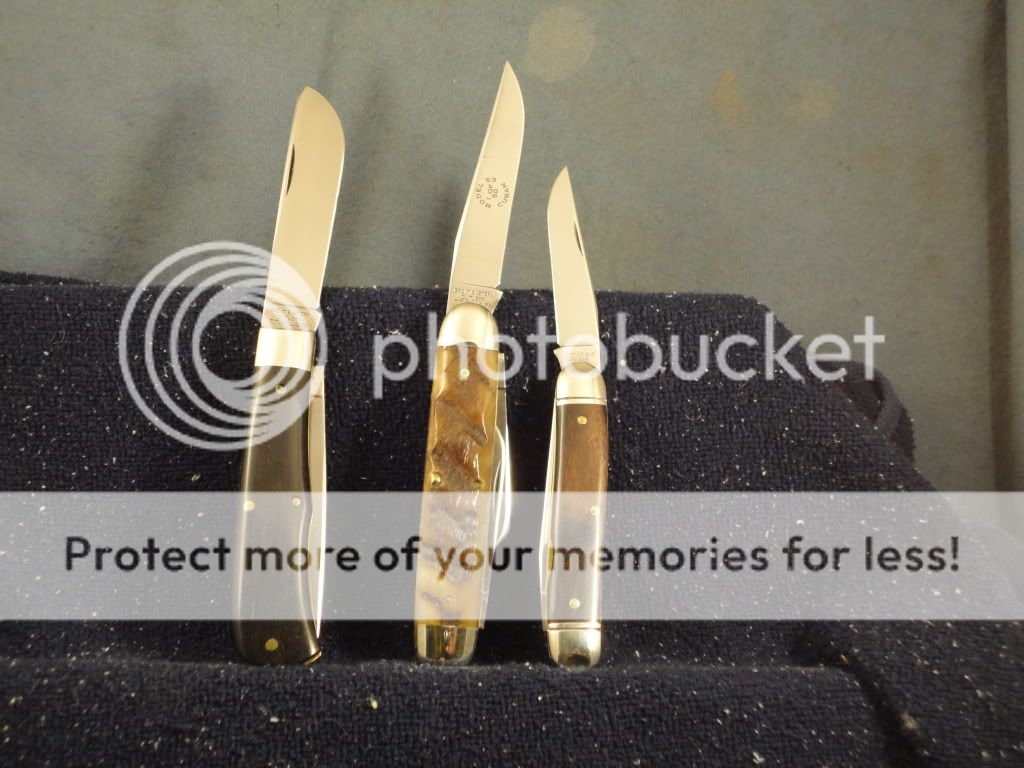
ebony scout--cuban ram--& ebony mink
scout is 2007 contract knife for cumberland, the ramhorn is for spice & the mink is 2010 ebony. contrast is certainly evidenced but as joebob mentioned one large piece of ebony can have varied colors--so the question goes unanswered.
dennis

- Joined
- Jan 18, 2007
- Messages
- 34,122
I've got a soft spot for that Tractor Green, very fine!
lambertiana
Gold Member
- Joined
- Jul 7, 2000
- Messages
- 9,966
African blackwood is not any more expensive than high quality gaboon ebony. It is an oily wood, and is a member of the rosewood family (dalbergia). It is not nearly as hard as ebony. The Janka hardness for blackwood is just over 1700, and gaboon (and macassar) ebony is 3220. Ebony is not oily at all.
DennisStrickland
BANNED
- Joined
- Jun 24, 2009
- Messages
- 5,040
lambertiana is it possible you misread the janka specs? i show african black at 4050 & australian black at 1100.thanks for reaching out , dennis. solomon blackwood is a whopping 4350. my reference is "wood species janka hardness scale". it's certainly easy to misread this data since it's so compacted.
Last edited:
I have some African Blackwood drying right now. It is the most expensive of any woods I have purchased, including Kingwood.
All woods will have sapwood and heartwood. The sapwood is going to be softer and lighter in color - and may be less stable. Some ebony, like the Macassar come with lighter streaks. There are a number of Asian woods that are described as ebonies, and they aren't as black as high quality African ebony. I have a Philippine flat stick made of Komagong, a form of Macassar ebony - it has lighter streaks running through the darker brown wood. I have some very old Gerber knives with Macasar ebony inlay that date from the 1970s.
All woods will have sapwood and heartwood. The sapwood is going to be softer and lighter in color - and may be less stable. Some ebony, like the Macassar come with lighter streaks. There are a number of Asian woods that are described as ebonies, and they aren't as black as high quality African ebony. I have a Philippine flat stick made of Komagong, a form of Macassar ebony - it has lighter streaks running through the darker brown wood. I have some very old Gerber knives with Macasar ebony inlay that date from the 1970s.

Campbellclanman
Platinum Member
- Joined
- Mar 10, 2007
- Messages
- 16,307
Dennis, Dwight,Lambertiana and joe-bob.
Thank you for the info on the Ebony, yep...I look at the older knives which are the very dark/black Ebony, and just have expected to see the same.Very interesting! :thumbup:
Thank you for the info on the Ebony, yep...I look at the older knives which are the very dark/black Ebony, and just have expected to see the same.Very interesting! :thumbup:
Last edited:
lambertiana
Gold Member
- Joined
- Jul 7, 2000
- Messages
- 9,966
Dennis - Check your source. African blackwood is usually listed around 1720, and ebony is 3220. If you google janka hardness scale, you will see a number of websites that generally agree with each other, although there is an occasional outlier that has suspect data. See this:
http://en.wikipedia.org/wiki/Janka_hardness_test
And a few other sources:
http://www.countyfloors.com/about_janka.html
http://tinytimbers.com/janka.htm
This one has a lot of information, although it can be hard to find what you want, and it is the only site I can find that lists African Blackwood (dalbergia melanoxylon) at 4050. Everyone else lists it at 1720. I did find another website where they say it should be well over 4000 based on the specific gravity, but that is not a valid way to determine hardness. Cocobolo (also a dalbergia) is as dense as blackwood, yet has a Janka hardness of only 1136. Only actual measurements with a .444" steel ball should be considered valid. I have also seen a few websites that list blackwood at 2940.
http://www.morlanwoodgifts.com/MM011.ASP?pageno=209
All that being said, I don't dispute the fact that African Blackwood makes quality handles. It's good stuff.
http://en.wikipedia.org/wiki/Janka_hardness_test
And a few other sources:
http://www.countyfloors.com/about_janka.html
http://tinytimbers.com/janka.htm
This one has a lot of information, although it can be hard to find what you want, and it is the only site I can find that lists African Blackwood (dalbergia melanoxylon) at 4050. Everyone else lists it at 1720. I did find another website where they say it should be well over 4000 based on the specific gravity, but that is not a valid way to determine hardness. Cocobolo (also a dalbergia) is as dense as blackwood, yet has a Janka hardness of only 1136. Only actual measurements with a .444" steel ball should be considered valid. I have also seen a few websites that list blackwood at 2940.
http://www.morlanwoodgifts.com/MM011.ASP?pageno=209
All that being said, I don't dispute the fact that African Blackwood makes quality handles. It's good stuff.
DennisStrickland
BANNED
- Joined
- Jun 24, 2009
- Messages
- 5,040
lambertiana maybe i misinterpreted the info, anyway i'm not doubting your info but can only wait till dodson or another wood expert chimes in before i can form a stout opinion.thanks dennis

As a long time, full time woodworker I'd like to point out that one of the exciting, as well as sometimes frustrating, properties of wood is its great variability-from species to species, tree to tree within a species, and place to place within an individual tree. I am fortunate to be able to work with locally available hardwoods that I often gather myself, but fully understand what's being said about the exotics. As I tell my students, accept the variability and learn to exploit it to your advantage, at least in terms of appearance.