Album First
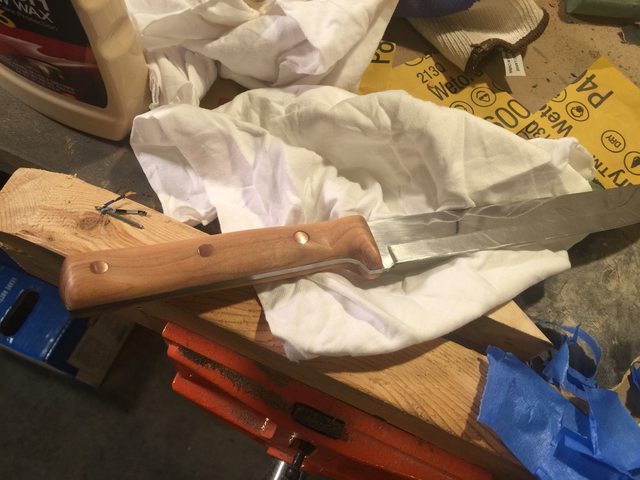
In trying to come up with a gift for my father in law while still giving myself an excuse to escape to the garage this holiday season I settled on attempting to make him a carving knife, as he is huge into smoking meat and general BBQ. I did far too little research and plunged into purchasing a chinese 440C knife blank ground and hardened from USAKnifeMaker, some stabilized cherry scales, and their medium copper corby bolts. I was under the impression that starting from a bar of flat stock would be much to difficult and time consuming for my first venture with the holiday deadline looming.
All work was done with hand tools, mainly sandpaper and various blocks and a file/rasp set. Some comments on the process:
1. The knife blank was nowhere close to flat. I blued the tang and sanded on a piece of plate glass to determine how bad it was. One side the center was proud and the other side the edges were proud. This took a lot of time sanding with 50 and 80 grit to flatten. Mostly due to the fact the blank was already hardened so any progress was slow. While I was at it I went up in grits to 1000 on the non-hollow ground portion of the blade going for a mirror finish. It was also extremely difficult to get the machine grinder marks out of this steel. They were much deeper than I would have liked, but what can you expect for a $15 blank.
2. I need much more practice drilling accurately with the drill press for the corby bolts. I would think a step drill may have helped, my pilot holes for the bolt shank were not quite concentric with the body holes for the bolts.
3. I should have shaped the scales close to the final tang outline prior to epoxying them to the blank. It took a ton more rasp work than necessary to remove all the material. The videos I watched were mostly using 2x72 grinders so it would have been easy to hog off the material then.
4. I had thought I read somewhere that stabilized wood can be polished with standard polishing compound. There were still some pores in the cherry scales after sanding to 1000 grit and as soon as the polishing compound went on they sucked it up and discolored the wood leaving it dirty looking. I attempted to remove it with mineral spirits but it didn't completely remove it. Any suggestions on what else might do it before I call it quits and wrap it up?
Overall it was a very fun experience and I have already ordered a strip of 1084 to make myself something a little better. I think I've caught the bug. Sorry for the wall of text!
In trying to come up with a gift for my father in law while still giving myself an excuse to escape to the garage this holiday season I settled on attempting to make him a carving knife, as he is huge into smoking meat and general BBQ. I did far too little research and plunged into purchasing a chinese 440C knife blank ground and hardened from USAKnifeMaker, some stabilized cherry scales, and their medium copper corby bolts. I was under the impression that starting from a bar of flat stock would be much to difficult and time consuming for my first venture with the holiday deadline looming.
All work was done with hand tools, mainly sandpaper and various blocks and a file/rasp set. Some comments on the process:
1. The knife blank was nowhere close to flat. I blued the tang and sanded on a piece of plate glass to determine how bad it was. One side the center was proud and the other side the edges were proud. This took a lot of time sanding with 50 and 80 grit to flatten. Mostly due to the fact the blank was already hardened so any progress was slow. While I was at it I went up in grits to 1000 on the non-hollow ground portion of the blade going for a mirror finish. It was also extremely difficult to get the machine grinder marks out of this steel. They were much deeper than I would have liked, but what can you expect for a $15 blank.
2. I need much more practice drilling accurately with the drill press for the corby bolts. I would think a step drill may have helped, my pilot holes for the bolt shank were not quite concentric with the body holes for the bolts.
3. I should have shaped the scales close to the final tang outline prior to epoxying them to the blank. It took a ton more rasp work than necessary to remove all the material. The videos I watched were mostly using 2x72 grinders so it would have been easy to hog off the material then.
4. I had thought I read somewhere that stabilized wood can be polished with standard polishing compound. There were still some pores in the cherry scales after sanding to 1000 grit and as soon as the polishing compound went on they sucked it up and discolored the wood leaving it dirty looking. I attempted to remove it with mineral spirits but it didn't completely remove it. Any suggestions on what else might do it before I call it quits and wrap it up?
Overall it was a very fun experience and I have already ordered a strip of 1084 to make myself something a little better. I think I've caught the bug. Sorry for the wall of text!