Polypores

Joined
May 5, 2006
Messages
1,265
http://en.wikipedia.org/wiki/Polypore

When I'm out and about in the woods and I come across polypore mushrooms, I usually harvest a few. I add them to tea (at the moment I'm drinking some Ganoderma tsugae I found recently in the Hudson Highlands) by just slicing off a sliver and dropping it in my cup.

Just wondering if anyone else harvests polypores and what you use them for - I've never tried utilizing them as tinder myself though I understand it's a popular use for them.
 
I keep looking at Chicken in the woods. These sulphur shelfs are supposed to be edible but I haven't tried them yet.

http://www.mushroomexpert.com/laetiporus_sulphureus.html

I have also looked at Hen in the woods but haven't tried them either.

http://www.mushroomexpert.com/grifola_frondosa.html


I believe that when either of these, especially the hen in the woods, goes past its prime they get very woody and tough. I always thought that they could be used for tinder but also have never tired that.

Too many ideas not enough time to try everything. :(

KR
 
http://wildwoodsurvival.com/survival/fire/tinder/tinderfungus/true.html http://www.zetatalk.com/shelter/tshlt06n.htm
I was introduced to true tinder fungus (a polypore, Innonotus Obliquus)about a year or so ago when I bought a fire piston. Once it is lit by the piston or a flint and steel it is very unlikly to go out. I've read that it was used by native American Indians as a treatment for many stomach problems,and is currently being used in the former Soviet Union for the treatment for stomach cancer with some sucess.
 
I'm afraid my interest in polypores is rather low.

There must be literally tons of them in my local forests (turkey tail and about a zillion types of conks), but compared to what else is to be found here; morels in the spring, boletes in the summer (gotta beat the fly larva though), chantrelles in the fall, and my favorite, hedgehogs (rare but occuring just about anytime) most polypores get passed by.

And that's just as compared to the more edible stuff, if you want to explore some of the less edible stuff (I say less, because some people do eat these) we also have corals, russulas, and amanitas (at high elevations, no less.)

I've never even used conks as tinder. Some people will burn the larger ones for mosquito repellent, but if you need natural tinder around here cedar bark is as easy to find and much more effective.

I guess the one exception is my current experiment in growing sulfur shelf (laetiporus) from inocculm that I got from Fungi Perfecti. I've had one log that actually fruited, unfortunately the fruiting occured directly at ground level and the fruit was so heavily encrusted with soil that I didn't get to eat it. but I'm hoping it will fruit again once the temperatures start to drop.

I'm also terribly conservative when it comes to experimenting with mushrooms, since everything we know about them had to be learned the hard way, and I never want to end up as some else's case report.
 
I'm afraid my interest in polypores is rather low.

There must be literally tons of them in my local forests (turkey tail and about a zillion types of conks), but compared to what else is to be found here; morels in the spring, boletes in the summer (gotta beat the fly larva though), chantrelles in the fall, and my favorite, hedgehogs (rare but occuring just about anytime) most polypores get passed by.

And that's just as compared to the more edible stuff, if you want to explore some of the less edible stuff (I say less, because some people do eat these) we also have corals, russulas, and amanitas (at high elevations, no less.)

I've never even used conks as tinder. Some people will burn the larger ones for mosquito repellent, but if you need natural tinder around here cedar bark is as easy to find and much more effective.

I guess the one exception is my current experiment in growing sulfur shelf (laetiporus) from inocculm that I got from Fungi Perfecti. I've had one log that actually fruited, unfortunately the fruiting occured directly at ground level and the fruit was so heavily encrusted with soil that I didn't get to eat it. but I'm hoping it will fruit again once the temperatures start to drop.

I'm also terribly conservative when it comes to experimenting with mushrooms, since everything we know about them had to be learned the hard way, and I never want to end up as some else's case report.

Never heard of burning them for mosquito repellent - learn something every day! :thumbup:

Might be that you don't have high enough humidity for your laetiporus given the fact that your one fruiting occurred at ground level where the humidity was probably highest. If low humidity is the issue, you might try some kind of "tenting" over your logs along with a humidity source (like a humidifier) to create a higher humidity environment. Or create an enclosure in an area of the woods that you know to be of higher humidity - swampy type areas or along creek beds.

I used to grow mushrooms commercially - mostly shiitake, maitake, lion's mane and oysters.

Ditto on being conservative in harvesting - if there's a doubt in my mind, it stays behind! :D
 
I keep looking at Chicken in the woods. These sulphur shelfs are supposed to be edible but I haven't tried them yet.

KR

Chicken of the Woods kicks ass. Use the outer parts of the shelf and they are the most tender. The part where it joins on to the stump is too fibrous.

I like to layer them in a casserole dish with potatos, goat cheese, garlic and oregano and cook at about 300 for a few hours.

Eaten them many many times one of my favorites.:thumbup:


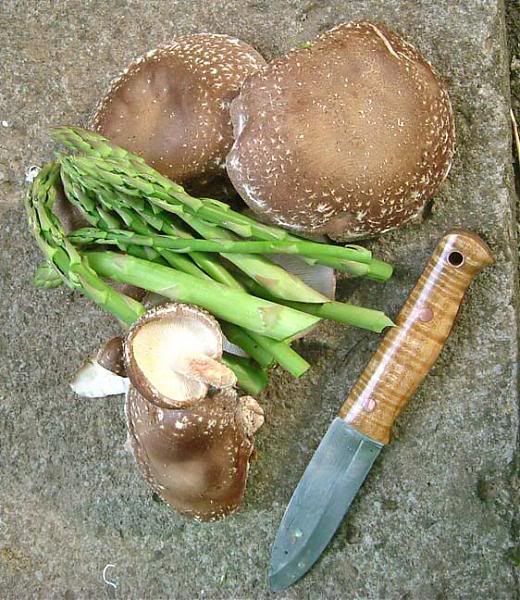
Not a polypore but here's a fungi I cooked and enjoyed.

THESE
 
Never heard of burning them for mosquito repellent - learn something every day! :thumbup:

Might be that you don't have high enough humidity for your laetiporus given the fact that your one fruiting occurred at ground level where the humidity was probably highest. If low humidity is the issue, you might try some kind of "tenting" over your logs along with a humidity source (like a humidifier) to create a higher humidity environment. Or create an enclosure in an area of the woods that you know to be of higher humidity - swampy type areas or along creek beds.

I used to grow mushrooms commercially - mostly shiitake, maitake, lion's mane and oysters.

Ditto on being conservative in harvesting - if there's a doubt in my mind, it stays behind! :D

Yep, you hit the nail right on the head. The ambient humidity is my biggest problem. This part of north Idaho sees pretty good precipitation and relatively mild winters but the late spring and summer are dry dry dry. The wild areas that reliably produce mushrooms tend to have damp microclimates (cedar stands, north facing drainages, and such) just like you describe.

Unfortunately (for mushroom growing) my own property is on a southern exposure and dries out pretty fast. I have logs inoculated with oyster, lion's mane and sulfur shelf. The only one that produces with any reliability are the oysters. Right now the fruiting logs are planted vertically, but I'm thinking about laying them out horizontally. I'll probably get better harvests, but burn them out quicker. I've toyed with the idea of stashing some logs out in the better areas of the forest but I'm concerned with cross contamination and nasty surprises.

Tenting sounds like a great idea to try - pretty cheap and easy too. :thumbup:
 
morels in the spring, boletes in the summer (gotta beat the fly larva though), chantrelles in the fall, and my favorite, hedgehogs (rare but occuring just about anytime) most polypores get passed by.

You are correct about other mushrooms. I should have mentioned the one that I eat almost every chance I get is Puffballs. Easy to identify and tastes great sautéed in butter or olive oil. Cut them in half. They should be all white inside and without any voids. This is critical.

Gem studded
p03p_hp_puffballs.jpg


or Giant

4puffballs.jpg


Biggest one I ever personally ate a piece of was the size of a soccer ball and I have seen that size a couple of times. :eek:

KR
 
Yep, you hit the nail right on the head. The ambient humidity is my biggest problem. This part of north Idaho sees pretty good precipitation and relatively mild winters but the late spring and summer are dry dry dry. The wild areas that reliably produce mushrooms tend to have damp microclimates (cedar stands, north facing drainages, and such) just like you describe.

Unfortunately (for mushroom growing) my own property is on a southern exposure and dries out pretty fast. I have logs inoculated with oyster, lion's mane and sulfur shelf. The only one that produces with any reliability are the oysters. Right now the fruiting logs are planted vertically, but I'm thinking about laying them out horizontally. I'll probably get better harvests, but burn them out quicker. I've toyed with the idea of stashing some logs out in the better areas of the forest but I'm concerned with cross contamination and nasty surprises.

Tenting sounds like a great idea to try - pretty cheap and easy too. :thumbup:

Yep, oysters are voracious and will fruit in almost any conditions. Be careful with them and don't let too many of the spores drift over things you value - like your house. I've heard stories of people making the mistake of fruiting oysters in their closets and the spores inoculate their drywall. Pretty soon the walls of their house is being consumed by pleurotus mycelium. Oysters will eat almost anything.

I haven't worked with logs that much myself (just sterilized sawdust blocks and pasteurize straw) but I don't think you've got too much to worry about in terms of cross contamination. Spores travel long distances so any local (undesirable) species are probably wafting through wherever you've got your logs at the moment anyway. And so long as you know the species you've inoculated the log with then you should be able to recognize if you've got an unintended fruiting. Ultimately, once the log is well colonized by a given species it's going to be difficult for another species to make much headway. Sealing the places where you plugged the logs and the cut ends with beeswax will help too.
 
I have grown shiitake but Oyster and COTW is so common there's no need to cultivate them:thumbup:

Strangely enough I've never found oysters in the wild out here. I've seeded them in a few spots, bo so far no results. I love shiitakes, but they're fairly inexpensive dried, so have no urge to cultivate them.

The puffballs out here are either the dark and nasty kind or the so bland as to not be worth it variety (sadly most of our boletes are in this category also.)
 
Yep, oysters are voracious and will fruit in almost any conditions. Be careful with them and don't let too many of the spores drift over things you value - like your house. I've heard stories of people making the mistake of fruiting oysters in their closets and the spores inoculate their drywall. Pretty soon the walls of their house is being consumed by pleurotus mycelium. Oysters will eat almost anything.

I haven't worked with logs that much myself (just sterilized sawdust blocks and pasteurize straw) but I don't think you've got too much to worry about in terms of cross contamination. Spores travel long distances so any local (undesirable) species are probably wafting through wherever you've got your logs at the moment anyway. And so long as you know the species you've inoculated the log with then you should be able to recognize if you've got an unintended fruiting. Ultimately, once the log is well colonized by a given species it's going to be difficult for another species to make much headway. Sealing the places where you plugged the logs and the cut ends with beeswax will help too.

My friend cuts thin sections of tree and then sterilizes them in a pressure cooker and then inoculates them with oyster.

He then takes a chainsaw and cuts a slit in the tree and hammers the section in.

For Shiitake I use oak logs about 4' long drilled and inoculated with sawdust spawn.
shiitake2.jpg

shiitake1.jpg

well.jpg
 
Nice looking shiitakes, HD!!:thumbup: Always love to see the white feathery caps!

Your friends "wedge" method is pretty much how the Japanese used to grow shiitake back in the day.

I gotta say again - your shiitakes look perfect! :)
 
I've been growing them for home use since 88.

Maple will give you fast crops and big crops if you keep them dry and then soak them, but the oak logs will last longer.

I have also taken an portable drill and inoculated downed trees in the woods although the yeild is kind of hit or miss.
 
Back
Top