Possible crack help.

Joined
Dec 6, 2010
Messages
1,154
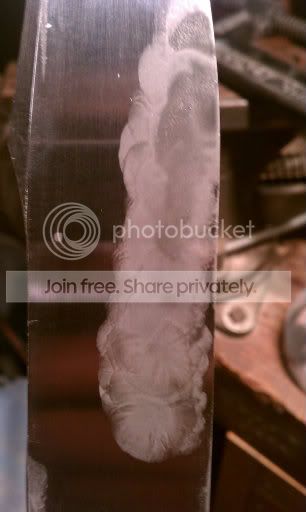
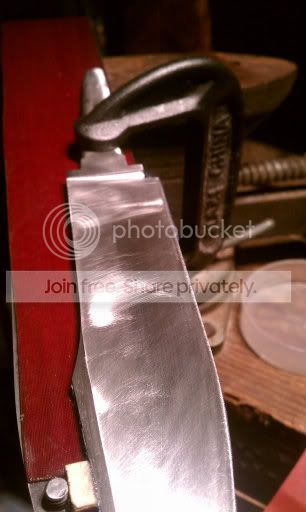
I am hand sanding a blade I have been working on. I already hand sanded one side to a 600 grit finish, after taking it up to a 800 grit dirty finish. Now I turn over the blade and I am working with 280 grit and I notice a line after I apply WD-40 and start sanding. The line looks like a crack, but I do not see it when there is no WD-40 on the blade, and even after applying WD-40 it only shows up after sanding enough to have "dirt" on the blade. I did not see anything at all like this on the other side. It is so long that I would think it would have gone all the way through to the other side.

What do you think, is this a crack?

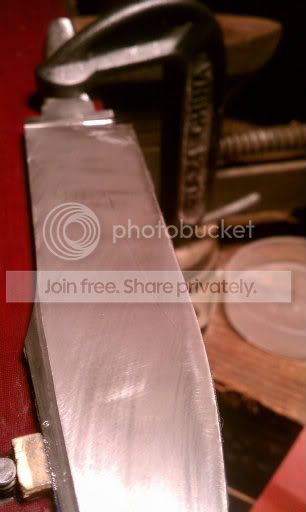
NO WD-40
IMAG0921.jpg


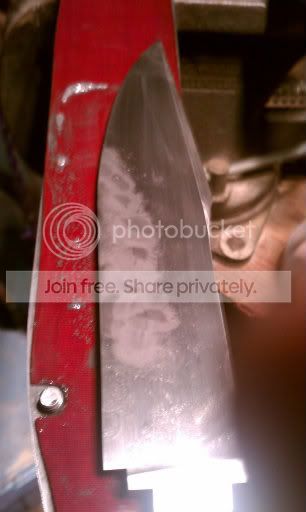
After WD-40 and sanding '
IMAG0920.jpg
 
It seems hard to imagine a crack not making it to the edge or other the side. I'm going with scratch or flaw in the material.
 
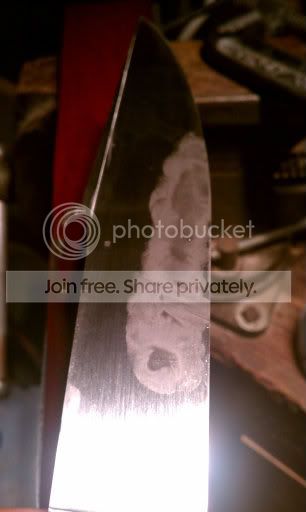
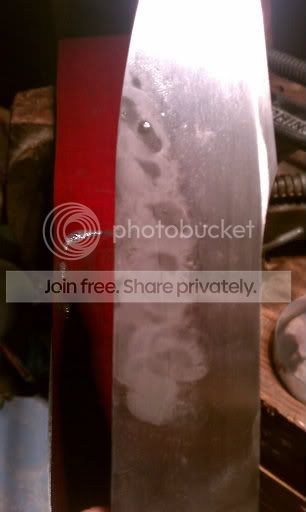
I decided to finish the side with the anomaly in it. I saved the WD-40 + 600 grit waste to dab on the opposite side and nothing.

IMAG0922.jpg
IMAG0925.jpg


IMAG0923.jpg
IMAG0924.jpg


I plan to do the dye penetrate testing tomorrow(Monday) I guess I'll find out then. Fingers crossed.
 
You didn't mention any details of the HT (unless I missed them). Is it possible this could be evidence of an unintentional differential HT (i.e. not quite a hamon, but more of a simple boundary zone)?
 
This blade is made from an old Shear blade which was already hardened. I believe it to be D2. I worked the knife slowly with lots of water. The entire time I was hearing a little voice say, "Use known material, with known heat treat.". :foot: It took so much longer than if I had ordered annealed material in the first place. This was one of the first knives I started making, and I have been wanting to finish it up for some time. I will not be using this stock again. :o

EDIT: This one was not planned to see much use, and now will definitely be more of a display piece. :(
 
If I were you I would mark the ends of the "crack" with a sharpie then put it in a vice and flex it a dozen or so times. If the crack travels, you know what to do...... smash it on the ground in fit of rage and self-hate.
 
If I were you I would mark the ends of the "crack" with a sharpie then put it in a vice and flex it a dozen or so times. If the crack travels, you know what to do...... smash it on the ground in fit of rage and self-hate.


All, while laughing manaically. :D
 
You can also use sound to find if there is a crack, un-cracked the blade should ring when struck with a metal object, and thud in there is a crack. Hold the blade very lightly and give a light tap with a hammer. Try on a un-cracked blade to have a comparison but the difference is very noticable.
 
If I were you I would mark the ends of the "crack" with a sharpie then put it in a vice and flex it a dozen or so times. If the crack travels, you know what to do...... smash it on the ground in fit of rage and self-hate.

In my best little kid voice "I don't wanna..."

Patrick, I was tapping it with my nail, and it sounded good. Gonna give it a few taps with a hammer in a bit.

Sam, I was hoping that would be it, even though that is not exactly good.
 
Keep on sanding.

Are you saying it will show up? What grit do you think it will show up at? Also is it possible a "crack" that long on one side of the blade, would not go through to the other at .050" thick?

I could hit it with a buffing wheel. would that work (to have the crack show up)?
 
Last edited:
I'm saying it will either go away or stay there. If it stays the same, it is a crack or slag inclusion. If it gets smaller or disappears, it is a minor flaw or a deep scratch.....sanding the surface down will tell which it is :)

And, yes, cracks can be on one side only.

Sometimes there is a mar or scratch that "burnishes" the steel. It may be caused in grinding, or an impact or hard scrape with a hardened surface. It will disappear when sanded, only to reappear as a bright line when polished. These can require going back and removing a few thousandths of an inch more steel to get past the compacted steel surface.
 
I read about a "poor mans magna flux" but never tried.

Take a rare earth neo magnet, stick it to the blade. Take some fine metal shavings and sprinkle on the blade. Move the magnet back and forth under the "crack" and see if the shavings do anything odd. Evidently cracks disrupt the magnetic field and cause the shavings to move around the crack differently if it is indeed a crack. never tried it though.
 
Back
Top