
Possible first knife designs....Advice?

Joined
Aug 25, 2013
Messages
658
Okay gents.... I've fantasized about it...wondered, dabbled... It's finally time for me to try to craft, and then ruin my first ever blade. :)

I'll be using a 1x30 belt sander, band saw, file guide (for the plunge lines) files, and sandpaper. And an edge pro apex for my secondary bevel...

Some random questions and thoughts: First of all, I think I've heard that the ricasso/plunge lines shouldn't be at a 90 degree angle to the blade... or perhaps it was that the end of the ricasso itself shouldn't be square? Could you guys help clarify this for me? I've been watching SO many videos and reading through the forum so much these past weeks, it's a little much for me to absorb everything.

Second, here are two designs I'm considering for my first attempt... Do you guys see any problems that a newbie would run into creating these two blades? Thanks.
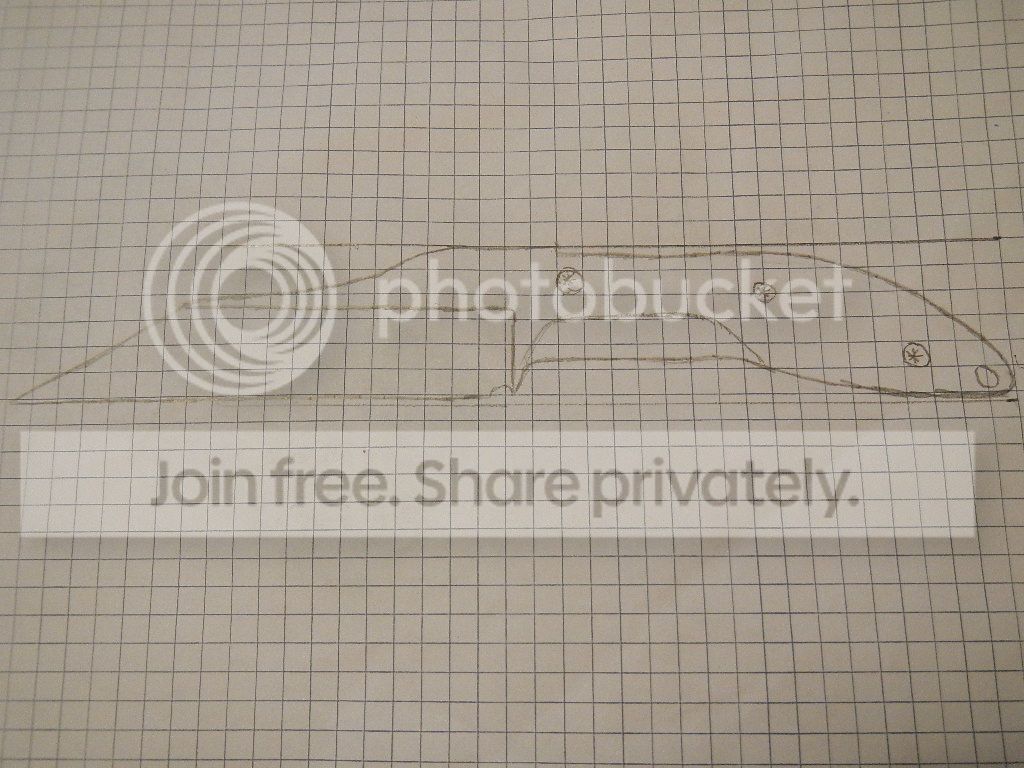


The raised portion on the blade end of the handle represents an indent in the handle scales, nothing to do with the tang of the knife.
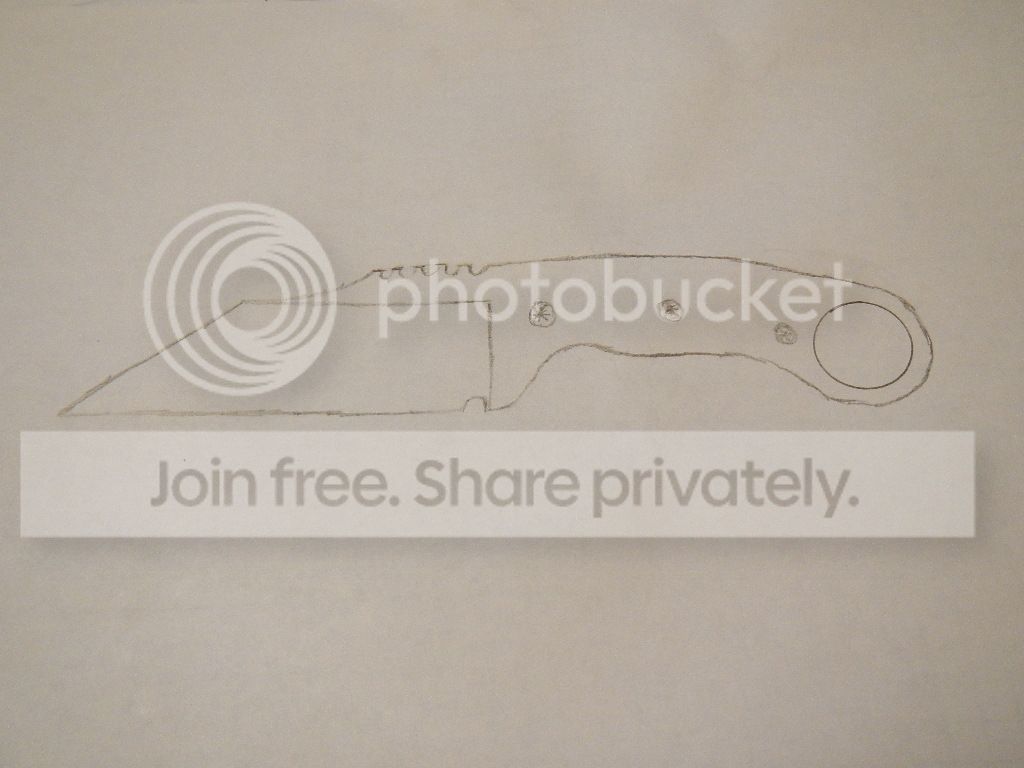


Thanks a lot guys...I appreciate any opinions/thoughts you might have on these two designs!
 
Simply put, I don't think those are patterns to start with. How about a plain 3" -4" bladed hunter made from carbon steel 1/8" thick. Can you draw one of those? Frank
 
I personally don't like a sharp squared off angle at the top of the plunge, where the highest part of the bevel meets the ricasso. A gentle curve is more appealing. I also think that a plunge line 90 degrees to the edge (or slightly less is fine) but you don't want to go more than 90 degrees. Okay, so that was looking at the blade in profile, now flip it over and look down at the edge. The angle there where the bevel meets the ricasso should be rounded too.
 
Thanks for the post I am have been trying to work on my designs and looking to see what beginners like me are using as tools. This gives me a few ideas. I like the drawings, but for my first knife I think I am going to keep it simple with a 3-4 inch drop point fixed blade with wood or G10 handles.
 
Thanks for the advice guys! Why do you all think that the wharnecliffe design is a too complicated? I figured that because of the flat blade, it would be easier to grind an even, flat bevel.
 
I was going to hold off commenting on the design itself besause of my newness but maybe I have something useful to add. Like Frank said, I think you are better off making something more traditional off the bat. You have seen plenty of knives with similar designs and should instinctively know what are your likes and dislikes. No one will fault you for "copying" a proven design for your first (or second, or third).

You really should include the front of the handle in your drawings and I don't think a sharp angled indent is either appealing or functional. Try rounding the edge of the handle all the way around.

I think a full flat grind wharncliffe is as easy as it gets but a half grind on the belt sander you are using will be tricky because you have to be precise for the full length of the bevel for a straight line.

I also don't think the hole is practical where it is currently located. Make a cardboard mock-up and you'll see what I mean.

Last thing, drop the jimping. As it is the jimping you have is way too deep and painful. I don't think it's a good idea to overcomplicate things right off the bat.
 
Practice grinding on something with that 1x30. Use wood, scrap steel, etc. it takes a while to get a feel for proper pressure and overall handling the steel. Just a recommendation from a beginner-mark your blade edge with some sort of dye or permanent marker and use a drill bit that is the same thicknes to mark where your grinds will meet. Grind a 45 deg edge and then grind in the bevels with the 1x30 when you're comfortable using it. Put on your file guide first so you can set where you want your plunge line. Do a few passes on one side, flip over, and do a few passes on the other. Keep the steel cool with water. Once you get your initial bevels in, switch to files. Those 1x30s are normally at a very high speed and are not variable, so mistakes happen quickly. With the files, you can work slow, steady, and achieve a true full flat grind. Good luck with everything.
 
The tip on both of those designs is going to end up very thin and snap off easily. I found that out with my first knife and it had a similar blade profile:

394251_4659668933680_1471710365_n.jpg


As already stated, the ring on the second knife doesn't look like it's in the right spot to be comfortable...plus they aren't horribly easy to cut out and sand. Make some wood mock ups of both blades/handle shapes and carry them around for a while. You will quickly feel what you need to change in your designs before you spend your valuable time making a knife that ends up being to uncomfortable to use.
 
Thanks for the advice guys! Why do you all think that the wharnecliffe design is a too complicated? I figured that because of the flat blade, it would be easier to grind an even, flat bevel.

Because your wharnie isn't necessarily a wharnie. If that's what you really want to make, make a "traditional" one that has been proven over time. Your second drawing looks like it wants to be a Karambit/wharnie mutant hybrid. If you're really planning on getting into knife making you're going to making many more knives and they're only going to get better and better. Make your first knife with the sole intent on "making a knife" so you know what's involved and they joy that awaits you. You'll have plenty of time to design that "innovative, never thought of, one of a kind, super cool" one at will once you know how to do it :)
 
okay... Drew something else up.. Hope it isn't as disliked as the last set... Still not a FFG wharncliffe... It just doesn't look right full flat ground on paper... I eliminated Jimping, handle hole, and made the plunge lines at a gradual angle instead of 90 deg... and I drew in the handle.... (sorry guys, still don't have french curves, so you're going to have to deal with my crappy free hand for now.

The blade from tip to sharpening choil is 3 3/8", OAL is 6 7/8"...Shown next to an SNG for size comparison... Thoughts?


I think that looks good, but unless you're a prodigy, you won't be able to get that nice even top edge where the bevel ends. I've been trying, but it's almost impossible with a 1x30. I think with enough practice, it's possible, but for your first knife it will be very hard.
 
That's kind of what I thought :P Which is why everyone is telling me to do a full flat... Which I should probably do... and will probably do after trying to make this design 3 or 4 times and failing miserably ;)
 
just from my experience when i first started out the flat line on top of the bevel is going to be really hard to get on a 1x30 belt grinder for a few reasons one the belts dont track as well as your other grinders ans second the belts dont get enough tension to get a solid flat grind. so my advice if you really want that beautiful flat line across the top of your bevel grind it down about an 1/8in below your desired area on the 1x30 then pull it off the grinder and switch to a file and work your way back to your mark. another tip towards getting a good flat bevel with a file coat your bevel with a permanent maker then go over the bevel with you file a few even swipes this will show you your high and low spots throughout the bevel work according to these spots untill its all uniform. hopefully you find this useful
 
Your plunge line should bisect the sharpening notch, aka Spanish notch, hitting it right at the apex of the half circle.

BTW, I freehand all of my knives, without using any french curves. Drawing curves should be done with the wrist, not the hand or the fingers.
 
That's kind of what I thought :P Which is why everyone is telling me to do a full flat... Which I should probably do... and will probably do after trying to make this design 3 or 4 times and failing miserably ;)

Just use your 1x30 to start the grind, then switch to files and if you are careful you can make that grind line come out clean and even. Take your time and go slow with both the grinder and files. Use dykem or sharpie to mark the blade often so that you can see where you are actuallly removing steel.

Going slow is not a sin. It really will help you to minimize your mistakes, and unless you are a prodigy you really should expect some hic-ups along the way. If you spend some time really looking at the knife as you progress you will see the mistakes as they happen and it will be easier to fix them.

Good luck and have fun

Jeff
 
Complete newbie here as well, I just finished grinding out my second knife.
I did the first knife with files and a 1x30... ended up with convex grind.
My second knife is a tanto and I used a filing jig to file and sand the bevels.
This really helped me get flatter, more even bevels.
Check out Aaron Gough's filing jig video on youtube. He has a great cheap and easy to build design and some good pointers on filing.
 
Back
Top