Possibly ruined Wicked Edge 100 grit stone?

Joined
Jun 14, 2016
Messages
21
Hey guys I just got myself a wicked edge and I'm worried I might have already messed it up a little. I've sharpened a few knives and they've been getting progressively better as the stones break in and I've been getting my technique down.

Problems came when my mother asked me to sharpen a couple of her kitchen knives that were pretty badly dinged up and chipped. I think I was a little overzealous with the 100 grit stones and potentially abraded away a portion of the diamonds. This leads me to a few questions:

How likely is it that I damaged the stones?
How much pressure am I able to use when reprofiling an edge?
How long does it generally take you guys to reprofile from say 40 to 30 inclusive?
When using the sharpie trick to create a bevel, does it ever seem like you can't get the last bit of marker at the edge?

The stones definitely seem smoother than when I got them, I'm not sure of that's normal break in or not. I wasn't really bearing down on them, but did use a pretty aggressive scrubbing motion trying to fix the damaged edges. Afterwards it's seeming to take longer to profile edges and I wasn't able to raise a burr on one knife even after a considerable length of time.

Anyways sorry for the long first post full of questions, if anyone has any help or advice for me I'd really appreciate it.

Thanks,
Dan
 
Hi,
Did you wash/clean/scrub the diamonds clean? Diamonds can load with metal just like any stone, this mean cutting action slows since the swarf is masking the abrasives, like if you put masking tape or foil on top of the stone, it gets in the way.

What you're supposed to do for longevity of diamonds, is use lube, and keep force below 1lb, that is if you put sharpening contraption on a scale, zero the scale, then put your hand on it and start stroking, it should read below 1lb (~450 grams)

If your edge bevel is 2mm wide, .5lb on a 2inch stone is about 3psi. half inch is 12psi and quarter inch is 25 psi

The smaller the contact area the lighter you should go.

For example in general for sharpening for best results, the finishing strokes for deburring/microbeveling , the scale should register under 100 grams, under 20 if you can manage it , thats ~1-4oz (1/16lb-1/4lb).

Even damaged diamond plates have lots and lots of use left in them, unless you've removed all the diamond and you're left with a shiny shiny shiny metal mirror.
Unless you're trying to apex with this 100 grit stone, even more than a little damage is not a big deal.
See this dmt has 10%-15% damage Also note the contrast, bare metal is shiny.
DSC04758640x183_zpsd41353bb.jpg
 
How likely is it that I damaged the stones?
How much pressure am I able to use when reprofiling an edge?
How long does it generally take you guys to reprofile from say 40 to 30 inclusive?
When using the sharpie trick to create a bevel, does it ever seem like you can't get the last bit of marker at the edge?

You should not use much pressure with diamond stones. The advise is always to let the stones do the work and the weight of the stone itself is enough.
Depending on the type of steel and the size of the knife, it can take a lot of time to reprofile and for a 5 degree per side reduction like in your example you will have to remove a lot of metal.
If you reprofile a knife to a lower angle, reaching the apex and removing that last bit of marker at the edge takes a relative long time because at that time you are removing the most metal across the entire width of the bevel.
 
Clean the stones with dish soap then bar keepers friend . I've found that the softer cheaper steels will load diamonds up in no time.

Clean your diamonds and run a glass jar across the surface that's really the most accurate way to see if your diamonds are still cutting if it scratches glass your GTG, if it doesn't you have a dead spot or spots .

Like someone posted above though even a damaged diamond still cuts . I have one that I thought was played out but it still cuts just not really at the speed and grit it's labeled .

I've found no matter what the diamond companies say never use them dry . You get better edges and they last forever with light pressure and a little water .

If the diamonds are cutting evenly through out the face of the plate then they are just breaking in . Question is wicked edge monocrystaline?
 
OK , easy on the pressure then . Mono breaks down but still cuts etc. It's a long story on the differences when breaking in they fracture and become less aggressive which is not really a bad thing at all.
 
OK , easy on the pressure then . Mono breaks down but still cuts etc. It's a long story on the differences when breaking in they fracture and become less aggressive which is not really a bad thing at all.

It is my understanding that it is not the mono-crystalline but the poly-crystalline diamonds that fracture.

From the topic on the WE forum:

there is a big difference poly-crystalline and mono-crystalline diamonds. The fact that there is an industry for poly-crystalline diamonds in the first place should give us some pretty good clues. The poly-crystalline diamonds are used, among other things, in lapidary for polishing gemstones and the like. The idea behind them is that the diamonds are friable and the crystals will fracture, exposing “new, sharp points” as they’re used. This means there is a need for “new sharp points”, from which we can infer that, at some point, the performance of the diamonds would suffer if new sharp points weren’t being produced, meaning that their old points would have gotten rounded:

“As the grinding, lapping and polishing occurs, these small crystallites will cleave and expose new and sharper cutting edges. The result is that polycrystalline diamond is a self sharpening abrasives which produces improved surface finishes having higher cut rates.” *http://www.metallographic.com/pdf/Data-friable.pdf
 
It is my understanding that it is not the mono-crystalline but the poly-crystalline diamonds that fracture.

From the topic on the WE forum:

there is a big difference poly-crystalline and mono-crystalline diamonds. The fact that there is an industry for poly-crystalline diamonds in the first place should give us some pretty good clues. The poly-crystalline diamonds are used, among other things, in lapidary for polishing gemstones and the like. The idea behind them is that the diamonds are friable and the crystals will fracture, exposing “new, sharp points” as they’re used. This means there is a need for “new sharp points”, from which we can infer that, at some point, the performance of the diamonds would suffer if new sharp points weren’t being produced, meaning that their old points would have gotten rounded:

“As the grinding, lapping and polishing occurs, these small crystallites will cleave and expose new and sharper cutting edges. The result is that polycrystalline diamond is a self sharpening abrasives which produces improved surface finishes having higher cut rates.” *http://www.metallographic.com/pdf/Data-friable.pdf

Guess I got them mixed up. I had always read that the mono broke down and was more of a self sharpening effect if that makes sense.

Regardless with diamonds light pressure is the key in wore out a plate with a jig because while in wasn't applying pressure just the Weight of the stone put more force on the diamond that was needed .

Since then I don't use diamonds dry either a little water mixed with dish soap has worked good for me.
 
Wow thanks for all the responses everyone. I went ahead and bought some bar keepers friend to clean out the stones. Hopefully that will help some and I'll have to remember to lighten up and be more patient when reprofiling. I also went ahead and ordered the 50/80 stones so I can hopefully repair some of my mother's damaged knives without further wearing out my 100 grit stones.

I haven't really read much on keeping diamond stones wet/lubricated but the idea interests me. I have a small spray bottle kicking around I may try spritzing the stone next time I have a big reprofile to do, couldn't hurt right? At the least I'd assume it would cut down on some of the abrasive dust that comes off.

Thanks again everyone I'll update the thread after I get my stones cleaned and sharpen another blade for anyone that may run in to the same problem.
 
I have always used a small spray bottle with water and a squirt of dish soap also. It tends to keep the swarf in a kind of mud. And I've always wondered if it actually aids in the cutting action at each grit level. But it has always made cleanup fast and easy, as well as minimizing the loadup at each stage. The only time I use the diamonds dry, is for just a few swipes in the beginning as I'm setting and tweaking the angle with sharpie. Water seems to take off sharpie in places that it should not have been. Then I wet the stones down good, and usually many more times during each grit along with a couple of stone cleans with cloth.

With one of my systems, I overly worked a 300 diamond stone for re-profiles before picking up a 100 grit. After replacing it, I found that it is now at a perfect abrasion level to use between 300 and 600. So I just re-labeled it 450, and put it in the lineup. :)
 
yet when it comes to getting the end result (sharpness) with water stones I soar through the air with the greatest of ease.

If nothing else Col. you won't have the longest post.
No apologies for mine.

Well allow me to “vent” a tiny little bit.

I was enjoying this thread and it reminded me to finally take some coarse diamonds to my pride and joy Manix CPM-S110V.
So while I was between posts here I went and got out the large Coarse DMT plate with continuous diamonds across its surface shown in the first photo bellow. Then I was reading the bit about light pressure. Long time ago out of frustration while attempting to flatten A2 wood working plane blade backs (very large surface like 2-1/2” by 2-1/2”) I applied ALOT of downward force on that stone after using it for days and hours and hours each day ATTEMPTING to flatten a number of A2 blades. First with light pressure as recommended.

It seems to still be quite usable as a sharpening plate though obviously not like it was when new.
Then I recalled I wanted to go more coarse anyway so I thought about the yellow plate with the round holes all over it.

Same exact over pressure on it as well.
Both have been used with and without water. See the rust on the yellow plate.
I pretty much never use the first plate and mostly only use the yellow one for flattening water stones. which it still does VERY aggressively and well. It is very flat checked on my Starrett surface plate with dial indicator . . . point being it makes the water stones very flat.

THEN !
I remembered the brand new little 220 DMT that came with my knife sharpening kit shown. It was never forced at all. I don’t think I have ever used it. Matter of fact I have only used the whole kit a couple of times and found it sorely lacking for little folding knives like a Case Medium Stockman. Just can not go shallow enough and the clamp gets in the way big time. It works for larger folders fine.

I just went back to hand held sharpening using my water stones for the little folders.

OK so that sets up the stage.
I have been less than impressed with the CPM-S110V steel.
I can hear you say that is because I don’t understand how to sharpen it.
I can accept THAT IS PROBABLY THE CASE.
So I have been practicing.

The problem I have is that I sharpen the blade and it gets dull in a couple of uses.
I have had it in various states of edge :
  • toothy coarse nail biting sharp.
  • toothy coarse nail biting sharp and sort of shave sharp but not hair whittling by any means.
  • Mirror polished easily hair whittling sharp

Today I planed to try sharpening it with diamonds for the first time.
After a day or two of very light use at work, about similar to cutting a couple of ropes but I was cutting a couple of little pieces of cloth reinforced rubber and also very light use on hard rubber. The blade was not too sharp as tested on my finger nail.
I was determined to try diamonds and go toothy with those so I used the brand new 220 mentioned above.

Used the marker as always. Put the stone in the holder / guide.
Not impressed no matter what I did :
  • light pressure
  • very light pressure
  • moving only one way on the plate . . . first only with / away form the edge . . . then only against the edge . . .
  • then free hand . . . one way then the other then circular feeling for the edge on the stone.

Always checking with bright light and a jeweler's magnification visor for a slight wire edge, which this steel does not make much of one. Part of what I like about it AND the CTS-XHP steel in the Cold Steel shown .

I never got decently nail biting let alone any kind of shave sharp.
My other test was to try to slice a plastic bag. Not impressed.

PS: interestingly enough I get better nail biting while sharpening a badly beat up cobalt drill bit or carbide saw teeth using my very heavily used diamond paddle that has never had a touch of water on it in it’s long service at work. It is a 220 DMT. The plastic handled paddle shown in the first photo.

The Cold Steel CTS-XHP is nail biting and slices plastic bag even after a day or two of similar use.
It is mirror polished but not excessively. It is a working EDC knife I have rotated for years. Scratched up . . . no special care.

What I am saying is . . . it isn’t that I can not get the CPM-S110V sharp. I can get it hair whittling sharp on my Edge Pro Shapton stones, I can get it hair whittling sharp hand held on my Shapton stones. It is just that I am getting nada fast from the diamonds.

And looking at how slowly it took off the magic marker across the sharpening bevel while using very light pressure . . . it would scratch it and scratch it and still be there . . . and finally removed it . . . while using light pressure to preserve the life of the diamonds. I finally went a tad steeper so I was right on the edge.

The Shapton 500, while using light pressure, on the Edge Pro, across the full bevel, would remove the marker in a couple of passes (real quick like) . . .

Sighhhhhhhhhhhhh.
!
. . . .
I just can’t imagine using the diamond plates. ESPECIALLY to remove any significant metal . . . I don't get it . . . I just don’t have a reason to.
other than . . .
In theory the diamond sharpens the super hard alloy carbides that the water stones can’t or don’t do fully or well.
And yet, and yet.

From this view that I have at this juncture . . .
diamonds . . . well . . . they suuuuuuuuuuuuuuuuuuuuuuuuuuuuuuuuuuuuuuuCK !

And my advice to the OP is get just about any little grinder that will turn a WHITE grinder stone with any grit from 220 down to 46 and take a quick, VERY light pass over it on each side of your Mom’s knives and in a matter of seconds or a minute if you want to take a breath while you flip the knife over.
You will have achieved “Geeeeeterdoneness”.

Then enjoy your nice Wicked edge for the ultra precise micro sharpening.

Thanks for listening.
I know I have ALOT to learn. Just not sure what that is at this point.
sigh . . .
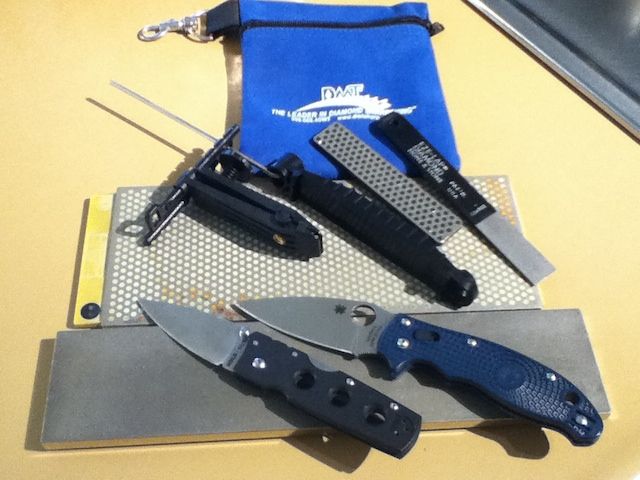


To be clear these are what I wasted a fair amount of time with today.
The knife cuts stuff, sort of, but she aint much. Three days a go it was hair whittling. Today before "sharpening" there were NO dings just a little dullness and a bit of slightly rolled edge here and there. If I had had a ding or chipped edge, at light pressure I could have been there all night.
 
Last edited:
Op, you very likely did not ruin your 100 grit stones.... The wicked edge diamond stones are some of the most durable I've found. Dmt's were pretty terrible in my experience, and atomas lasted about 40-50 knives before they were no longer good. The wicked edge diamonds last 300-500 knives in my experience. You can use a lot of pressure with the lower grit stones without any adverse effects. I've used them with light pressure, hard pressure water, and dry. Currently I use them in a scrubbing motion with moderate to hard pressure and dry.
 
Although a bit off-topic, Wowbagger does have a point: A belt grinder is much quicker than diamond plates for material removal. I find that I use the WSKO to do heavy work and the Edge Pro or Wicked Edge for more detail work. Coarse plates are still necessary if the grinders can't be used, esp. indoors.
 
Thank you Josh.

I learned some stuff.

Col Cluster,
By the way the Wicked Edge seems to make better (prettier, more consistent looking), bevels than the Edge Pro. I have yet to sit down and think that out yet. The bevel, at least with small knives tends to get thinner / shallower angle towards the tip. I haven't sprung for or made the small knife accessory. I imagine one day I will . Not convince it will help my bevel problem. Maybe it will though.
 
Nothing clogs a stone like a gummy, low carbon, high chromium kitchen knife.

Not to mention the massive wire edges that just go and go and hang on for ever.
I hates it I do.
 
You can use a lot of pressure with the lower grit stones without any adverse effects. I've used them with light pressure, hard pressure water, and dry. Currently I use them in a scrubbing motion with moderate to hard pressure and dry.
Hi,
how much pressure is that? how many pounds/oz/grams on a scale?
 
Are you removing burr with high angle passes?
high angle ? ! ? !

BLASPHEMY !

Ha,ha,ha

I am a shallow edge freak. So nah dude, nah

No I find the best way is to do most of my sharpening with the edge meaning the stone is going down the bevel and then off the edge and once I am about totally done, at a higher polished edge usually, I take a pass or two up the bevel, against the edge to help remove the wire / foil like flap and then a time or two back down the bevel to HOPEFULLY fix some to the microscopic damage I envision that I caused. I have a phobia of stropping . . . so that's the way I deal with it.

For me edge shape is every thing and I hate rounding the very smallest part of the bevel by stropping. I can very clearly tell the difference when trimming something hard like hard plastic or my fingernails.
 
Until Josh gets back to you
A LOT of pressure
how much pressure is that? how many pounds/oz/grams on a scale?

Allow me to answer that with what my old room mate use to say.
When someone would ask how tight to make a good sized bolt he would say "Just tighten it (or in this case push on it) till you fart and that ought to be enough". ;)
 
Back
Top
