cbwz34,
But over time I've learned that raising the angle to remove the burr, is different than creating a microbevel. My edges come out MUCH MUCH better and last WAAAAAY longer. Done properly, there's no evidence of a microbevel or second edge, even under magnification. (I'm sure there is at some level, but not a factor).
So, give it a try... with a bit of practice, guaranteed the results will be a big improvement.
Sounds frightening.
I'm listening though.
I come from a woodworking back ground and sharpening for the really cantankerous woods (except those from Australia THOSE LADS ARE REALLY IN A WHOLE DIFFERENT WORLD I HOPE TO NEVER HAVE TO DEAL WITH. There is a little part of me that says "Bring it on ! I can sharpen for anything" but then I give him a dope slap and tell him to get back in his cage.)
What I am saying is I have a pretty darned good idea of what works for heavy cutting and long term cutting and what is counter productive. Obviously you know better than me for pocket knives BUT it sounds kind of like stropping or running the edge through the wood to get rid of the bur and I can guarantee you that both are a BAD IDEA. The best performance was ALWAYS pick an angle, the minimum angle that would not tear out or fold up and that was the best angle. Any roundy roundy was the equivalent of dulling the edge / ruining the geometry.
Best to stick to a finite angle and go through the grits until the foil like wire came off in little bits on the stone.
Then walk by a strop on the way to the woodwork and wave but don't stop to chat. If you know what I mean.
The wood in the photo is Bubinga. Highly tear out prone, somewhat abrasive and ALWAYS HARD (think hard plastic with a tricksters passion for messing with you all the time). That's the first photo.

This is the final result with no finish on the table. Any misjudgment in the edge quality causes hunks to tear out and or the edge to just stop cutting and judder across the surface causing damage so pronounced one can see it from across the room. Granted this edge was quite obtuse and not "shallow" but the angle was unmolested. "Cheating" as you describe would have caused surface damage or at the very least reduced quantity of material removed between sharpening .
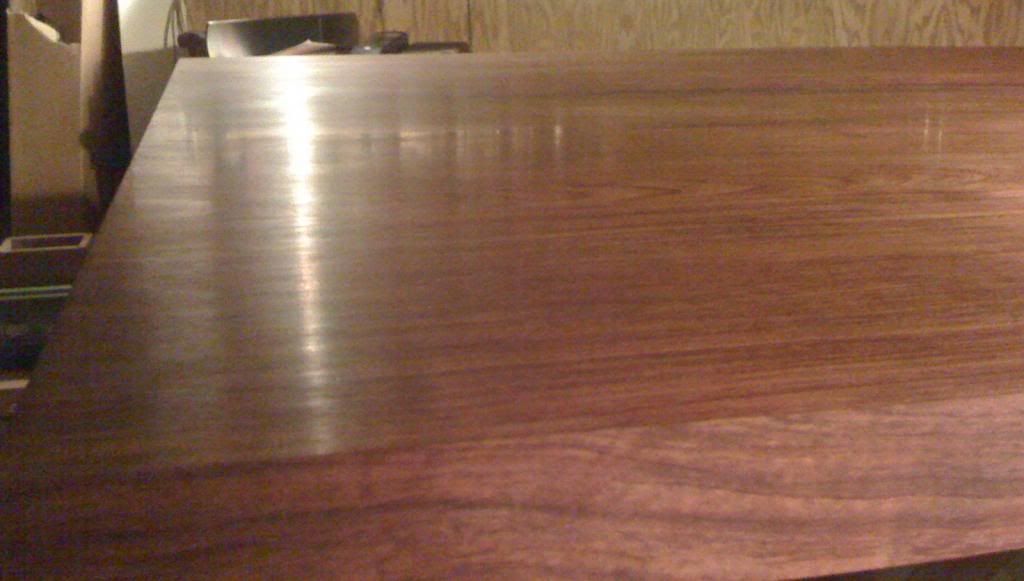
That and purple heart wood which can be more of the same but even more so. They DEMANDED that I really pay attention hard to every detail of my edges. Purple heart is the next two photos. My work bench. All hand tool work; no sand paper touched either wood (the table or my work bench).

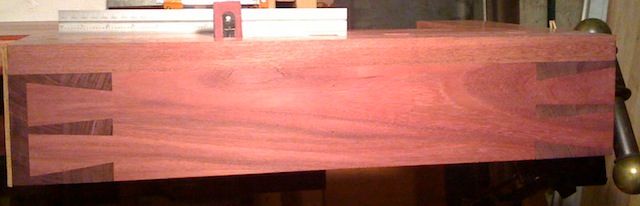
It was a hard won battle but I mastered both woods. After that I feel I can sharpen for anything that can be cut.
I will experiment with what you have told me but I feel like I am going over old ground which I found to be bad form and counter productive short-cutting. Perhaps all is different when it comes to pocket knives. By the way the steel I use almost exclusively for the plane blades is A-2. Maybe. . . hahaha . . . I ONLY know how to sharpen A-2.




