Post your strop! (Pics)

Another question. If the smooth side is the side with the silicates wouldn't the rough side produce a smoother finish? Smooth side coarse, rough side fine?


No, the silicates are what cut the steel.... they are the abrasive and you need abrasion to sharpen. The rough side is just the back side, it has no abrasive action and is not meant to be stropped on. Now if you put compound on it it probably wouldn't matter but using it bare you must use the smooth side for the proper effect.
 
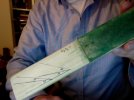
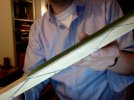
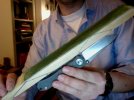
as promised. 4mm thick vegetable tanned leather. rough side with some chromiumoxide. some angles on the handle and on the side, so I can easily align my blade with the angle
attachment.php

attachment.php

attachment.php
 

Attachments

  • Photo on 2010-03-17 at 23.11.jpg
    Photo on 2010-03-17 at 23.11.jpg
    41.6 KB · Views: 262
  • Photo on 2010-03-17 at 23.12.jpg
    Photo on 2010-03-17 at 23.12.jpg
    43.9 KB · Views: 261
  • Photo on 2010-03-17 at 23.12 #5.jpg
    Photo on 2010-03-17 at 23.12 #5.jpg
    44.8 KB · Views: 741
Zyhano, what a great idea! So simple I can't believe I didn't think of it myself. Good stuff.
thanks, It's very easy to always have the right angle available for reference. I'm not where I can say "I sharpen at 17 degrees" and have to say I'm sceptical about people that claim they can freehand that for every knife they own. I do find that it's easier to 'remember' by muscle memory if you continually check your angle against something you know is right.

I have the same lines on my water stones and other strops :thumbup:
 
Now if you put compound on it it probably wouldn't matter but using it bare you must use the smooth side for the proper effect.

Could it also depend on which type of compound you use...powder compound/rough side, waxy compound/smooth side. My Herbs yellowstone compound just slides right off the smooth, whereas the rough side pockets the powder and allowing it to serve its intended purpose...making my knife shine like the face of Christ.
 
Could it also depend on which type of compound you use...powder compound/rough side, waxy compound/smooth side. My Herbs yellowstone compound just slides right off the smooth, whereas the rough side pockets the powder and allowing it to serve its intended purpose...making my knife shine like the face of Christ.


The first that comes to mind as a down side to using the back of the leather is the fibers that stick up. As you run the blade over that surface those fibers will want to jump back up once the edge passes them, this could cause slight rounding of the edge and a lack in sharpness and performance. When you get to this point in sharpening all the small details really start to matter, with edge width's measured in sub microns everything else in the small world of the edge is huge.
 
Another question. If the smooth side is the side with the silicates wouldn't the rough side produce a smoother finish? Smooth side coarse, rough side fine?

The natural silicates in leather are MUCH smaller than any compound you can buy. They are not big like grains of sand.

Imagine; if one silicate grain were the size of a pingpong ball, one grain of CrO2 would be about the size of a basketball! That's why bare leather is used for the absolute finishing strop. It's got the absolute finest grit of everything we can use! :)
(But being so fine, it cuts verrrrry slowly.)

Stitchawl
 
hones.jpg


I made all these myself. The one on the right was my first one. I made it so that I could fit it to doorhandles while being at home. Both sides have a polishing compound on them.

The Two small ones are my most recent ones and I've made those to have in the woods. The idea behind the paracord is that you can snag it on branches etc. and hold the other end. One is darker and another is lighter, the difference being that I oiled one up with sewing machine oil to see what it would do. Seems it just makes it slicker to sharpen. I mean, the blade just glides effortlessly — and it get's sharp! It only has a polishing compound on one side, again leaving the smooth side untouched (except for oil). The other hone only has a polishing compound on one side and is untouched by oils. They work really well.

The two large ones are my beasts. I had some stones cut out for me as a base, so that the hones wouldn't move around on my desk. One is untouched and the other has a polishing compound on it. Both of them have the smooth side up, which I like better than the rough side. I also applied copious amounts of silicone glue on the bottom of the stones, so now they won't budge one bit!

I also have one that I bought online. It's small simple one which is mounted onto a board and has leather on both sides. Works great too.

 
hones.jpg


I made all these myself. The one on the right was my first one. I made it so that I could fit it to doorhandles while being at home. Both sides have a polishing compound on them.

The Two small ones are my most recent ones and I've made those to have in the woods. The idea behind the paracord is that you can snag it on branches etc. and hold the other end. One is darker and another is lighter, the difference being that I oiled one up with sewing machine oil to see what it would do. Seems it just makes it slicker to sharpen. I mean, the blade just glides effortlessly — and it get's sharp! It only has a polishing compound on one side, again leaving the smooth side untouched (except for oil). The other hone only has a polishing compound on one side and is untouched by oils. They work really well.

The two large ones are my beasts. I had some stones cut out for me as a base, so that the hones wouldn't move around on my desk. One is untouched and the other has a polishing compound on it. Both of them have the smooth side up, which I like better than the rough side. I also applied copious amounts of silicone glue on the bottom of the stones, so now they won't budge one bit!

I also have one that I bought online. It's small simple one which is mounted onto a board and has leather on both sides. Works great too.
Wow your hanging strops look awesome.
How heavy are your bench strops?
 
Thanks. The bench strops with a stone base are VERY heavy. I wanted it that way, but of course it doesn't make them very portable, as they are very heavy and they can break if they are dropped. Well, I guess they're like waterstones with leather on top of them hahah!
 
The first that comes to mind as a down side to using the back of the leather is the fibers that stick up. As you run the blade over that surface those fibers will want to jump back up once the edge passes them, this could cause slight rounding of the edge and a lack in sharpness and performance. When you get to this point in sharpening all the small details really start to matter, with edge width's measured in sub microns everything else in the small world of the edge is huge.

yes, that is something that i noticed...but the bit of leather, much like a piece of wood, seems to have a grain. If you go with the grain, the fibers stay flat (especially when its loaded with the compound) and things work out really well.
 
hones.jpg

The two large ones are my beasts. I had some stones cut out for me as a base, so that the hones wouldn't move around on my desk. ... I also applied copious amounts of silicone glue on the bottom of the stones, so now they won't budge one bit!

The bench strops with a stone base are VERY heavy. I wanted it that way, but of course it doesn't make them very portable, as they are very heavy and they can break if they are dropped.

Hey stoffi,
Nice work! I like how you have strops for many different locations and scenarios. Your need(?) for stone or something heavy to weigh the strop down so it doesn't move is interesting to me. I just made a few of my own strops, with about the same surface area as yours, but with only a 7/8" thick piece of wood for the base instead of thick, heavy stone like yours. And I gotta say that so far I've had no problems with movement or slippage during use, and I'm not even using rubber/foam/wet towel underneath it. I do have my left hand on the side or edge of the base as I strop with my right hand, but it's not really necessary to hold it secure, it's there moreso for peace of mind. So I guess my question is, did you used to have problems with your strops moving around before you started using stone bases? I wonder if our stropping techniques are so different that they dictate different bases for stability. Whereas I strop very lightly, in my imagination I see you bearing down to the point that your face is red and your knuckles white:eek:. I'm sure that's not the case, though.;)
 
Hahaha, good read! No, I don't use a lot of pressure and of course a block of wood would have done equally well, but I wanted them to never move. I have rubber mats etc. but most of my water stones sometimes move around anyway, so I wanted more stability. The table I'm working on is made out of Corian, so it's pretty slippery in itself. I agree that using a stone as a base may seem a bit overboard, but I made them to have them at home, so I figured what the heck — I'll just make the foundation out of stone.
 
Hahaha, good read! No, I don't use a lot of pressure and of course a block of wood would have done equally well, but I wanted them to never move. I have rubber mats etc. but most of my water stones sometimes move around anyway, so I wanted more stability. The table I'm working on is made out of Corian, so it's pretty slippery in itself. I agree that using a stone as a base may seem a bit overboard, but I made them to have them at home, so I figured what the heck — I'll just make the foundation out of stone.

Can we get a shot of the base?
 
I just smeared some silicone glue on the bottom. Let it dry with a tape-frame. Presto.

LATE EDIT:
stones.jpg
 
Last edited:
Back
Top