Pre Heat treating

Joined
Nov 23, 2012
Messages
6
One of the most common problem during heat treating blades is warping. Before you folks do heat treating how thin do you
you usually go with the edge of the knife before you heat treat? 1mm, 2mm, 3mm? Another is what is the last grit do you use
prior to HT?


If a blade is heat treated using a vacuum furnace is there a big advantage of preventing warping ?


mm/inch conversion
1mm - 0.0394 decimals
2mm - 0.0787
3mm - 0.1181
4mm - 0.1575
 
Last edited:
....1mm, 2mm, 3mm.........

I hope you forgot the decimal. Many blades aren't 3mm at the spine. I take the edge to about .1mm ( .004") before HT.
It depends on the steel type and thickness, too.

A vacuum HT oven will prevent decarb, but won't affect warp one way or the other.
 
I was just about to make a thread similar to this...

....1mm, 2mm, 3mm.........

I hope you forgot the decimal. Many blades aren't 3mm at the spine. I take the edge to about .1mm ( .004") before HT.
It depends on the steel type and thickness, too.

A vacuum HT oven will prevent decarb, but won't affect warp one way or the other.
How thin can you get away with leaving the edge on an A2 knife being sent to Texas knife making?
 
If a blade is heat treated using a vacuum furnace is there a big advantage of preventing warping ?
No. As Stacy said, vacuum furnaces don't prevent warping - even grinds and not overheating the blade before HT does help prevent warping.

Vacuum furnaces give a big advantage in pre-HT finishing, though. I routinely sand my blades up to 600 grit, sometimes much higher, before HT. There is only a very thin layer of oxide coloring to sand off afterwards, and I'm pretty certain that normal sharpening removes any small amount of decarb that may have occurred on the thin edge.

This saves loads of time hand-sanding. Grinding or sanding out coarse 220 grit scratches on a hardened, tempered blade of stainless or tool steel takes a while. There's a reason so many makers using wear-resistant steels prefer machine/scotch-brite, tumbled and blasted finishes ;)

How thin can you get away with leaving the edge on an A2 knife being sent to Texas knife making, hypothetically?

I haven't used their service but I'd be comfortable with a .015" edge in general. I usually go thinner but that leaves some wiggle room.
 
On A-2, James' .015 recommendation is fine ( .4mm). I would say that .010 is good (.25mm). I would go with 400 grit, but with a vacuum oven, a much finer grit will be better. 800-1000 would not be too fine.

On stainless blades, I go down to .005" ( .1mm) and finish to 400-800.
 
I haven't used their service but I'd be comfortable with a .015" edge in general. I usually go thinner but that leaves some wiggle room.

On A-2, James' .015 recommendation is fine ( .4mm). I would say that .010 is good (.25mm). I would go with 400 grit, but with a vacuum oven, a much finer grit will be better. 800-1000 would not be too fine.

On stainless blades, I go down to .005" ( .1mm) and finish to 400-800.
This is why I love this forum, thanks guys! :thumbup:
 
HI Stacy, I'm much used to in using metric rather than inches :o
but I've edited my post and placed the conversion below :-)


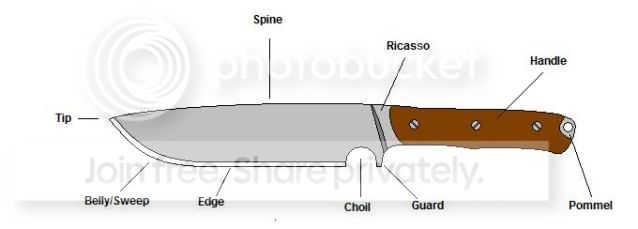
Knife_anatomy.jpg

what I'm talking about is the edge of the knife. They tend to warp during heat treatment
specially if it is so thin :-(


....1mm, 2mm, 3mm.........

I hope you forgot the decimal. Many blades aren't 3mm at the spine. I take the edge to about .1mm ( .004") before HT.
It depends on the steel type and thickness, too.

A vacuum HT oven will prevent decarb, but won't affect warp one way or the other.
 
I would go with 400 grit, but with a vacuum oven, a much finer grit will be better. 800-1000 would not be too fine.

On stainless blades, I go down to .005" ( .1mm) and finish to 400-800.
So does it mean if I use vacuum heat treatment. I could go staight away
to hand finishing or bead blasting?....It is like heat treating the blade at almost a finished stage?

....and thanks Stacy, I really appreciate your help :-)
 
It might be a good idea to give the blade a stress relieve anneal or temper -- 1200 F for two hours --after all the working has been finished.
 
I have used Texas and blades come out really clean with little oxidation, I usually sand to 400 grit and have a edge of 0.015. Looking at your figure it looks like a flat grind, so the 0.015 is before the 'Edge' is put on the blade, that is after HT. I have not had any trouble with warpage from TX except so long (14"+) susi blades, and they got them pretty straight.
 
Sorry for intruding, but I was wondering if there is a different thickness for chisel ground blades, since they aren't evenly ground, they would tend to warp more, correct?
 
Sorry for intruding, but I was wondering if there is a different thickness for chisel ground blades, since they aren't evenly ground, they would tend to warp more, correct?

That's a fair question. I have done a grand total of one chisel-ground blade so far. I just checked and it's actually thinner than the others in the same batch/same steel. (.006" chisel vs. .009" flat-ground, 52100 steel at 58Rc) None of them warped.
 
Almost all blades will warp no matter what the thickness of the edge, I think the overall geometry has more to do with warping than the edge thickness, there is still alot of steel left on the blade. Typically the blades are straigtened by who ever is doing the HT. I think the pros have less trouble wiht warping and this is why I send all of mine out, I got tired of straighting blades. For me if the spine is 1/8 or less I expect trouble, 1/8 or more they seem to stay pretty straight.
 
HI Stacy, I'm much used to in using metric rather than inches :o
but I've edited my post and placed the conversion below :-)


Knife_anatomy.jpg

what I'm talking about is the edge of the knife. They tend to warp during heat treatment
specially if it is so thin :-(


The area you have labeled as "ricasso" is the bolster. The area between the end of the sharpened edge and the handle ( the area above the choil and guard in your drawing) is the ricasso.
 
The option of grinding after heat treat should be considered here. Don't grind pre heat treat, so thin that there is a good chance of warp or decarb at the edge.
Grinding after the heat treat is completed is preferable to reshaping a blade.

I also stress relieve blades before heat treat.
 
Back
Top