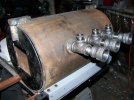
problem with a blown forge

Joined
Nov 14, 2007
Messages
588
Ok guys I need some help with this beast I’m trying to build….the forge chamber is around8 inches….I’m running a 2 inch pipe in one end of the forge that’s been reduced down to 1 ¼ and im injecting gas thru a 3/32 hole in the 2inch pipe just past the gate valve from the blower... the problem I’m having is the flame is wanting to jump back up in the pipe and make a “blowback” sound like a oxy acetylene torch… this only happens when the forge reaches a hot enough temperature that the reducer is igniting the gas mix before it exits the pipe…I’ve tried turning up the air and turning down the gas but I can’t maintain a constant temperature with a oxygen free atmosphere….I had thought of moving the “burner” back outside the forge chamber but I’m not sure if that would be the right thing to do …..Any suggestions?

Thanks ,
Lon
 
Sounds like your blower is not overcoming the backpressure generated by the forge when it gets up to heat.This iss often a problem when useing squirrel cage blowers.
Stan
 
the blower has enough ass.... if i open the valve more i make too much scale on the steel..or it starts burning the steel...im starting to think i might be adding too much gas?
 
I burned out the liner and coatings from my Ellis forge by burning too hot. I thought I had the blower & fuel mix just right but I should have suspected a problem when my steel got light yellow so fast.
Once I got a thermocouple it became astoundingly easy to get the right setup that saves my lining, my steel and propane use.

I guess I would recommend a thermocouple.
 
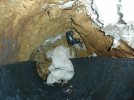
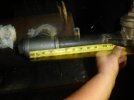
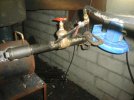
here are some pics...i dunno how a thermocouple is going to help...i know its too damn hot i cant controle it
 

Attachments

  • 001.jpg
    001.jpg
    50.3 KB · Views: 72
  • 002.jpg
    002.jpg
    26.9 KB · Views: 66
  • 003.jpg
    003.jpg
    41.8 KB · Views: 74
  • 005.jpg
    005.jpg
    36.7 KB · Views: 64
You could try installing a needle valve right behind your shut off valve to get better gas control.Also the Tee going into the forge may be causing a flow issue, should be an elbow instead.I run mine on 1-1/2 lbs on the regulator and fine tune with the needle valve,gate valve open about 2 turns.
Stan
 
Hey Lon good to visit this weekend with you. I have a blown forge in the works where I used a T-pipe (black iron) right off the pipe going into the forge. Off the t the propane will go in and will not have as far to travel as the setup that you have. The forced air will feed into the straight of the t. Here is a pic of it not yet completed but you can see how the propane will feed into the top of the t through a needle valve. The needle valve will give you much better control of the flow.
 

Attachments

  • forge_big.jpg
    forge_big.jpg
    45.2 KB · Views: 46
Not sure if this is the problem, but you might think about putting a concentric ring "flame holder" at the end of your pipe. I pipe mine in using 2", but set mine up with a flame holder and it seems to work great. I think it helps the problem of the fuel burning in the pipe.

-Mike
 
I would also recommend getting a needle valve for your propane. You will get much more controlled gas flow with a needle valve. I run about 3-4 lbs propane and open my gate valve 21/2 turns when starting up and slowly close it slightly as it warms up. I use Pyrometer as a guide for temp and adjust the gas and air so I have a 3-4 inch flame out the door which seems to be the perfect atmosphere so I dont scale too bad.
Chris
 
The first words that popped out to me were "injecting gas thru a 3/32 hole". If it is a blown burner, you don't inject the gas. Use a 1/8" or 1/4" pipe fitting and a needle valve to supply the gas to the burner. The gas needs free access to the burner. Get rid of the restriction and the burner will run much better.

The adjustments go like this ( best initially done with the burner clamped on a saw horse outside):

Turn on the air and choke the air valve down to about 1/4 open.

Light a propane torch ( for the ignition source).

While holding the torch in front of the burner, slowly open the gas needle valve.

Once the burner lights, make gas/air adjustments to get it burning smooth, and let it burn a few minutes to warm up.

Open the air and gas valves to get the burner balanced at full burn.

Once everything is OK, turn it off, let it cool, reinstall in the forge with the burner nozzle just shy of the inner chamber wall.

Re-ignite and adjust to run at the rate desired. It may be necessary to move the burner in or out a bit to get some sputtering and noises to disappear.
 
I had mine set up with the 1/4 inch tube going straight into the mixing chamber. This is a 3" nipple with the blower coming into one end and exiting to the forge on the other trough a 2 " bell reducer. Gas line goes through a ball valve into a needle valve then into the chamber. I use a gate valve to control the air flow and it is infinitely adjustable. I also have a "flame restriction" ring at the end of my 2" burner. Now I was able to adjust the burn OK but was not able to control it enough for my taste. It also was using a great deal more propane that my old setup. So I added a .07 orifice to the propane tube. This has made a huge difference. I can fire it up to 2500F easily but can turn it back and let it cook at 1500f with little or no adjustment of the gas airflow mix. This is without a thermocouple controller. I do have a temp prob but no control on the gas. I also have the burner tube just resting on the edge of the forge with space around for free airflow. My propane consumption has gotten much better. I am back to getting 3 days of forging out of my 100lb bottles. This is at least 6 hours of forging per day at welding temps. There are many designs out there and all of us have our pet units. You need to keep trying until you find the design that works best for you. Just keep it safe.

Sorry for the novel
 
Hi Lon,

The needle valve is needed to control the amount of gas while the regulator controls the pressure. When you set it up in this manner you will be able to find that sweet spot where your forge runs at it's full potential.

I like to insert the gas as close to the body of the forge as I can. I believe its easier to tune when this is the case.

Some thing that may or may not be of importance; I see the rear of the forge where the burner head comes in is closed. I had the last one I built closed off but found I could not control the temp. I believe the closed end causes a lot of back pressure from the burned fuel air mix having no where to exit, so its forcing the flame back up the burner pipe.


Good to chat with you this weekend. We had a great time and Moon got his KMG. He's thrilled.
Fred
 
Back
Top