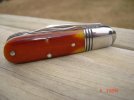
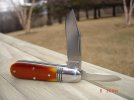
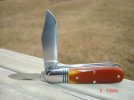
If there is dirt/grime/gunk in the pivot, give the knife a bath in hot water & dish detergent (like Ivory, Dawn, etc.). Open & close the blades while in the soapy water. You might open the pen blade to half-open position, before putting it in the water, just to make it easier to access that blade (it'll be hard to grip in the soapy water). Don't necessarily need to completely close it, while in there, but exercise it as much as you can. You want to maintain a good grip on the blade. If need be, you might even wrap that blade with something to help protect your fingers while exercising it. After that, rinse thoroughly in hot water, again exercising the joints. Then dry everything completely. Using the hot water will heat up the internals of the knife, which will speed evaporation and aid in drying it out afterwards. You can also use a hair dryer if you have one, to help dry it out. A light spritz of WD-40 into the pivot can flush out any remaining moisture, or you can accomplish the same with some isopropyl alcohol. Very lightly lube the pivots, after everything is dry.
I've always preferred to do it this way, as opposed to attempting to flush out the pivot with oil or WD-40 alone. Adding more oil to the gunk, without flushing it out after, can sometimes make it worse after the oil dries (makes more 'gunk' if any of the particles/compound/dirt gets left behind). Better to use the soap & water to get the joint as clean as possible, then lightly oil afterwards. I have used WD-40 to help flush out joints like this, but I always followed that with the soap & water bath.
For sharpening, unless you want to completely re-do the bevel on the blade, I'd recommend the Sharpmaker first. Easier for a novice to learn fairly quickly, and it should handle the touch-up on the new blade. The Lansky is very useful for re-bevelling (it's coarse & medium hones are much more aggressive than the Sharpmakers standard hones), but might be a little awkward initially, for someone looking for a relatively quick, simple solution for touching up the blade on a new knife.
You can also use some medium/fine grit wet/dry sandpaper, on a hard backing like glass, to sharpen most any blade. It is 'freehand' though, and if you've never done that before, it might be somewhat challenging initially. Still a very good thing to practice, using some less-precious knives (old kitchen knives are great for this).