
proper post-heat treat grind on thin blades?

Joined
Dec 21, 2006
Messages
3,158
Sometime in the future, once I'm caught up on orders, I plan on making myself a Japanese petty knife, very much like a Masamoto HC 150mm. These knives are thin to begin with, .065" at the spine and a full flat grind. I plan on using the steel I just received from Germany 1.2519 / 110WCrV5 / O-7. It is a carbon tool steel with a bit of tungsten and vanadium. This steel allows for very low edge angles, but certainly isn't an impact steel by any means. Probably best served as a kitchen slicer, or something like that. The steel is .063", so it will be heat treated before shaping of the bevels. My question comes when grinding after the heat treat has been completed.

What is the proper way to grind this thin blade down? Do one pass at a time on each side, flipping to the other side every pass? Do a few passes at a time, and then flip? Do most of one side first, then flip and do most of the other side?

This may be a matter of opinion, I don't know. My worry is the blade will want form a bow in it.....if I were to complete the grind on one side before switching to the other.

Your thoughts are much appreciated!!!

I thought I would include a pic of my personal knife and show it off. My first time using G10, and Cru Forge V. Knife is Aaron's Resolute model, used by permission. SAM_1219.jpg
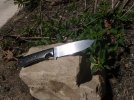
 
I would start with a sharp, fresh higher grit belt maybe, a 80- 120 grit ceramic belt and go slow, dunking every pass. Changing sides after every pass is probably a good idea since there is so little room for error with stock that thin.
 
Sometime in the future, once I'm caught up on orders, I plan on making myself a Japanese petty knife, very much like a Masamoto HC 150mm. These knives are thin to begin with, .065" at the spine and a full flat grind. I plan on using the steel I just received from Germany 1.2519 / 110WCrV5 / O-7. It is a carbon tool steel with a bit of tungsten and vanadium. This steel allows for very low edge angles, but certainly isn't an impact steel by any means. Probably best served as a kitchen slicer, or something like that. The steel is .063", so it will be heat treated before shaping of the bevels. My question comes when grinding after the heat treat has been completed.

What is the proper way to grind this thin blade down? Do one pass at a time on each side, flipping to the other side every pass? Do a few passes at a time, and then flip? Do most of one side first, then flip and do most of the other side?

This may be a matter of opinion, I don't know. My worry is the blade will want form a bow in it.....if I were to complete the grind on one side before switching to the other.

Your thoughts are much appreciated!!!

I thought I would include a pic of my personal knife and show it off. My first time using G10, and Cru Forge V. Knife is Aaron's Resolute model, used by permission. View attachment 424563

I do quite a bit of hollow ground straight razors and small kitchens knives and I start with a fresh 60 grit belt. You have to be mindful of your edge thickness and how much material must be removed to clean the scratches off from the previous grit. When possible, use a heatsink and remember to dunk into cold clean water after every few passes. In regards to bowing, I have had issues with it when using thinner stock; just swap sides every few passes.
 
Use fresh 120 Blue Zirc belts. Make a pass and dip the blade. I do a few passes on a side, then flip. Take your time, grind on a slower speed, and don't get it hot. Clean up on 220 and 320 belts. Once you have the basic bevel, switch to stones and/or paper.
 
What the other fellows said. I certainly wouldn't go any coarser than 60 grit. Cool is the rule, and one pass per side, then dunk surely won't hurt anything.

I also hold thin blades with a rigid welding magnet to prevent them from flexing while grinding (whether they're hardened already or not).
 
Use fresh 120 Blue Zirc belts. Make a pass and dip the blade. I do a few passes on a side, then flip. Take your time, grind on a slower speed, and don't get it hot. Clean up on 220 and 320 belts. Once you have the basic bevel, switch to stones and/or paper.

Stacy, is there an advantage in going with Zirc belts at 120 rather than ceramic? I like using 60g Zirc for stainless when grinding larger blades pre-heat treatment but had not given it much thought post ht. Thanks in advance.
 
Probably not. I use the 120 grit blue zirconium belts with great success, so I recommend them. I find they grind cleaner, faster, and cooler than a 80 grit ceramic belt. They are my go-to belt for flattening and cutting in bevels.
 
Thank you Stacy, I'll have to give them a try. I sure hate paying a higher price for ceramic if zirc can do the same or better.
 
Thank you for your help. I will go a few swipes at a time. I suppose I should mention my "grinder" is a Delta 4x36. Of course, it only has one speed, 3450rpm. I think that is kind of fast....no? I'm not familiar with 2x72 knife maker's grinders and the speeds they run at. Originally I was planning on using these 36 grit ceramic belts at the local borg store. I've used them before, and they can really remove the material. Do you guys think 36 is too coarse? They have a 80 grit, a 120 grit, and I THINK 60grit. I will go to a finer grit if you think 36 is too much. Carbonsteel...thank you for the reminder to leave material for the next grits. I don't have one of those awesome grinder/welder magnets. Need to get one. As far as a heat sink....I hadn't thought of that at all. I would think that a piece of scrap metal held against the blade will grinding will help keep it straight and help, if just a little, with heat sink. Again....thank you all. Should I use a finer grit than 36 for initial stock removal on a 63 rc blade?
 
Try it out on a blade and see what happens, but expect the blade to be severely affected by heat.

IMHO, a 4X36 running at 3450RPM is not the tool to try and bevel an Rc63 blade.

I think a set of stones or DMT plates would be far better choice.
 
Stacy, your opinion is a carbon copy of my opinion.....a Delta 4x36 is not the tool for the job. However, it is what I have at the moment. I do have the DMT extra extra coarse stone which is 120 grit. I would think that would take forever, especially on a blade that will be tempered to a high RC like 63 or so. And I always worry about wearing the diamond out....even when sharpening knives. I tend to baby them. Would the stone be pretty much done with after using it to bevel a 150mm petty knife, or is the diamond so hard I won't hardly notice?

I am nervous about this for sure, but like I said, it will be maybe a month before I can start on it. I am making my dad the same knife in 1095 beforehand, and I will experiment with my grinder and grits, and report the results. I hear you, Stacy, but it is my only option, besides your DMT recommendation. I thought of cutting the bevels before heat treat, if not all the way down, but I don't think that is a good idea. I'm going to harden the blade, and then see what I can do. No gloves, water handy, heat sink handy, and patience. If nothing else, a friend of mine in Del Rio Texas has been making knives for years. Bill Nyman of Ringtail Knives. He has a couple of Burr King grinders and said I can use them anytime. He is 3 hours away, tho.

Out of curiosity, you guys with variable speed control on your grinders, what speed would you run to bevel a blade at 63rc? Much lower than 3450, I assume.
 
Yep, when I grind hardened blades I grind at about 1000-1500 with 60X belts and reduce the speed as I progress through the grits. By the time I get to 400X I'm only running at about 700-800 SFPM. If you take a blade to less than .010" at 3450 you're gonna get it too hot and ruin it.
 
Thanks, Darrin. What I am going to do is be very careful in the major stock removal with the grinder. Once it gets to a certain point....I may switch over to the DMT 120 grit stone. You can't wire in a rheostat (spelling?) and expect to vary the speed of the motor...right? It's more involved than that isn't it?

As far as grinding on my 4x36 running at 3450 rpm....pressure is a function of heat as well. I feel like I can vary the amount of material removal/heat buildup with the amount of pressure applied to the platen. Which, by the way, I recently made dead flat with files, sandpaper, and straight edge checks while doing it.

While I will not even begin to attempt my complete grind with this grinder.....I feel that I can get the bulk of it removed without heat problems.

Then there is the complete other school of thought......go ahead and grind the bevels and edge down to maybe .040, or 030....pre-heat treat. Hey....you guys are the experts at grinding, heat treating, and over all knife making.....and I am here to learn. Your recommendations are always taken to heart. I hate the fact that when resonding to other people online, body languange, tone of voice, etc...are left out. I really appreciate the knowlegdge you guys give out. I've always said it...I always will. It means more than you know....to me.
 
Last edited:
Thanks, Darrin. What I am going to do is be very careful in the major stock removal with the grinder. Once it gets to a certain point....I may switch over to the DMT 120 grit stone. You can't wire in a rheostat (spelling?) and expect to vary the speed of the motor...right? It's more involved than that isn't it?

As far as grinding on my 4x36 running at 3450 rpm....pressure is a function of heat as well. I feel like I can vary the amount of material removal/heat buildup with the amount of pressure applied to the platen. Which, by the way, I recently made dead flat with files, sandpaper, and straight edge checks while doing it.

While I will not even begin to attempt my complete grind with this grinder.....I feel that I can get the bulk of it removed without heat problems.

Then there is the complete other school of thought......go ahead and grind the bevels and edge down to maybe .040, or 030....pre-heat treat. Hey....you guys are the experts at grinding, heat treating, and over all knife making.....and I am here to learn. Your recommendations are always taken to heart. I hate the fact that when resonding to other people online, body languange, tone of voice, etc...are left out. I really appreciate the knowlegdge you guys give out. I've always said it...I always will. It means more than you know....to me.

That sounds like a good way to do it Stuart. Pressure does have a lot to do with heat but I find that if I try to grind with pressure that light I don't get a good flat grind. But thats just me.
You're very right about emotion and body language. I believe that a lack thereof are the main reason 90+% of the forum squabbles. If the same two people said the same words face to face instead of typing them in B&W they would never even break stride.
Be sure to let us know how the blade comes out and what actually worked the best.
 
Just to give an update to Darrin, Stacy, and the others who helped me out. I wanted to practice on 1095 before I totally messed up this 1.2519 I have. I guess that would be O-7 here in the states. Hardened the 1095. I did 1600F cool to black, 1500F cool to black, 1400F cool to black, and 1475 for 15 minutes into room temp Parks 50. No warping at all. Tempered for an hour at 350, then checked it.....small decarb layer then hit rock hard steel. Cleaned off all scale to determine tempering colours. Back into oven at 400F for an hour. Have no idea what the RC is, but it should be 60-61 or so. Went to the 36 grit belt running at Mach 5 and was able to cut bevels, a few passes on each side at a time, down to an edge about .015. I could tell it was getting a little warm, so I stopped. I used bare hands, never even let it build up any heat at all. This being my first time grinding freehand after heat treat, and it went very well. Next I'll grind the flats down to almost zero using a combination of the 80 grit paper laid flat on granite, and the DMT. I'll update with pics once it's done.
 
I think you are on the right track for your equipment. You dont want a higher grit belt anywhere near that steel at those speeds. The way I do it on a 2x72 is to grind the bevels in with a 50 or 60 grit going very fast. It cuts fast but does not build heat as fast, so light passes until I get essentially the final geometry. Then I slow the grinder down and go to a165 trizac. I am only trying to get scratches out, not establish or change geometry. Once the 50 grit scratched out, I slow the grinder way down and do the final belt polish on a65 then a45.
 
Thanks John! BTW, I have a correction to make. The belt speed on the 4x36 sander is 2000rpm. The motor speed, which is what I originally saw on the side of the sander, is 3450RPM.

2000 RPM is still very fast, from what you guys are telling me.
 
Your 4X36" belt sander runs at 2000 SFPM.

2000RPM on a 36" belt is 7200SFPM.....which would burn the bearings out of it.
 
I don't know about burning bearings out of things. My belt sander says RPM 3450. I assume that is motor RPM. Online it says belt speed is 2000 SFPM and the disc grinder just over 3,000RPM. All I know is....what I did, with the equipment I have....worked.
 
Last edited:
Thanks John! BTW, I have a correction to make. The belt speed on the 4x36 sander is 2000rpm. The motor speed, which is what I originally saw on the side of the sander, is 3450RPM.

2000 RPM
is still very fast, from what you guys are telling me.

That was what I was correcting. Your motor runs at 3450 revolutions per minute, the belt moves at 2000 surface feet per minute....very different things. The bearings on the belt rollers would have to be very good grade and well lubricated to survive continuously running at a speed to allow the belt to run 2000 RPM, which for a 36" belt would be 7200 SFPM. The disc sander is rotational, and is rated in RPM.
 
Back
Top