Pump for a quench tank

Joined
Jun 20, 2007
Messages
1,361
I am putting together a new quench tank. It will have a heater and I am looking for a circulating pump. Having said that I am looking for a pump that meets the following criteria:

able to run on 110-120V AC current

prefer a thru-wall mount or able to be mounted externally and hooked up by plumbing to tank ( thus allowing for maintenance and easy removal if need be)

moves 500 GPH minimum and possibly more

small to minimize size and weight

can handle temps of up to 150*

$50.00 or less in cost


Maybe some of you remember seeing this when it was posted!

http://www.dave-larsen.com/StuffbyDaveLarsen/Quench1.html

I recently emailed him and he says it is still running well. The only thing in his post when you get to where he talks of the pump he says and I quote, Post-Build Note: This is a 500 GPH garden fountain pump. If I had it to do over again I’d buy a much more powerful pump, because, while it does move the oil, it moves it rather too slowly for my taste

For the last three days I have been trying to find a pump that would meet my criteria. So far I haven't found anything that will meet all the criteria. Anyone using a pump on there quench tank that wants to offer up the make and model, it would be greatly appreciated. Or maybe you have a suggestion for such a pump! I am open to any and all discussion for the pump! I want to put together something that works and works well.
 
500 GPH and minimum size don't go together. $50 or less does not go with a sealed 120VAC oil pump for hot oil.

How huge will this tank be?

What I use to circulate my oil is a 12VDC fuel pump from an automotive supply. It is run from a yard sale battery charger. It pumps about 100GPH. I also added a transmission oil cooler to the oil line that can be by-pass switched to cool the oil during multiple quenches. The tank holds 10 gallons.
The piping is a "J" of copper pipe that goes down the inside of the quench tank. It clips onto the edge. The outlet of this "J" sits in the center of the tank bottom, aiming up. The return is a "U" of pipe that is connected to the pump intake. It just goes about 4" down the oil. The pump creates the maximum cooling along the blade. The oil pump and cooler are connected together with 1/2" neoprene fuel line and clamp on bibb fittings.
 
8 gpm, 150°F and no meaningful head pressure on the pump circulating a tank at atmospheric pressure?

Those little Bell and Gossett circulating pumps that people install on their water heaters will meet those specs. 1/12 hp 250° max temp, bronze impeller.
 
Those circulating pumps are probably right on but WOW the price is a lot more than $50.00.

Stacy the tank is going to made from a stand alone fuel tank I picked up at the flea market this weekend. It is about 11" in diameter and 5' or 60" in length.

OK if my calculations are correct it will take approximately some where between 24-25 inches of liquid in this 11" diameter tank to equal about 10 gals. That should give me enough depth to quench pretty much anything I am going to make.

Let me approach this in a different manner and ask some questions.

The reason I refrenced (500GPH plus) is the post that Dave Larsen had made about he would like to have more with his setup.
How many GPM do you need to move if you are only doing one knife at a time most of the time?

What kind of electric fuel pump are you talking about?

Another question is there such a thing as a converter from 110-120 AC to 12V DC besides a battery charger? (I don't have a car battery charger)

Could a battery charger for a cordless drill be hooked up as such a converter? (Thinking out loud on that last one)
 
Last edited:
Look into a pump from a parts washer. It will do everything you mentioned. Actually, you might be able to get a benchtop parts washer complete for around $100 and that will have everything you need for a complete quench tank included in it, except for a way to heat the quenchant..Time to buy a water heater element for a fish tank :)
 
Mike I took a look at the pumps for a parts washer and I think they may just fit the bill, thanks! They have one that might just work for a little better than $50.00!

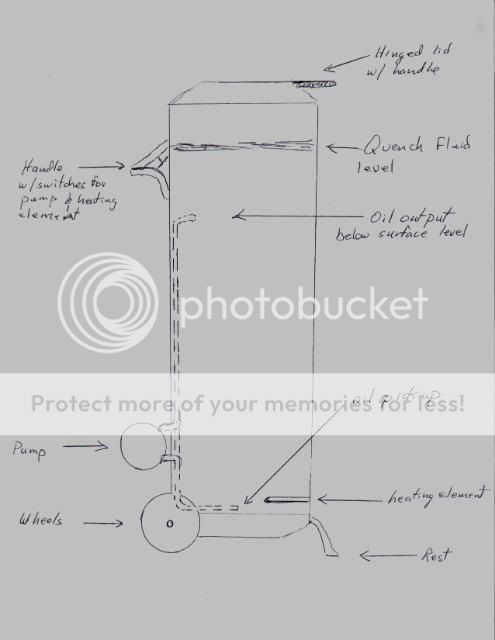
Stacy here is what I have designed for the quench tank. It is a lot like a stand up compressor. This is a crude hand drawn sketch of what I have in mind.


Quenchtank.jpg


So what do you all think?
 
Looks good but you might wanna move the p/u a little higher to keep it from getting clogged with scale or bits of clay that fall off the blade when quenching. After you get the bugs worked out and find a steady supply of parts i bet you could sell a few.
 
Yes I agree Darrin. I plan on bringing it up off the bottom some, and maybe putting a shield over the top, like I said its a rough drawing. I have been thinking about this for a while.

I was out last Sat. for a doctors appointment. I had a little time to kill so stopped at one flea market. Managed to pick up a brand new still in the package heating element for a $1.50. Went to my appointment and on the way back I passed by another flea market and spotted this tank. I hung a U turn and went back. The guy wanted $25.00 for it. I offered him $10.00 he countered with $15..00. I told him no I feel comfortable at $10.00 but that's it. I started to walk off and he says OK. So so far I $11.50 into this build. When I start it I am going to do a WIP on the quench tank build.
 
I don't get it, if you aren't using a cooling array why do you need to pipe the oil out and back into the tank? What I used to do on m plating tanks was just take a plastic (you could use a plain metal one) handheld blender, or just a small motor with a plastic shaft and propeller into the tank to agitate and circulate the solution. A cheap cordless drill with a squirrel wheel paint mixer will move much more oil than your little pump.


-Xander
 
My idea on that is two fold the circulation helps too cool overheating and it will also ensure a more consistent temp of the oil if used during multiple quenchs and the movement of the oil close to the surface of the oil helps in the agitation that you need during the quench. The idea of the pump being exterior as in the drawing is to facilitate if the need arises to remove the pump for maintenance of replacement. I said it was a crude drawing mostly for my purposes. Not shown in that drawing there will be a valve that can be opened or closed to shut off the oil. Thus allowing for removal of the pump should it become necessary with only minimal lose of oil. If I find it necessary to add a cooler with this sit up I will have only to add it in and replumb the hookup.
 
The oil flow needs to be the other direction than drawn. It should exit the pump in the bottom center and jet straight up the center of the tank. The return should be at the side near the top. This causes the oil to run along the quenched blade. It speeds and evens the quench.
 
The oil flow needs to be the other direction than drawn. It should exit the pump in the bottom center and jet straight up the center of the tank. The return should be at the side near the top. This causes the oil to run along the quenched blade. It speeds and evens the quench.


Well I am beginning to think I never should have never posted this drawing. The drawing is crude and is basically for my purposes.[/B]My idea is the pickup is at the bottom of the tank and the return is below surface at the top.

OK I went back and looked at my drawing and now I am confused. Stacy you are saying the pickup needs to exactly opposite of what I have drawn. And thinking about the way you worded your explanation. If the pump returns it from the bottom in an upturned pipe I can see where the flow would be directed back to the surface. However I am not convinced at how far up this returning stream would travel! If it does go high enough that idea works well.

My idea was that with it flowing in at the top under the surface (my thoughts was a slightly downward turn the pipe returning the flow) would aid in the agitation as well. I see your point on this Stacy but I would love to hear a little more! I am thinking by your explanation you feel that your direction would make more mid point agitation and the way I have it would make more surface agitation. I could use a little clarification as too which direction works better and why. Now you really have me really questioning which direction is better for the most agitation, but this is good as I want to get this build right the first time!
 
Last edited:
The way I read Stacy's first post is that the pump tubing enters and exits from the top of the tank.

this would prevent having any sealing or leakage problems you would have if you piped it through the side of the tank.


and

assuming contamination of one oil with another is not a big problem, it would be movable between 2 quench tanks
(2 different quench oil speeds )
 
Count, I see what you are talking about but I wanted the pump low for balance reasons. The pump will have a valve on either side (not shown on the drawing) of it that can be closed for removal of the pump should it be needed and that will allow for minimal loss of quench oil! My main concern now that Stacy raised the issue is direction of flow and why one is better than the other. I want maximum agitation and now I am questioning myself which direction of flow would be better for that. I can visualize both in my head and now I think about it Stacy may be right with it coming out from the bottom and rising in a stream. From the top down would be more close to the surface agitation, and not sure the flow would encompass the entire blade on a longer blade.

I may have to do some testing to try and figure this out. My head is beginning to ache so will have to ponder on this some more later!
 
I just looked at the drawing again. Your heat element is on the bottom. So why the pump? I ask because it seems to me, if you were to mount just about any old metal fan blade on the end of a shaft driven from above the tank could be used to de-stratify the quenchant, the fluid convection will manage the rest of the work. though it does seem to require a change in the design of the vessel to ensure the pumping action and the quenching action don't interfere with one another.

Also a fan blade mixer would require less maintanence than a pump, and not be prone to particulate troubles.
 
Your sketch is fine.
My first post was about a removable pump system. It works just like a plumbed one, but there are no through the wall fittings.

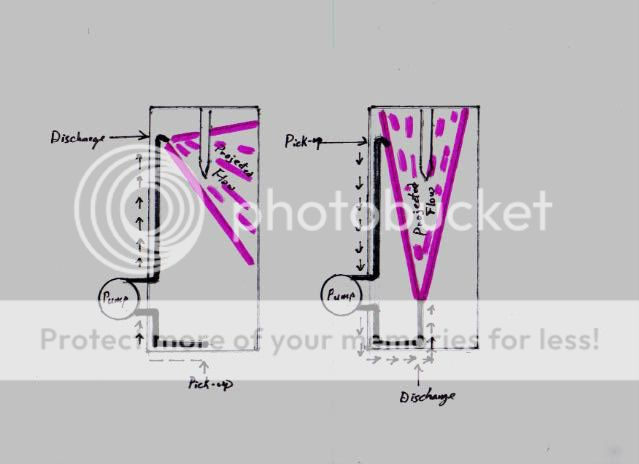
Lets go to your drawing for clarity. The way is should run is:

The oil is drawn FROM the top of the tank.
It goes down through the pump.
It comes OUT the fitting at the tank bottom.
There is a 90 degree bend pointing UP the tank from the center bottom.


The stream from the bottom will cause all the oil in the tank to circulate up the center, and down the sides. This will create the optimal agitation and quenching situation.

If the pump expelled the oil at the top and sucked it in from the bottom, there would never be even circulation.
The center jet can be a piece of copper plumbing tubing with an elbow on the end. Just friction fit it into the pipe coming through wall. The elbow doesn't need to be soldered if it fits snug.

All your drawing needs is to have the flow reversed, and add an upward nipple to the bottom pipe. The top pipe nipple should be drawing the oil along the perimeter of the tank if possible, but it won't really matter if it sticks straight out as drawn.


Now, what if someone took an old hot-tub and filled it with 500 gallons of oil, and set the heater to 130F, and..............Just thinking outside the box.

BTW, an old electric hot water heater ( or a new one) has the tank, fittings, thermostat, and heater element needed to make one just like you are making. All you need is to cut out the top.
 
Your sketch is fine.
My first post was about a removable pump system. It works just like a plumbed one, but there are no through the wall fittings.

Lets go to your drawing for clarity. The way is should run is:

The oil is drawn FROM the top of the tank.
It goes down through the pump.
It comes OUT the fitting at the tank bottom.
There is a 90 degree bend pointing UP the tank from the center bottom.


The stream from the bottom will cause all the oil in the tank to circulate up the center, and down the sides. This will create the optimal agitation and quenching situation.

If the pump expelled the oil at the top and sucked it in from the bottom, there would never be even circulation.
The center jet can be a piece of copper plumbing tubing with an elbow on the end. Just friction fit it into the pipe coming through wall. The elbow doesn't need to be soldered if it fits snug.

All your drawing needs is to have the flow reversed, and add an upward nipple to the bottom pipe. The top pipe nipple should be drawing the oil along the perimeter of the tank if possible, but it won't really matter if it sticks straight out as drawn.


Now, what if someone took an old hot-tub and filled it with 500 gallons of oil, and set the heater to 130F, and..............Just thinking outside the box.

BTW, an old electric hot water heater ( or a new one) has the tank, fittings, thermostat, and heater element needed to make one just like you are making. All you need is to cut out the top.

First thing there will be thru wall fitting for the pump to connect when I get done welding them into place.

Second thing I know where there is an appliance grave yard. If I can find an old water heater I may be able to cut the flange from it and weld it to my tank. If not I will have to fabricate one from scratch. Then I can use the new element I bought at the flea market the other day. Most of the time when a hot water heater is replaced it is because it leaks and usually the thermostat is still good. This graveyard is for an apartment complex and they use the under the counter heaters so underthings so work to swap over just fine.


OK Stacy I have been giving it some thought and here is another crude drawing. Sometimes my brain need visual stimuli so I took the time to do this drawing and here is what my thoughts are. I have convinced myself after doing the drawing that you are correct in the direction of the oil feed. Yes ladies and gentleman Uncle Stacy is right again.:D
Pickup at top and discharge at the bottom this will give a better flow to the oil allowing for a more equal quench. Here is the drawing!

Quenchtank-1.jpg
 
You got it now, bud.

More things to add to your list:
Weld a 3/4" pipe coupling to the tank at the bottom edge, and put on a drain valve. That way you can drain the oil as needed to clean the crud out of the tank.

Make a good, snug fitting cover. This will put out flare-ups ( unlikely), as well as keep trash and critters out ( likely).

Weld a 1/2" or 1/4" coupling to the center area of the tank and install a screw in TC or plain old dial thermometer.
Examples:
http://www.ebay.com/itm/2-Bimetal-t...213?pt=LH_DefaultDomain_0&hash=item415fdce0bd
http://www.ebay.com/itm/J-Type-Ther...150?pt=LH_DefaultDomain_2&hash=item4ab31eec56
(for reference only, cheaper ones are found) http://www.ebay.com/itm/Stewart-War...Parts_Accessories&vxp=mtr&hash=item4cfd9ce970
 
Thanks for sharing your R&D with us Dixieblade57. (Sorry, my participation on BF is such that I've missed your name.) These open explorations are helpful to many of us.

I always wonder about how hot water heater elements work. Do they heat by just being fully on (high heat temp) and stay fully on until the liquid reaches the target temp when they are shut off via the thermostat? If so, wouldn't that accelerate oil degradation? I believe I've read quenchent specs that refer to heating temp specifications cautioning using too high a heat. Maybe it's a mute point because hot water heating element heat with low temps? I wonder what folks thoughts are on this. Thanks, Phil
 
Phil,

Water heaters have many configurations, multi-staged elements, upper and lower elements, and single elements. Careful planning and checking of the wiring diagram, maybe coupled with some experimentation would easily determine the "elements" operating temperature.

I am still wondering what the objective of the design is, destratification of the fluid, flow (for some other purpose), or uniform temperature?
 
Back
Top