After buggering my plunge cuts on my first knife in 15 years or so, I realized I need some kind of guide (which of course I knew but hoped I could get away without) to keep them straight and even. I've got little bits of 1080 and other steel laying around, and came up with an idea that is either brilliant or stupid, depending on whether it works or not. What would happen if I superglued steel scraps to my knife-to-be in place of a jig, and then ground as usual? Seems to me the superglue would stick long enough to be effective for a jig, and would come off easily with a soft sheer blow. Anybody ever try this?

-
The BladeForums.com 2024 Traditional Knife is available! Price is $250 ea (shipped within CONUS).
Order here: https://www.bladeforums.com/help/2024-traditional/
You are using an out of date browser. It may not display this or other websites correctly.
You should upgrade or use an alternative browser.
You should upgrade or use an alternative browser.
Punge cut guide idea...
- Thread starter wordsmith
- Start date

- Joined
- Oct 6, 2008
- Messages
- 4,076
Make or buy a fileguide like this. I think it would be a pain to glue two pieces of steel on either side of a blade and get them nice and square. The file guides stay nice and straight/square in use. :thumbup: I have one like in that link, and I like it very much.

- Joined
- Dec 25, 2004
- Messages
- 1,363
I dont think super glue would withstand the heat of grinding, and also I dont think it is necessary to glue guide to knife. A simple jig is mostly used by knife makers. I too used this kind of jig before. These days I dont use any jig as my hands have learned how to plunge evenly with freehand grinding. The jig was something like the attachment...
Attachments
- Joined
- Oct 6, 2008
- Messages
- 4,076
Richard, I really like the carbide faces/inserts idea you told me about. If you need someone to test drive your prototype, just let me know. 

- Joined
- Jun 2, 2007
- Messages
- 1,354
is it possible to accidently grind into the file guide when using it to grind a plunge line if the belt is riding a little overlapped on the platen?

- Joined
- Dec 5, 2008
- Messages
- 1,597
That's definitely possible, and likely. I made a jig to hold angles (Look for my thread about it if you care) and I've hit the edge quite a few times. Nothing really happens, and it's only 1/8" thick. You just want to try to miss the screws or go too deep.
- Joined
- Jun 2, 2007
- Messages
- 1,354
Been thinking about making some to file the slots for guards....1/4" stock or 3/8" ?!@?!?@
pohan, i have one made from unhardeded d2 and its been chewed on by my disc sander several times. thats why i'm going to carbide inserts. if one side gets worn down you flip it over and silver solder it back into place. i can also surface grind them flat again if they arent too bad.

Bill DeShivs
Knifemaker / Craftsman / Service Provider
- Joined
- Jun 6, 2000
- Messages
- 12,958
You can make a guide out of 2 pieces of angle iron, drilled to accept screws (or bolts) and nuts. Just tighten it down on the blade. If it wears out, just make another.
Superglued guides will fall off the first time you try to grind and the blade gets hot.
Superglued guides will fall off the first time you try to grind and the blade gets hot.
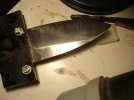
Just an update, I tried my superglue scraps method and it worked great, to a point. The point at which it failed would also have failed with a better two piece bolted guide, and that is because my belts don't run down the center of my platen, and the platen is wider than my belts. The guide would have to be offset to accommodate for different spacing, and I can freehand them almost as well anyway. Heat and glue release was NOT a problem, and I'm still convinced the idea is sound with some modification.

- Joined
- Jun 16, 2008
- Messages
- 3,415
Another member used the file guides with a round file. Carved out the plunges on both sides, then free hand grinding the bevel. You already have the plunges set jus grind down until you are even with them. Just don't get close enough to the plung t mess up the nice round shape it gives you. I tried it on three blades this weekend and it worked out great. Thanks to Paul(p j 234) for the great idea.
-frank
-frank