Puukko Handle Shapes?

Joined
Jul 28, 2011
Messages
5,782
A poorly formed question for the Puukko fans and experts among us...

What are the names, stories, significance and reasons for the different handle shapes I see on Puukkos?

In looking around at the various threads and retail outlets about information on Puukkos, I notice that the shapes of the handles can vary. I see several recurring styles and am wondering if they have names and if the different styles are associated with different uses such as carpentry, fishing/boatwork or hunting?

Here are the ones I'm seeing and obviously, this list isn't exhaustive. Would love to be pointed to a full list though.

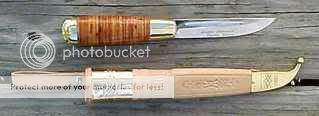
"Bird's Head Pommel"? This looks like the US stacked leather knives like those made by Western that are sometimes called bird's head pommels.
p124507370-4.jpg


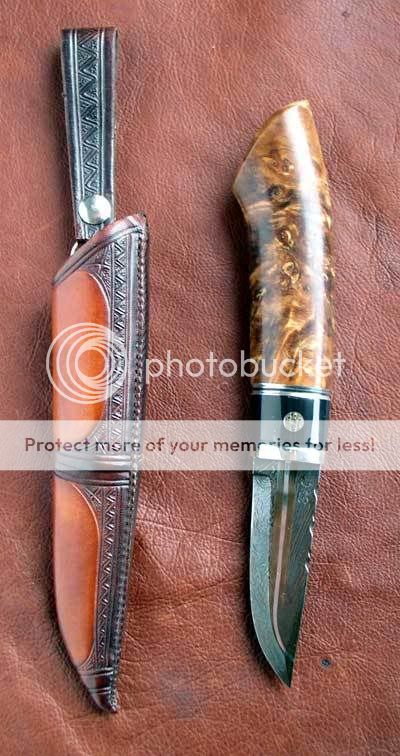
Here's another, very similar.
IMG_2437_zps04c7e270.jpg


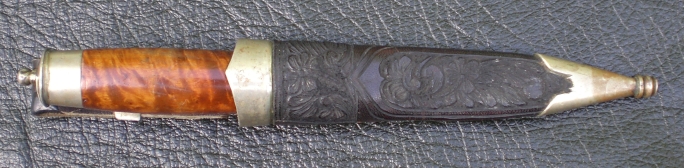
I'm calling this one "barrel". I see this a lot. Thicker in the center like a barrel.
4d2dbe63.jpg


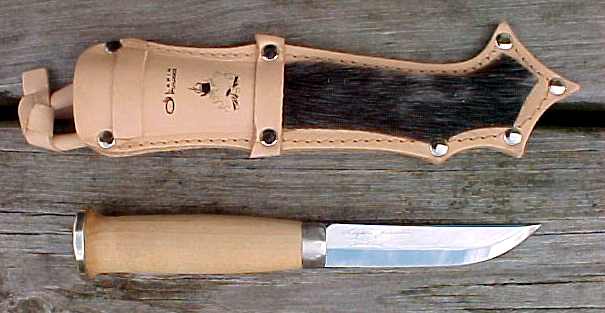
I'm calling this one "crown pommel". I just made that up. The butt end looks like a crown to me.
standard.jpg


And I'm calling this one "straight" for obvious reasons.
klc05358_tapio_wirkkala_design_puukko_ce_pop_up.jpg


And I'm calling this one the "Loveless" because it reminds of a Loveless knife but I'm guessing Loveless copied, er, was inspired by this design?
1242.jpg
 
Interessting topic. Pinnah, your 2nd & 3rd pics aren't showing to me.
Pics are working now.
 
Last edited:
Check out the Helle Jubileumkniven. Very interesting geometric handle. Interesting shape, but it might cause some bad hot spots under use. I have one of the early ones (possibly 1965) that I traded into at a gunshow.

Don't forget the barrel shaped ones with a horsehead.
 
Some puukko handle shapes started out as regional styles. IIRC, your "bird's head" was from western Finland - Ostrobothnia.

Finnish knives from the northern areas where the Lapp people lived tended to have a pronounced swell on the pommel end.
https://www.google.com/search?q=leu...4EtHQkQfZjoHoAQ&ved=0CCsQsAQ&biw=1680&bih=948

A handle with any sort of enlarged pommel end is less likely to slide out of you hand when doing draw cuts, especially with gloves on.

The "barrel" is a Fininsh style. The center swell keeps the knife in place on draw cuts.

Your "straight" was designed by a famous modern artist and designer, Tapio Wirkkala. It's his impression of a puukko with a traditional blade. It was manufactured by a first-rate Swedish manufacturer. http://en.wikipedia.org/wiki/Tapio_Wirkkala

The "crown" is Swedish. Norwegians make much the same. Finns would deny that it's a puukko, and the Norwegians and Swedes don't call them "puukko" (plr. "puukot"). They call them "kniven."

"Loveless" does not remind me of any iconic Bob Loveless designs, but he made so many knives he probably made one like it. It's a traditional puukko blade got up in a non-traditional handle. The next step was to clip the point so it looked even more foreign to a Finn. But Scandinavian and Finnish makers have always been willing to make non-traditional knives for foreign markets. They even make occasional "Scandi grind" knives to suit foreign tastes.
 
Last edited:
I recommend book Knifemaking by Bo Bergman( if you can find one),lot of good info :thumbup:
i like that name Bird's Head pommel,another one i heard (read) somewhere is salmon(shaped) handle,
it is common to use animal figures as decoration pommels or just flared and enlarged to help pull knife from tight fit sheaths.

but barrel as most simple and versatile shape is probably The Handle,

jfk-with-puukko.jpg


spot horsehead puuko on president's desk
 
Interesting...i understand that the horse head pommel was started as a tribute of some sort to an English officer whose cane had a horse head pommel...im not sure if this is correct?.......FES

 
Some puukko handle shapes started out as regional styles.

Thomas, thank you for such an informative and helpful response!! Additional questions inline...


IIRC, your "bird's head" was from western Finland - Ostrobothnia.

I associate it with the Marttiini/Rapalla fillet knives (my only exposure to Finnish knives, really).

Would it be correct to associate this style with fishing and boat work in ways that other regional Finnish styles might not be?

Finnish knives from the northern areas where the Lapp people lived tended to have a pronounced swell on the pommel end.

The "crown" is Swedish. Norwegians make much the same. Finns would deny that it's a puukko, and the Norwegians and Swedes don't call them "puukko" (plr. "puukot"). They call them "kniven."


Is the primary distinction between these a) a flat butt end on the former and a pointed butt end on the latter or b) a decorative end cap material of metal or bone on the latter?


The "barrel" is a Finish style. The center swell keeps the knife in place on draw cuts.

By Finnish, do you mean central or eastern Finnish? Is this more of a woodland design?


Your "straight" was designed by a famous modern artist and designer, Tapio Wirkkala. It's his impression of a puukko with a traditional blade. It was manufactured by a first-rate Swedish manufacturer. http://en.wikipedia.org/wiki/Tapio_Wirkkala

Who knew? Super, super interesting.


"Loveless" does not remind me of any iconic Bob Loveless designs, but he made so many knives he probably made one like it. It's a traditional puukko blade got up in a non-traditional handle. The next step was to clip the point so it looked even more foreign to a Finn. But Scandinavian and Finnish makers have always been willing to make non-traditional knives for foreign markets. They even make occasional "Scandi grind" knives to suit foreign tastes.

Coiuld you say more about grinds? Do Finnish puukkos use a full pure scandi (sharpend the full face to the edge) or is more convexed in practice more towards a saber grind and "mirco beveled" edge?

Regarding Loveless, I was thinking of the back slanted profile of the handle butt. In a book by Loveless, he claims to have stumbled on it for no good reason but I've seen several "puukkos" with that sort of back slant and it got me wondering who used who for inspiration.
drop-point-front.jpg
 
Some puukko handle shapes started out as regional styles. IIRC, your "bird's head" was from western Finland - Ostrobothnia.

Finnish knives from the northern areas where the Lapp people lived tended to have a pronounced swell on the pommel end.
https://www.google.com/search?q=leu...4EtHQkQfZjoHoAQ&ved=0CCsQsAQ&biw=1680&bih=948

A handle with any sort of enlarged pommel end is less likely to slide out of you hand when doing draw cuts, especially with gloves on.

The "barrel" is a Finish style. The center swell keeps the knife in place on draw cuts.

Your "straight" was designed by a famous modern artist and designer, Tapio Wirkkala. It's his impression of a puukko with a traditional blade. It was manufactured by a first-rate Swedish manufacturer. http://en.wikipedia.org/wiki/Tapio_Wirkkala

The "crown" is Swedish. Norwegians make much the same. Finns would deny that it's a puukko, and the Norwegians and Swedes don't call them "puukko" (plr. "puukot"). They call them "kniven."

"Loveless" does not remind me of any iconic Bob Loveless designs, but he made so many knives he probably made one like it. It's a traditional puukko blade got up in a non-traditional handle. The next step was to clip the point so it looked even more foreign to a Finn. But Scandinavian and Finnish makers have always been willing to make non-traditional knives for foreign markets. They even make occasional "Scandi grind" knives to suit foreign tastes.

I always love to see some Scandinavian stuff on here as a Sweed I can give some light on some stuff, for whats its worth :) "Kniv" is just the general word for knife, "kniven" whould be translated
to "the knife" or "a knife" a specific knife that is. Alot of ppl here especially non knife ppl would call everything a "mora" lol
 
The "crown" is Swedish. Norwegians make much the same. Finns would deny that it's a puukko, and the Norwegians and Swedes don't call them "puukko" (plr. "puukot"). They call them "kniven."

Actually, we don't have a specific name for that kind of knife. "Kniven" just means "the knife" in Swedish, without any particular style in mind.
 
The grandfather style knife always struck me as a useful small fixed blade. Helle Nying, Roselli Grandfather. Sort of a flattened oval shape. I've seen one reference to it being designed for fisherman, but I think as its name implies, a design that's easier for arthritic hands to grip.
 
Actually, we don't have a specific name for that kind of knife. "Kniven" just means "the knife" in Swedish, without any particular style in mind.

That is what I meant to convey. Sorry that I was unclear.

pinnah, I pretty well exhausted what I know. We have collectors from the area who come here. They know far more.

As to grinds, the "scandi" grind seems to be a British idea of a "proper" knife. I have dozens of knives from Scandinavia and Finland -- factory, shop-made, and custom. One came with a "Scandi grind" (saber grind with no secondary bevel). The rest had a secondary bevel or were convex ground. But the makers will accommodate foreign tastes, however odd they believe them to be. The Norwegian moderator of the "Scandi" subforum at BritishBlades tried to explain these facts to the British membership, but finally gave up. Ideas, once generally accepted, have great power even when unrelated to reality.
 
Thomas, just rewatched "The Man Who Shot Liberty Valance" in which a mean Lee Marvin threatens a bunch of farmers calling them "sodbusters". He gets shot and the wrong man gets the credit.

When the truth comes out, the reporter tears up the notes.

"Sir, this is The West. When legend becomes fact, print the legend."
 
That is what I meant to convey. Sorry that I was unclear.

No worries, it's just that things like that can spread fast and then you end up with people calling that specific style "kniven" for no real reason. You know how it is.
 
the "Scandi" subforum at BritishBlades

Thanks for the excellent comments about different handle styles and for the mention of the Scandi forum. I went and looked through the site and collected a number of photo links, in the interest of seeing the different pommel treatments, and in an attempt to determine if any particular style is for fishing, hunting, or other special purpose.

I found one knife claimed to be for fishing, from an inaccurate source who claimed it originated in Findland, while others insist the knife is Norwegian. In any case, the fishing feature is a notch on the tang, possibly for bending fish hooks.

I also found reference to the use of the flat pommel as a base for the off hand to assist push cuts. Interesting stuff, I hope you enjoy the photos:

The following comments are from the thread the photos come from, not my comments, not my photos. I include links to credit the sources websites:

---
http://www.britishblades.com/forums/showthread.php?43990-scandis-typology

This style is common in Norway:
Opp-08.jpg


This style is common in Finland:
kauhavalainen.jpg


This style is common in Lapland (northern parts):
Halvhornskniv.jpg


This style is common in Sweden:
db_Lasses.gif

P1010025.jpg


Some fairly generic users from Finland here...
PP2240031A.jpg


a "fishing knife from Finland"
Natten1.jpg


there's a strange little notch on the top of the blade where it meets the bolster.
… I think the little notch is used for bending fishing hooks
… The knife and its sheat looks very "Norweigan" to me, not Finnish.
Natten4.jpg


a site full of puukko pics
http://home.earthlink.net/~rsblade/nordic.htm

Finnish Puukko

http://home.earthlink.net/~rsblade/nordic2.htm
nordic2.jpg

nordic5.jpg

nordic4.jpg


Large Finnish Leuku
leuku.jpg


Norwegian Knives
nordic11.jpg

Swedish Knives
nordic9.jpg

some comments on the differences between Finnish, Swedish, Norwegian and Saami knives:
http://www.ragweedforge.com/scankniv.html
http://www.ragweedforge.com/LapinPuukkoCatalog.html
Leukupuukko
3008.jpg

The leuku style flat pommel facilitates using the off hand to apply pressure to the point.
---
 
Well-taken point about care in using words. Wouldn't want "messer" to stand only for "scout"/Hitler Youth pattern.

Nice collection, Jon. That ball on the end does look Norwegian so far as I understand.

An original Hall of Fame member, Ken Warner, once observed that you may need to pound on the butt of your knife and the only "tool" to pound may be your hand, therefore . . . .

As for common Swedish knives, would this not be THE example?
 
As for common Swedish knives, would this not be THE example?

It is by far the most common knife here, so I agree on that. Sadly the majority of the people here aren't very into knives, and it causes misunderstanding, misconception, and sometimes even hostility towards all knives.
 
jfk-with-puukko.jpg


spot horsehead puuko on president's desk

google dug up this
http://translate.google.com/transla...http://www.cultur.nu/knivar/artiklar/kennedy/

which suggests the knife may have been a gift in 1961 from President Urho Kekkonen of Finland
the article also suggests the knife is sitting in the sheath backwards, and that the sheath is upside down, hiding a second smaller knife similar to this configuration:
Dubbel_IJ_hela_mini.jpg


i understand that the horse head pommel was started as a tribute of some sort
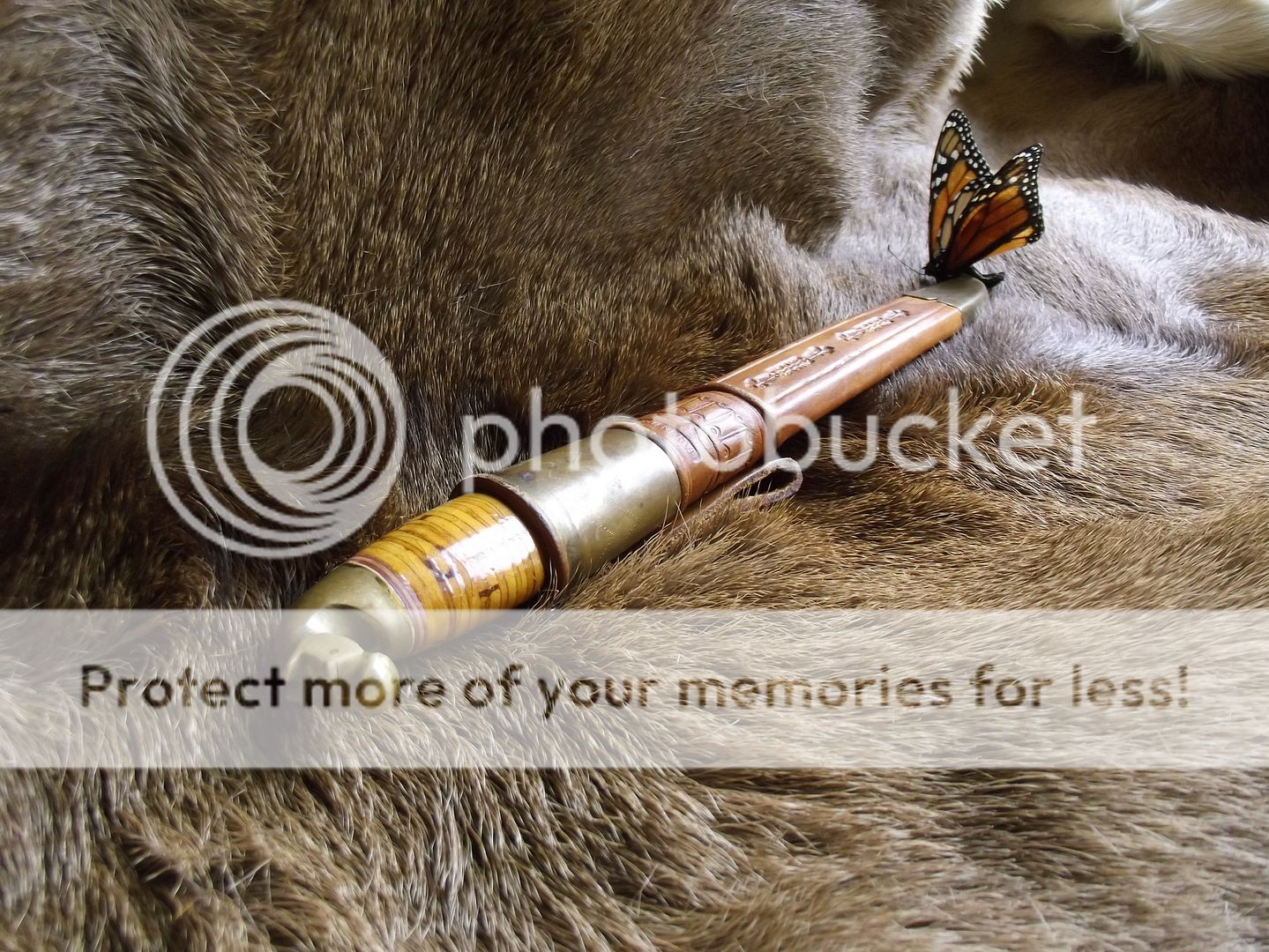
butterfly007.jpg
[/URL]

I did a little googleing, as is my penchant, and found this info:
http://nordiskaknivar.wordpress.com/tag/horse-head-puukko/
"The Finnish knife ornament in the shape of such a horse’s head is worth a few lines. Credit for having designed the horse head goes to another famous knife maker from this time, Juho Kustaa Lammi. Juho was requested by a cavalry office to make a horsewhip crowned with a horse head. This was so good that Lammi began to mount those on their knives. "

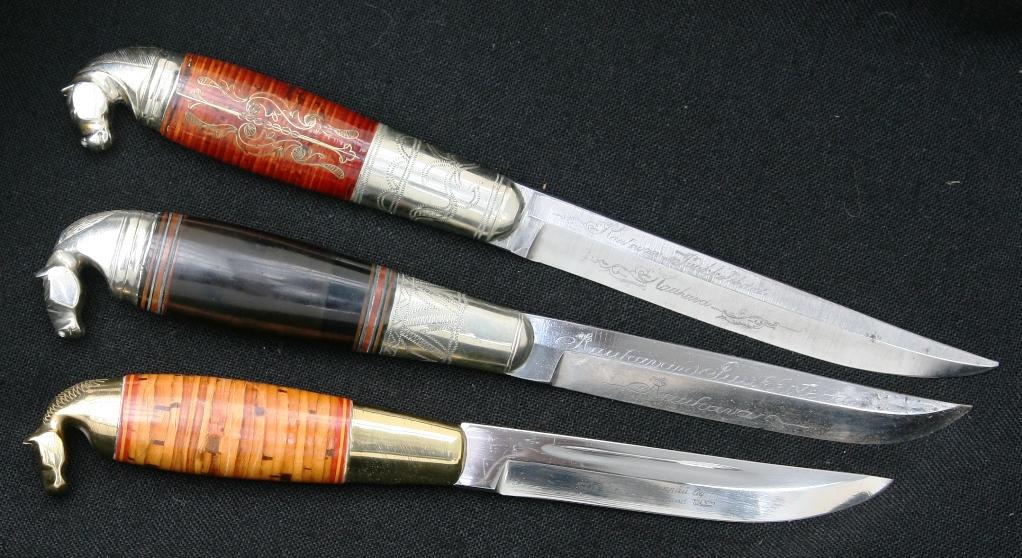
that site says the top knife in the following picture is from 1887, middle from 1917, bottom from 1967, the one with the fuller (blood groove). It also says this about the fuller:
"the blood groove, something that began in 1905 which was a requirement for the U.S. market."
anders-22.jpg


regarding the horse head pommel, on another site someone from Helsinki Finland posted:
"The story tells that Juho Kustaa Lammi made his first horse head pommel to sabre which owner was cavalry officer (it happens time when Finland was a part of Imperial Russian). "

From the 12th until the start of the 19th century, Finland was a part of Sweden. It then became an autonomous Grand Duchy within the Russian Empire until the Russian Revolution ( of 1917). Juho Kustaa Lammi lived from (1859-1924). So the story fits the historical fact of Finland being Russian at the time the horse head pommel came into use on the Finnish Puukko in the 1880's, and continues today.. Horsehead Puukkos are "fancy", "dress", or "Sunday" knives.

Here is another version:
"As the story of horsehead pommel is recorded in literature, it came to be when Juho Kustaa Lammi was working with other men of Kauhava at building the railroad in the 1880s. He was known to be a skilled craftsman so a Russian officer approached him, wanting Juho Kustaa to make him a decorative end-piece for his (IIRC) riding crop. In the shape of a horse's head. Which was done and from there the design was adapted into knives as well."
 
Last edited:
Back
Top