Quench Plates?

Joined
Dec 7, 2000
Messages
5,179
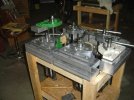
What do you folks use for quench plates, and where did you get them? Do you use more than one set when HTing multiple blades?

 
Dave, I just use aluminum bar stock. I picked up a few pieces of 1" x 2" x 14" and 1" x 4" x ~ 18" 6013. Your length will be determined by the size blades you're doing. If I'm doing multiple blades I put a bucket of water close by and drop the quench plates in for a minute to cool them off. A quick wipe to dry them off and they're ready to go again. Picked them up at the local fab shop.


:cool:
 
Hello Dave,

I picked my plates up at the local metal scrap yard. They are 1" X 8" X 16" aluminum stock. Works very well.

Eric
 
How thick are your plates? I'm thinking 1/2" would be about right but does anyone get by with thinner? Thanks!
 
You need thicker, not thinner.
The thermal mass of the plates has to absorb the heat from the blade (and radiate it out). Aluminum has a high coefficient, so it is excellent for this. 1" thick, or thicker, is what you want. The plates need at least 30 to 50 times the thermal mass (the combined volume of both plates) to efficiently do the job. A good size for most blades is 1"X3-4"X16". 1.5" is even better.
Stacy
 
I got my plates from eBay. I found a 1x12x12 plate for a good price that I cut in half for two 1x12x6 plates. If you quench multiple blades, get plates
big enough to have some separation between the blades and let the plates cool between HT rounds.

--nathan
 
I had some 1/2 plate so I made mine 12"x12" and bolted 2 sets of 2 together with recessed heads to make them an 1" thick.
 
I've got two sets now, both from eBay. The first is 3/4 thick and seems to work well
with the thinner stock I mostly use. The new set is 1" thick. Both are 6-8 wide and
15-17 long (I figure too long is better than too short and it's extra mass).

Got the second set so that I can heat treat multiple thicknesses at once.
 
I use steel.

I have large aluminum drops laying around, including big 2" plate, but I use steel.

It has been a while since I investigated this, so my memory may be imperfect, but here was my reasoning:

The thermal mass of steel is three times that of aluminum (meaning it can absorb three times more heat for each degree it warms, which effects the delta T in heat transfer, somewhat reducing the advantage of aluminum)
The heat conductivity of aluminum is three times that of steel
The heat conductivity of air is orders of magnitude less than the heat conductivity of steel
These are air quench steels

Heat conductivity is not the only variable in determining heat transfer.
Even though aluminum has three times the thermal conductivity, it will not achieve three times the quench speed
Steel is more stable, more durable, more available, and quenches so far under the nose that the heat transfer advantage of aluminum was moot.

There has been some hoopla in injection mold tooling where aluminum is supposed to allow a faster cycle time than steel tooling because of the better heat conductivity. In practice there is frequently little difference because the bottle neck can be the heat conductivity of the plastic itself

I'm not saying that steel is better. I am saying that, like quench oils, faster is not necessarily better, and the difference is moot in many applications.

For my application, I use steel, even though aluminum is available.
 
I found a whole bunch of aluminum on ebay, but did not look for steel plate. Nathan, do you use 1" steel plate in your application?

Brian, that vice setup is absolutely the coolest thing I've seen all day. That's such an elegant solution to my next concern, I'm just sitting here thinking where I'm going to find those...
 
I found a whole bunch of aluminum on ebay, but did not look for steel plate. Nathan, do you use 1" steel plate in your application?

Brian, that vice setup is absolutely the coolest thing I've seen all day. That's such an elegant solution to my next concern, I'm just sitting here thinking where I'm going to find those...

Yes, 1". And I test my setup to be sure I'm getting good even contact over as much of the blade as possible before starting.

BTW, the seam in the foil needs to be on the edge so it doesn't come between the blade and the plate.
 
I bought a 7/8"X14"X16" piece of aircraft Al-6150?-on ebay and cut it in half. I've been using them for several years now and just press them togethe by hand. You don't need a lot of pressure they conduct heat with contact.

I do put them in the freezer prior to use and do two blades at a time. I can make at least two runs without them getting warm.
 
Yeah Steve, that's about what I'm looking at too though might go a bit thicker since it's so readily available.

BTW, the seam in the foil needs to be on the edge so it doesn't come between the blade and the plate.

Hm. So you don't have to strip off the foil before quenching? That's a good thing. I've been trying to rehearse in my head how that would go, and not getting any good pictures... :D
 
Dave, I fill up one of those portable air tanks and shoot compressed air in between the plates when quenching. I'm not sure if it really helps anything but it makes me feel better doing it.
 
Back
Top