Quench tank questions

Karl, what is that big spring in the corner of your first picture?

It's a big spring.
I have three of them! 311 pounds each.
1 7/8" 5160.
They were from a special pour of 5160 to be used in hydraulic cylinders.
They were off-spec and headed for the dumpster!
I think I'll cut one of them in half and use it for bases of a new coffee table.
They're almost 4 feet tall so I can stand up items inside them and use them to organize my rakes and shovels and/or bar stock.
Right now I'm using one to stack my milk crates on so they're out of the way.
You're not thinking that I would use them as STEEL, are you?
spring1.jpg
 
What do you use for your oil quench tank?
Do you quench tip down or edge down horizontally? Does it matter?
How big should the oil tank be to be able to quench blades up to 10" in length and how much oil is needed?
Oh and how do you go about pre-heating the oil? I always just heat up scrap steel and dunk it in prior to quench.

Technically, you need 1 gallon of oil for every 1lb. of steel being quenched. If a lot of blades are quenched one after another, 1 gallon of oil is going to get too hot and will need time and/or technique to cool it to the proper quenching temperature.

Thin wall quench tanks heat and cool faster than thick wall tanks.

Ideally, there is enough room (depth or length) in the quench tank to move the blade up and down or back and forth. If I only wanted one quench tank and didn't want to edge quench (I don't and I don't), I'd have a 2 to 2 1/2 gallon vertical tank. 5" square at 23" of oil is 2.5 gallons... 6" round at 20" of oil is too.

Mike
 
I use an Airvoid 5 gallon vertical tank, with a circulation system.

I believe you need both options, horizontal and vertical quenching, depending on what you are trying to achieve.

doggon_jpg+028.jpg
 
My wife, Deb, is still a little steamed about it.

She liked to use it for when we had a party or the like, to put iced tea or lemonade in.

I spied it in the shed one winter and next thing I new, it was in the shop full of oil.

I know this is not just a problem I have, knife makers are always on the lookout for shop equipment.:D wherever it might be found.:thumbup:
 
I recycled an old turkey fryer we had. It allows me to hook up a propane tank to heat the oil with.
It is deep and wide enough for both horizontal and vertical quenching.
quench.jpg
 
I've read that people use baking sheets (1/2" deep with oil) and only quench the edge, not the whole blade. I don't know how that works, but I thought I'd throw it in for this conversation.
 
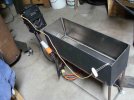
Here's my home made quench tank. Started with a sheet of mild steel, cut then tig welded the tank together. Added a heating element and PID temperature control that I share with my forge. This pic was before filling with 5 gal Parks #50. Seems to work fine for me.

Eric
 

Attachments

  • QuenchTank001.jpg
    QuenchTank001.jpg
    43.6 KB · Views: 113
  • QuenchTank002.jpg
    QuenchTank002.jpg
    60.8 KB · Views: 120
That looks like a great quench tank, Eric.

Karl, that spring is a BEAST!

Everyone else, thanks for sharing what you use for quench tanks.
I found a large metal gardening pail today at the dollar store. Nothing fancy but, it should do the job.
 
Some narrow single edged blades with simple cross sections, e.g. a full flat ground Scottish dirk or tanto, I only quench spine down to avoid the tip dropping in oil,

Kevin I've been reading a lot of your stuff lately prepping to HT @ home. I'm a little cloudy on the point you're trying to make here. When you say "spine down" do you been edge to the sky?:confused: I really value your opinion and don't want to glean the wrong info here. Thx
 
Fred, I have some suggestions for your tank:
Change the plumbing so the oil is pumped up from the bottom of the tank. It will create agitation that will greatly increase the efficiency of the oil.
You will have to reverse the in/out fittings on the pump. Make a simple "J" tube that is inside the tank to send the oil jet directly up the center. This will give you the best oil cooling of the blades.
Even if you don't change the direction of the oil flow Please put the top tube below the oil surface. With it above the surface, and thus hot oil being sprayed into the tank from the air ( like it is now) it is a fire disaster waiting to happen. Think what would happen if it was deflected out of the tank accidentally while the 1500F blade was being inserted into the tank. You could be spraying flaming oil all over the shop floor.
Stacy
 
Eric, that is a beauty!!! Very nicely done.
 
I've read that people use baking sheets (1/2" deep with oil) and only quench the edge, not the whole blade. I don't know how that works, but I thought I'd throw it in for this conversation.

IN my opinion this would be bad in countless ways. First I am not a fan of the edge quench anyhow since I have seldom seen it result in a pearlite free edge. But more importantly using that low a volume of oil will definitely results in undesirable issues. Those that do enjoy edge quenching use a pan capable of holding a good volume and then put a well perforated platform that they adjust to the proper height in the oil so that you can still get decent oil circulation around around and away from the hot edge. Also in the event of a flash fire (which is the likelihood is increased exponentially by such a shallow pan) dealing with it is much trickier.

When encounter this advise I would skip over it and read on.
 
Kevin I've been reading a lot of your stuff lately prepping to HT @ home. I'm a little cloudy on the point you're trying to make here. When you say "spine down" do you been edge to the sky?:confused: I really value your opinion and don't want to glean the wrong info here. Thx

Due to thermal extraction rates and some complexities in thermal and phase based expansion rates- yes. I go into the oil on such blades horizontally, spine down with the edge facing the ceiling so the spine hits the quenchant just a split second before the edge does. But this is combined with proper agitation. I still see too many makers ignoring the great importance of movement in the oil. Either movement of the blade or movement of the oil. Any quenchant will work better if there is agitation despite our fears of distortion, in fact it will reduce distortion by overcoming uneven vapor jacket collapse.
 
Fred, I have some suggestions for your tank:
Change the plumbing so the oil is pumped up from the bottom of the tank. It will create agitation that will greatly increase the efficiency of the oil.
You will have to reverse the in/out fittings on the pump. Make a simple "J" tube that is inside the tank to send the oil jet directly up the center. This will give you the best oil cooling of the blades.
Even if you don't change the direction of the oil flow Please put the top tube below the oil surface. With it above the surface, and thus hot oil being sprayed into the tank from the air ( like it is now) it is a fire disaster waiting to happen. Think what would happen if it was deflected out of the tank accidentally while the 1500F blade was being inserted into the tank. You could be spraying flaming oil all over the shop floor.
Stacy

Stacy,

I have had this same conversation with other smiths and the consensus is with you; about the direction of flow.
Even though I am not fully convinced, I believe there is merit to your line of reasoning.

My thinking is; there is too little gpm [1 gpm] being produced by this pump to influence the quench in any measurable way; at least as far as dissipating the heat from the blade, by the flow of cooler oil coming from the pipe. Too small a time frame and too little flow, is involved.
I do believe, there is more agitation produced by the flow coming from the top; because of its proximity to the blade itself. My main objective, in building this, was to disrupt the thermal envelope that surrounds the blade when inserted into the quench, thus relieving me of the need to move the blade about in the oil.
If I bring the oil in from the bottom, the proximity of the inlet tube, to the blade, would be farther, therefore less agitation relative to the blades position and therefore not producing the desired effect.

The picture shows the inlet tube above the fluid, which is not the case in normal operation. It is always submerged. Fire scares me:eek:.

One of the side benefits of the pump is being able to run the fluid out of the container, by repositioning the top tube and engaging the motor.
This allows me to move the oil to other containers that might be needed for edge quenching or the like.

This is not an optimum setup, by any means; I am always looking for ways to improve the product that comes from my shop, as knife makers tend to do.

My fantasy quench tank would be similar to one of those flush toilets with the tank positioned, high on the wall, above it.
There would be a foot valve that would flush the quench oil from the tank across the submerged blade and into a lower reservoir; where it would be collected and pumped into the upper tank for the next "flush".:D
This is still in the planning stage:rolleyes::)

As always, I appreciate your comments and advice and especially your concern as to working safely in the shop.

Fred

I have been playing with the manual side needle valve, on the chariot and have found that it can be adjusted to such a position, relative to set point, that the pid controller activates 3 or 4 times in a minute instead of the of and on ever couple of seconds cycling.

 
IN my opinion this would be bad in countless ways. First I am not a fan of the edge quench anyhow since I have seldom seen it result in a pearlite free edge. But more importantly using that low a volume of oil will definitely results in undesirable issues. Those that do enjoy edge quenching use a pan capable of holding a good volume and then put a well perforated platform that they adjust to the proper height in the oil so that you can still get decent oil circulation around around and away from the hot edge. Also in the event of a flash fire (which is the likelihood is increased exponentially by such a shallow pan) dealing with it is much trickier.

When encounter this advise I would skip over it and read on.

Thanks for that. I haven't got a forge yet (next two weeks hopefully) and so I'm looking for as much info as I can get, from testimonies of users about different methods.
 
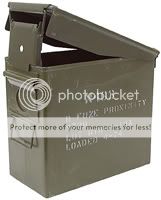
Some of you mentioned ammo cans for use as a quench tank. I found some at the surplus center: http://www.surpluscenter.com/item.asp?UID=2009032618110931&item=1-2259&catname=misc

These should work well for quenching and other stuff and the price seems right.

p1-2259C.jpg


.50 CAL AMMO BOX END HINGE $7.95
New, U.S. Military surplus. Steel construction with end-hinge and gasket on lid. Ideal for storing tools, papers, etc. Shpg. 9 lb.

Internal dimensions: 11" x 5-3/4" x 9-3/4"
External dimensions 12" X 6-1/8" X 10-1/8"
 
Due to thermal extraction rates and some complexities in thermal and phase based expansion rates- yes. I go into the oil on such blades horizontally, spine down with the edge facing the ceiling so the spine hits the quenchant just a split second before the edge does. But this is combined with proper agitation. I still see too many makers ignoring the great importance of movement in the oil. Either movement of the blade or movement of the oil. Any quenchant will work better if there is agitation despite our fears of distortion, in fact it will reduce distortion by overcoming uneven vapor jacket collapse.
Thanks for clarifying.
*spine down...agitate...got it.
 
Back
Top