
Quenched blade 0.1mm surface is soft, please help

BluntCut MetalWorks

Knifemaker / Craftsman / Service Provider
Joined
Apr 28, 2012
Messages
3,476
I've been lurking here for awhile, so time to seek your help.

I am using a propane torch (hooks to a 5 gal tank) + bricks + charcoals to heat treat various steels. My ht goal is obtain 60% yield from optimal per ht target. Hopefully this isn't a futile quest.

This week I made 2 razors.

52100: re-used from a cracked nakiri. Austentite -> oil quenched, no temper, wag ~ 64rc using a carbide indenter. This blade is full of pits under 100x magnification. However very sharp at 14* inclusive angle, and surprisingly tough too.

cpm3V: 0.046" thick sandwiched between two 0.1" 52100 bars to avoid direct flame. heat to above austenite temp(non-magnetic) for 3 minutes, interrupted canola oil quenched 3 seconds, air cool. Look like after 3 seconds in oil, the blade is not smoking in air? Didn't tempered afterward. Edge is stable at 22* or above inclusive bevel angle.

After quenched the 3v blade is soft (to file) on the outside 0.1mm and very hard (can't file) in the middle. Initially I thought it was due to RA but after some research, I became more confused & stumped -> your advices/insights will be greatly appreciated!

btw - I also encountered this problem with cpm-m4 but not cpm-s90v.

Thanks.
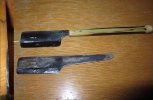
razors20130419.jpg
 
Thanks fumbler. I don't have proper equipments for following most high alloys ht specs. All I did was burn & dunk, I wasn't even know for sure that the steel even harden. But seem that the steel got harden in an odd way (in compare to simpler steels), so for not being a metallurgist, I wonder what this soft-shell (core harden) mean & why. Please elucidate/speculate. Arm with understanding/idea perhaps I can avoid this condition (hey, it's a laminated mono steel :eek:).

As for obtain services from professional heattreatment or purchase proper equipment - I am resisting both (for now:D)
 
If you are serious about heat treating knives and not a troll.... Then you need to forget M4 and 3V and S90v. Heat treating in your forge is ridiculous to tell it straight. Honestly, just use the steel as is as it will save you the cost of fuel and all that time with the same results...

I know this sounds harsh? Maybe? I apologize as I honestly don't want to hurt your feelings, but you know a couple big words but not any real heat treat knowledge.
 
read and learn. Start with reading about decarb, if you wantto play with high alloy steels either spend a lot on HT equipment or pay a professional heat treater. If you want to do it yourself, buy some 1084 from NJsteelbaron.com and follow the directions, it is one of the few steels you will be able to treat with what you have

-Page
 
read and learn. Start with reading about decarb, if you wantto play with high alloy steels either spend a lot on HT equipment or pay a professional heat treater. If you want to do it yourself, buy some 1084 from NJsteelbaron.com and follow the directions, it is one of the few steels you will be able to treat with what you have

-Page
 
If a steel is more complex than O-1 or A-2, you can't do a HT worth much in a good forge. With the setup you describe, I wouldn't expect many good results beyond simple carbon steels. Even 52100 would be hard to get optimal results as described.

I agree with Page, get a bar or two of 1084 and make whatever you wish. You will get 100% optimal results.
Read the info in the stickies on HT and metallurgy. It will help you understand what is happening.
 
I have made razors with 1084,did the simple home heat treat and temper.They got hard and sharp.What else could you want at an elementary level.
Eddie
 
Thanks very much for frank and valuable feedbacks. James also gave similar feedback when I posted an Elmax petty in the kitchen subforum. Last post in that thread, I shown what look like decarb in my cracked m4 blade.

I've been eyeing a Paragon 18D oven and get a local LN bath but hopefully there is a fix for my stubborness in hoping one can get ht 60-80% usable result by using a very simple forge. I enjoy learning by context of doing (applied learning), so is it soft-casing because of decarb? but if I interrupt water quench (1 second dip), I get warped very hard but not soft-casing blade. Is it quick temperature drop - very thin blade - during transfer from heat source to quench bath? nonuniform elements distribution in steel solution because lacked of soaking time? Is it blade thickness has direct influence on heat diffusion in quenchant? I value your time & feedback, just let me know if I am wasting everybody time, then I would go to lurk mode & doing silent experiments.
 
get yourself some 1084

do the suggested reading

do not bathe yourself in Liquid nitrogen, it will not get you clean

-Page
 
Thanks Page.

I agree, 1084 would be an excellent starter (I'm newb) choice steel. I've made a couple knives out of each these carbon steels 1080, 5160, 1095, cruforgeV (a forged chopper). Perhaps first/surface glance along the journey is more fun than deep diving or end products. Cryo & subzero sounds like extra fun. Is there a way to turn a yellow note pad into an ipad or opposite is true?

I read technical docs/articles but don't remember much without context. An unfortunate weakness, I reckon.

Thanks for being patience & polite. Also good to dish out direct & raw assessments/opinions/teaching.
 
Thanks very much for frank and valuable feedbacks. James also gave similar feedback when I posted an Elmax petty in the kitchen subforum. Last post in that thread, I shown what look like decarb in my cracked m4 blade.

I've been eyeing a Paragon 18D oven and get a local LN bath but hopefully there is a fix for my stubborness in hoping one can get ht 60-80% usable result by using a very simple forge. I enjoy learning by context of doing (applied learning), so is it soft-casing because of decarb? but if I interrupt water quench (1 second dip), I get warped very hard but not soft-casing blade. Is it quick temperature drop - very thin blade - during transfer from heat source to quench bath? nonuniform elements distribution in steel solution because lacked of soaking time? Is it blade thickness has direct influence on heat diffusion in quenchant? I value your time & feedback, just let me know if I am wasting everybody time, then I would go to lurk mode & doing silent experiments.

Mora's Triflex steel is an intentionally decarburized steel that behaves in a similar fashion to the steel that you made your razor out of. It has about the same 0.1 mm of decarb on it. Your first quench was in oil, right? But your second was in water. That seems to indicate that you caught the pearlite nose of the decarbed steel (outer layer) on the oil quench. The water quench would have been a lot faster thereby avoiding the nose. But, your equipment is fairly crude so the repeatability, and thereby the comparison of results is in question. Disclaimer: I hope I am interpreting your posts correctly..
 
Mora's Triflex steel is an intentionally decarburized steel that behaves in a similar fashion to the steel that you made your razor out of. It has about the same 0.1 mm of decarb on it. Your first quench was in oil, right? But your second was in water. That seems to indicate that you caught the pearlite nose of the decarbed steel (outer layer) on the oil quench. The water quench would have been a lot faster thereby avoiding the nose. But, your equipment is fairly crude so the repeatability, and thereby the comparison of results is in question. Disclaimer: I hope I am interpreting your posts correctly..

Yes, your interpretation is accurate. Awesome info, much appreciated. disclaimer: as newb I eval all info good or bad. Apparently before, I didn't grinded my 3v razor edge until the harden steel. So I grinded down and rebevel to an iffy 12* inclusive, I expect edge failure at this level but oh well, will see how much facial burns I get.

edit:
* 3v edge is not stable below 20* inclusive. it's now settled to a very stable 24* angle.
* fwiw - I test quenched 8 small pieces of 3v in water with differents vicousity mixes (starch, sugar, kudzu). 1 tsp kudzu in a cup of h20 worked like interrupted oil. Of course will need to factor in surface area/thickness of the blade. I guess, even in oil, I need to stir the workpiece around the oil.
 
Last edited:
Just ordered 1084, 15n20 + other steels from Aldo. I will make a few more razors from variety of steels, then apple-orange(grain) compare them. Of course all will be base on questionable ht, nevertheless by this same knut. I felt like my knives tinkering noise aren't a good fit for this subforum. Please advise an alternative place. Maint & Tinkering sub?
 
This forum is probably the best. Many of the members are pragmatic so you might not get the responses you hope for (i.e. why reinvent the wheel?). Also, ask specific questions. Posting pictures along with your questions usually gets a response. For you work on grain refinement, get a Nicholson file and break it in half. The metal should have a silky appearance. That is what you are aiming for. I do not believe that there is anything wrong with exploring the limits of the equipment you have.
 
Back
Top