quenching question

m. wohlwend

BANNED
Joined
Apr 21, 2007
Messages
2,681
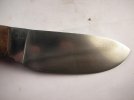
In response to earlier threads about "fast-quenching" high carbon steel, I thinned the oil down in my quench pan and got this result. A wide line full of "swirls" and fainter swirls in the hardened area. The steel is from a 60" sawmill blade, 1095 ? I assume.

Is this too hard ? am I over stressing the steel ?

What do you think?
 

Attachments

  • kniveS 005.jpg
    kniveS 005.jpg
    27.9 KB · Views: 95
Assume ?? This is another "mystery steel " and there's no way to tell what it is. The best you can to is experiment with pieces and work out a HT.The blade is more likely to be a lower carbon grade.
 
did you have it too hot? thats what it looks like to me. i would do what mete said and experiment with some. take a piece about 4" long and heat it up to a bright red-not quite orange then quench in the same oil. test it with the corner of a sharp file to see if its hard.
 
it was past magnetic because I tested with a magnet, and color wise it was more orange than red. My thoughts on this were that if I tempered it, should turn out ok, but we will see. I am going to sharpen it up, see how it responds to some cutting, and I will see if I can get the edge to chip.

My main question I guess is can you over harden steel to the point that is cannot be tempered into a usable edge?
 
My main question I guess is can you over harden steel to the point that is cannot be tempered into a usable edge?

I'm thinking.....................................ok....I'm saying no.

You actually want to have the steel in a stress free situation when you heat it up to hardening temperature. Your hoping to get it as hard as possible with the quench, and then temper it. With a proper hardening temperature and proper quenching oil, you'll get the highest hardness out of the steel. Then with the proper tempering temperatures and tempering times/cycles, you'll get the toughness and optimum resultant hardness for that particular blade steel.

I quit playing with "mystery" steels long ago, because of this problem of having to put a "LOT" of work into many blades to figure out everything about the heat treat. With a known, quality steel you'll already have the information that you need to get the most out of that steel.
 
Charlie, The problem is there is a lot more than HARD happening when you HT steel.
When you harden steel in the quench the structure of the iron and carbon rearranges from the austenite that forms above the curie point (non-magnetic) to martensite -assuming the quench was fast enough to avoid pearlite forming. You will get the same hardness with every quench, regardless of how hot the steel was ( 1700F doesn't make it harder than 1500F). What does happen at the higher temperatures is grain growth ( and some other undesirable things) which makes the steel more brittle.

The reason you need to know the make-up of the steel (not just a guess) is the temperature,soak time, and type of quenchant are all determined by the composition of the steel.

Let's take your blade .It came from a saw mill blade. That could be anything from 1030, to L-6, to 9260, to 1095 ( actually 1095 is unlikely), or something entirely different ( often called "Chrome-moly steel"). If it was L-6 it would need a different quenchant and HT specs than if it was 1095. You can experiment with some samples and come up with a HT that will harden it, but without testing equipment and microscopes, it will only still be a guess as to how well the steel is hardened.

The temper done after the quench (it should be tempered as soon as the steel returns to room temperature) will be a function of the steel type,too. The temper is where the brittleness is modified into toughness, reaching a compromise that is desired for the blades function and use.

So, you see why it would be better to start with a known piece of steel and design the HT parameters around that knowledge.If you have a large amount of what appears to be good steel (60" saw blade) send a 1X4" piece to be tested, then you will know the composition, and your "Found Steel" may become "found money".
Stacy

 
What I find interesting from reading Metalurgy fundamentals is that 1080 is the steel that goes austenite closest to the lower transition line (non magnetic) If you have more carbon like 1095 you are going to need more heat. But, also if you have less carbon you will also need more heat. 1070 has to get hotter than 1080 to make maximuim. Start adding chrome and that changes stuff to. About the only problem with rapid quenching for martinensite is are you able to do it fast enough without cracking or warping. The more I read and understand the more important I realize the importance of knowing whaat steel your working with.
 
First of all thanks to all who gave input and thanks to Richard for the late nite phone call. Knife building has been a real learning experience for me, and if you keep an open mind you can earn all the time. I started my small shop on a very limited budget, and to this date I have never ordered "stock" steel. I have worked with L-6 and with some 5160. I then found several of these larges blades. They have made some good knives but I am sure I got the one in the picture too hot. I am really seeing the advantage if you know WHAT steel you work with.
Once again thanks....
 
Back
Top