question about climbing

Joined
Mar 19, 2007
Messages
664
so I know this isn't a forum for climbing, but I figure a few of you guys might know a thing or two. Anyway, in my town, there is this cave about 75 feet up in a rock face that has history dating back to the Native American wars with my town in the 1600s so I have had this dream since I was a kid of climbing up there. Anyway I have never had the nerve to do it because I am afraid I won't be able to get down. The climb up is pretty easy. Anyway I think I am finally ready to make the final push and make the climb. Right now I have some rope and a harness with caribeners. There is no top rope anchor and I dont want to buy anything expensive for top roping. But I was wondering if there is some easy way to get down with ropes without a top rope. Sorry for so much text.

PS. If anyone is interested the cave is in Connecticut.
 
without some sort of pre-existing anchor, i.e. bolted anchors, big tree...it will be pretty darn hard to get down..... and if you do climb it, how are you going to take your rope up with you....
 
Taking the rope up is easy, if you have a pack (just stuff the harness and 'biners in there with it). But Mike is right: no anchors, no rappel. unless you can sling a large object like a huge boulder inside the cave, a tree, or some other immovable object. Or, you can find someone with a bolt kit to drill a few bolts inside the cave, and there's your anchor. That defaces the rock, IMO, so would not be the route I would recommend. You could also borrow or buy some assorted protection, and set up a semi-permanent anchor (several well placed nuts and hexes should do it). The problem with this is it takes someone with some skill to set this up, not to mention the gear can be expensive, and you'd have to leave it behind. So, sorry if none of this is much help, but sounds like your situation is a difficult one.
 
I assume you want to use some self belayed ascent and descent. I would really advise that you get in contact with someone that has some experience and can belay and advise you on the climb. Maybe there is a local climbing club or group nearby.

Self belaying requires you either top rope or bottom rope. Both also require considerably more experience and devices then you may have. A minimum is you will require an ascender (unless you have the ultimate confidence in your ability to tie perfect hitches or prusiks), some quickdraws and some protection devices i.e. nuts, hexes or cams.
 
If you havent set up anchors before I would stongly suggest that you take an expericanced climber with you. No matter how you anchor you must leave some gear behind ( a sling and biner min, 2 slings and 2 biners is concitered the norm) You will also need a belay device like a gri gri, figure 8 or ATC type device. You must also be trained to use them safely. If you rappel to fast you belay device can melt your rope. I would not recommend you rappel off a biner unless you absolutely have too. Once again take a trained climber with you, your life depends on the anchor you chose, that could be as small as a 3/8" bolt or some small flakes of rock.
 
Best bet would be to run some slings around any available trees if possible. If no trees then you could run some slings around a large enough rock. This could be a tunnel, chockstone or horn protruding from the rock. Just be sure to equalize your anchors and back them up. I like to girth hitch tunnels and horns myself.
A good book to get is "Climbing Anchors" by John Long put out by Chockstone press.
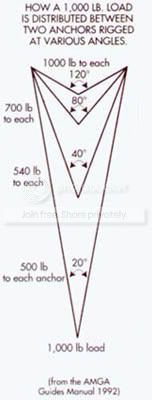
anchor_forces.jpg


Here is a little exerpt about anchors.

Strong: Good anchor systems are built off of solid components, such as a good bolt, stout tree or immobile boulder.
Redundant: Anchor systems must be constructed of multiple components so that if any one component fails, the anchor will not fail.
Equalized: Building an anchor system so that the load is shared by all of the components decreases the chance that any one component will fail.
No Extension: If a component does fail, the anchor system should be constructed so that the remaining components are not shock loaded.

Using cord or webbing you can connect anchors together to equalize them and create redundancy, but also they are useful to adjust the length and position of the system so that the rope is not rubbing across the rock.

Intuitively you might think that two anchor points will split the load 50/50 in an anchor system. In fact, the geometry of the system determines how the load is distributed in an equalized system.

Consider the diagram at left. Of the four examples, which angle is will create the safest anchor?

When building an anchor system, how can you adjust the angle to ensure that you don't create an unsafe system?
 
Also, define "pretty easy". I've done lots of 3rd class peakbagging all over the west unroped because to me 3rd class is "pretty easy". Most people piss their pants in the same situation. Sounds like this is a class 4 from your description. Getting up is easy but downclimbing is always harder. Also, do you know how to rappell?


* Class 1 is walking with a low chance of injury and a fall unlikely to be fatal.
* Classes 2 and 3 are steeper scrambling with increased exposure and a greater chance of severe injury, but falls are not always fatal.
* Class 4 can involve short steep sections where the use of a rope is recommended, and un-roped falls could be fatal.
* Class 5 is considered true rock climbing, predominantly on vertical or near vertical rock, and requires skill and a rope to proceed safely. Un-roped falls would result in severe injury or death.
 
Andrew, the other suggestions here regarding the technical aspects of climbing are things you should keep in mind, but let me suggest another part of this adventure to consider. Believe me, I very much understand your interest in that cave, but if it is indeed a genuine archaeological site please treat it with respect and don't screw it up with amateur plundering. When I majored in anthropology at FSU many years ago, I learned a lot about what not to do when exploring an archaeological site. People have plundered sites all over the world for many centuries, but there is no excuse for someone doing that today. If you have a university nearby with an anthropology department, maybe you can talk to someone there and not only learn something about that cave, but you could possibly get someone else interested in checking it so you would have some help and an added safety factor. That's just my two cents' worth. Good luck.
 
Here is a question you have to ask yourself...I can get up OK but, once I'm up I feel I need protection to get back down. What happens if I get stuck halfway on my way up?

Really, get someone experienced to help.
 
Here is a question you have to ask yourself...I can get up OK but, once I'm up I feel I need protection to get back down. What happens if I get stuck halfway on my way up?

Really, get someone experienced to help.

Then you get the fear. You have 2 options. Sack up and continue up to a safer place (also known as upward failure). Or you get hurt.

I also agree that if the site has any cultural or spiritual value, leave it alone. You also need to find someone that knows what they are doing to help you. In my experience there are climbers that learn first and then go out, and those that have no clue, get hurt and never climb again. Sometimes they don't do anything again. Also, if you do head out, get the right equipment, especially rope. Don't get rope from a hardware store. Even the static line you will need for a rap will cost you $100.
 
I'm just curious if there might be a non-climbing route to the top of the cliff. Then maybe you could rappel down to the cave and climb back, or just descend all the way to the bottom and retrieve your gear from the top later. Whichever route you choose, I'm with everyone else in suggesting that you ask for some advice and assistance from an experienced climber.
 
so I know this isn't a forum for climbing, but I figure a few of you guys might know a thing or two. Anyway, in my town, there is this cave about 75 feet up in a rock face that has history dating back to the Native American wars with my town in the 1600s so I have had this dream since I was a kid of climbing up there. Anyway I have never had the nerve to do it because I am afraid I won't be able to get down. The climb up is pretty easy. Anyway I think I am finally ready to make the final push and make the climb. Right now I have some rope and a harness with caribeners. There is no top rope anchor and I dont want to buy anything expensive for top roping. But I was wondering if there is some easy way to get down with ropes without a top rope. Sorry for so much text.

PS. If anyone is interested the cave is in Connecticut.

Out of local interest, what CT venue are you referring to?
 
I'm not going to have much to add here, given that everyone has done a thorough job. But let me summarize:

1. Up is usually the easiest route. You're right to be worried about down.

2. You can't rappel down unless you have an anchor.

3. Anchors are not something you want to teach yourself at the top of a climb. You have to select the right anchor and know how to really secure its hold before you trust it as bomb-proof. No matter what good advice we give you, anchors must come down to experience.

4. An experienced climber will definitely help, but...

5. An experienced climber will almost certainly be highly reluctant to secure a new anchor into rock with any anthropological value. In fact, more and more climbers are reluctant to employ new anchors, as some popular rock faces are being degraded by the sheer number of anchors.

6. You may want to think this dilemma out for another year, which could be spent learning to anchor.
 
You could always come out to Eldo and I can teach you. :D
IMG_0769.jpg

Ookla,

Please tell me that's not the view from your back porch. I'd poodle-hump the mailman's leg just to sniff the tire tracks of the mail truck that carried a postcard from that place. That is beautiful. Seriously, don't be surprised if you find me living in a tent in your backyard soon. THAT is where I'd be happy dying.

Thanks for sharing the pic.
 
Ookla,

Please tell me that's not the view from your back porch. I'd poodle-hump the mailman's leg just to sniff the tire tracks of the mail truck that carried a postcard from that place. That is beautiful. Seriously, don't be surprised if you find me living in a tent in your backyard soon. THAT is where I'd be happy dying.

Thanks for sharing the pic.

This is a 5 minute walk from my house. The view from the front porch isn't bad either! :D
 
Thanks for all the advice guys. The climb isnt really that hard and there are ledges to stop and rest on the way up, however on my way down if I were to fall, it could be fatal and I don't want to get stuck up there, that would be embarrassing:(


You could always come out to Eldo and I can teach you. :D

You know I am half tempted to take you up on that... Im sure you are far away, where is that?

Out of local interest, what CT venue are you referring to?


Its called Kings Phillips Cave on Talcott Mountain. Have you ever been up there?


Andrew, the other suggestions here regarding the technical aspects of climbing are things you should keep in mind, but let me suggest another part of this adventure to consider. Believe me, I very much understand your interest in that cave, but if it is indeed a genuine archaeological site please treat it with respect and don't screw it up with amateur plundering. When I majored in anthropology at FSU many years ago, I learned a lot about what not to do when exploring an archaeological site. People have plundered sites all over the world for many centuries, but there is no excuse for someone doing that today. If you have a university nearby with an anthropology department, maybe you can talk to someone there and not only learn something about that cave, but you could possibly get someone else interested in checking it so you would have some help and an added safety factor. That's just my two cents' worth. Good luck.


From what I have heard, the cave was never actually used by Native Americans. The actual cave was nearby, but that doesnt stop it from being in local legend. I originally heard the story that it was this cave so even tho I dont think its the true cave, I like to believe it is. So I dont think I would be hurting anything historic, and not that this justifies it, but many others have been to the cave before me.
 
This is a 5 minute walk from my house. The view from the front porch isn't bad either! :D

Thanks for posting that picture. It was very inspiring. If you promise to post more pics, I'll burn you a copy of all the Thundarr episodes and mail it to you.
 
Back
Top