Question about lightened tang for the experts.

I've got the OBM and a small wheel attachment, the only thing is that my grinder doesn't tilt so I cant really make the very most out of the small wheel attachment. I still use it a lot and like it but It would be nice if my grinder tilted
There is an attachment that you can buy for rolling your knife up and down. It has a built in magnet for holding your knife. A lot of guys use it to “mill” their blades after forging to get a uniform surface. I wonder if you could use that same attachment to roll your knife on the rollers? Also if you have a tool rest that is adjustable, you can use it to match where your grind needs to be on the knife.
 
There is an attachment that you can buy for rolling your knife up and down. It has a built in magnet for holding your knife. A lot of guys use it to “mill” their blades after forging to get a uniform surface. I wonder if you could use that same attachment to roll your knife on the rollers? Also if you have a tool rest that is adjustable, you can use it to match where your grind needs to be on the knife.
You mean like a surface grinding attachment? I don't have one because they're not cheap and because I think they work better horizontal
 
You mean like a surface grinding attachment? I don't have one because they're not cheap and because I think they work better horizontal
Yes. I’ll bet if a maker knows their grinder and adjusts everything, you could get a nice straight fuller when utilizing one. Dunno…just a thought. I’m not a fan of using a disk grinder to create a fuller. It’s not uniform and the depth of the fuller would vary. Also a lot of hand sanding to clean up the groove so as not to make it look like a backyard job.

But even without that surface grinder, an adjustable tool rest, placement of blade and a small roller attachment should help to make it look great. Some guys even utilize the fuller and drilled holes so that the tang is practically weightless.
 
Yes. I’ll bet if a maker knows their grinder and adjusts everything, you could get a nice straight fuller when utilizing one. Dunno…just a thought. I’m not a fan of using a disk grinder to create a fuller. It’s not uniform and the depth of the fuller would vary. Also a lot of hand sanding to clean up the groove so as not to make it look like a backyard job.
yes, I havent done any fullers with mine but im sure I could and I wouldn't use an disk grinder for that job either 🥵
 
yes, I havent done any fullers with mine but im sure I could and I wouldn't use an disk grinder for that job either 🥵
I’ve watched a couple DIYs where guys “cut” fullers and would fast forward to where they would. Then they would bring the disk grinder out and I would cringe. Not saying it can’t be done, but I’m all for doing the job right and done. No clean up or extra work.
 
I’ve watched a couple DIYs where guys “cut” fullers and would fast forward to where they would. Then they would bring the disk grinder out and I would cringe. Not saying it can’t be done, but I’m all for doing the job right and done. No clean up or extra work.
Ive got the standard OBM myself. Its been a great grinder for quite a few years now. Mine doesn't tilt either. Ive gotten pretty good at using the sides of the platen with the belt hanging off to grind contours, though I tend to use half round files to true up the groves. The back part of the handle on this knife has been the toughest one yet due to the tight space and 1.25 inch radius. Definitely seeing the appeal of small wheels with a rest haha.
 
Ive got the standard OBM myself. Its been a great grinder for quite a few years now. Mine doesn't tilt either. Ive gotten pretty good at using the sides of the platen with the belt hanging off to grind contours, though I tend to use half round files to true up the groves. The back part of the handle on this knife has been the toughest one yet due to the tight space and 1.25 inch radius. Definitely seeing the appeal of small wheels with a rest haha.
I do the same thing with the side of the platen. The new carbide platen I got makes it even crisper
 
I do the same thing with the side of the platen. The new carbide platen I got makes it even crisper
Nice! My steel platen is getting worn out, my corners have rounded off in the area I use for profiling. Works well for how I grind contours otherwise I would swap it out haha.
 
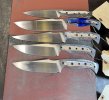
You don’t need precise grinds to lighten the tang. The main thing is to make sure you don’t run the grind off the edge of the tang which would create a gap between the scale and the handle or past what the front of the handle will cover. The knives below are where I went and ground more out after I tapered the tangs. I just use the largest wheel on my small wheel attachment. For reference the center knife is 10” long and only weighs 4.75 oz finished. For a fuller you could do the same thing but would be better off setting up your work rest to the correct height so you only have to worry about moving right-left.

IMG_1113.jpeg
 
You don’t need precise grinds to lighten the tang. The main thing is to make sure you don’t run the grind off the edge of the tang which would create a gap between the scale and the handle or past what the front of the handle will cover. The knives below are where I went and ground more out after I tapered the tangs. I just use the largest wheel on my small wheel attachment. For reference the center knife is 10” long and only weighs 4.75 oz finished. For a fuller you could do the same thing but would be better off setting up your work rest to the correct height so you only have to worry about moving right-left.

View attachment 3094453
Man I appreciate you backing up my post with pics. I knew there were guys on here who did that…I just haven’t done it yet myself.
 
Hey all, I'm making a 1/4 inch chopper for myself and have a question about lightening the tang. What is the general rule of thumb for hole spacing and placement?

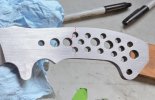
I drilled a bunch of holes in this tang to get the balance right, and looking at it now, I'm wondering if it drilled too many and compromised the tang.

View attachment 3093615View attachment 3093616

Its pops 8670 at about .270 all of the holes are over .200 from the edge, with the closest at .210. The holes are all about 1/8 inch away from each other except for a top 1/4 hole on in the middle that is exactly .100 from the 3/8th hole.

I'm planning on sending this out to Peter's to hardened to 58-60, blast, and black oxide once I get the scales fit and finish ready, so I figured id ask the experts before I send it out.

Thanks in advance!


If that's going to cause it to break

Which it probably won't

But if it does, it's probably going to break here

Screenshot_20260202_154628_Chrome.jpg


As long as that's not the weakest part of the knife (usually in the blade or ricasso area), your weight reduction will have no effect on the durability of the knife.

I think it should be fine.

Many times weight reduction is not just about taking weight out of the knife but adjusting the balance. Sometimes you can actually benefit from additional weight in the rear tang of a chopper. People sometimes put a tapered tang on these kinds of knives and it's counterproductive in function.

I think it looks pretty good
 
You don’t need precise grinds to lighten the tang. The main thing is to make sure you don’t run the grind off the edge of the tang which would create a gap between the scale and the handle or past what the front of the handle will cover. The knives below are where I went and ground more out after I tapered the tangs. I just use the largest wheel on my small wheel attachment. For reference the center knife is 10” long and only weighs 4.75 oz finished. For a fuller you could do the same thing but would be better off setting up your work rest to the correct height so you only have to worry about moving right-left.

View attachment 3094453
Those look pretty sweet! I'll have to remember that. Thanks for the advice!
 
If that's going to cause it to break

Which it probably won't

But if it does, it's probably going to break here

View attachment 3094532


As long as that's not the weakest part of the knife (usually in the blade or ricasso area), your weight reduction will have no effect on the durability of the knife.

I think it should be fine.

Many times weight reduction is not just about taking weight out of the knife but adjusting the balance. Sometimes you can actually benefit from additional weight in the rear tang of a chopper. People sometimes put a tapered tang on these kinds of knives and it's counterproductive in function.

I think it looks pretty good
Thanks Nathan! Yeah, I was lightening the tang to get the balance to move forward to account for the scale weight and keep it right around the choil/plunge line area. Normally I just leave the tang solid, but this one balanced farther back than I wanted without the handles attached.

I'll have to check again when I get home, but I think I measured your red lined area at around .800 thousands from the narrowest connections between the holes along that path. I check most of the top to bottom hole lines and I think the narrowest was .726 or so. The handle is right around 1.3 to 1.4 if memory serves. I'm going wider and narrower on this one for a relaxed swing grip.

I'll take a measurement again and report back.

Thanks again!
 
Those look pretty sweet! I'll have to remember that. Thanks for the advice!

On a chopper I agree with Nathan. Do whatever you need to get the balance right. An unbalanced chopper will wear you out and not perform like you want it to.

If you’re making hunting/field/edc type knives you can start looking at tapered and/or hollowed tangs to take a little more meat off.
 
If that's going to cause it to break

Which it probably won't

But if it does, it's probably going to break here

View attachment 3094532


As long as that's not the weakest part of the knife (usually in the blade or ricasso area), your weight reduction will have no effect on the durability of the knife.

I think it should be fine.

Many times weight reduction is not just about taking weight out of the knife but adjusting the balance. Sometimes you can actually benefit from additional weight in the rear tang of a chopper. People sometimes put a tapered tang on these kinds of knives and it's counterproductive in function.

I think it looks pretty good
Nathan,

I went back and measured. I'm about 1.40 at the section you mentioned with right at .800 thousands of material left running down those lines you marked. Looking at the rest, the narrowest spot I've found is .736 where it is about 1.38. Right before the transition to the pommel/butt.

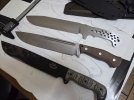
Here's a photo with two of my favorite choppers I used for reference of where the balance should be with the handles, which is estimated with two 1.5x5 micarta slabs set on the tang to simulate the weight of the shaped scales. One of them should look a little familiar...20260202_174320.jpg
 
On a chopper I agree with Nathan. Do whatever you need to get the balance right. An unbalanced chopper will wear you out and not perform like you want it to.

If you’re making hunting/field/edc type knives you can start looking at tapered and/or hollowed tangs to take a little more meat off.
I hear that. I've been using choppers out in the woods for camping, trail maintenance, and survival/bushcrafting for about a decade now and too much forward weight really stresses the forearms while too far back cuts into the performance. Two of my favorites and most carried are a BUSSE ASHBM and one of Nathan's medium choppers. I got the ASHBM two years ago and the MC this time last year.
 
I suggest heat treating before scales, in the future..... Once it's treated, put an edge on it, wrap it with tape, and then Beat on it..... You might wanna tweak the shape, and then have an understanding of what feels good in your hand while chopping
 
I suggest heat treating before scales, in the future..... Once it's treated, put an edge on it, wrap it with tape, and then Beat on it..... You might wanna tweak the shape, and then have an understanding of what feels good in your hand while chopping
Thanks Crag, this one is going out for a heat treat, bead/sand blast, and black oxide finish, so the scales had to be finished before the heat treat so that shaping them wouldn't grind the surface treatment off the tang. Normally I only rough the blade in to about 120-220 then do most of the finish work after. This one needed some extra prep work, it pretty much had to be finish specs before hardening.
 
Thanks Crag, this one is going out for a heat treat, bead/sand blast, and black oxide finish, so the scales had to be finished before the heat treat so that shaping them wouldn't grind the surface treatment off the tang. Normally I only rough the blade in to about 120-220 then do most of the finish work after. This one needed some extra prep work, it pretty much had to be finish specs before hardening.

Ahhhhh I wasn't paying attention to the finish. Gotcha. :)
I like the top handle palm swell. I find that helps with a good grip
 
Back
Top