I've been doing some reading lately and just read Cody Lundin's book. He recommends a Mora knife in carbon steel because the steel is easier to sharpen than supersteels (or stainless) and because the scandi grind creates a bevel that lends itself to ease of sharpening, as opposed to the more modern, hi-tech grinds most high dollar knives feature. I am no steel expert but my own experience has led me to some intuitive knowledge that agrees with this. Carbon steel always seems easier to sharpen to me, regardless of the grind. Lundin argues that modern steels nearly require a hi-tech sharpening device of some kind, and I have to agree with him. I wouldn't even think about using a stone on a Dozier; one, I can't maintain the angle, and two, I can't seem to make a dent in the steel because it's so hard. I can certainly see the utility of having a ready made sharpening guide incorporated into the bevel of the knife. Does anyone else feel this way? I am going to get a Mora or two to try for myself, but I'd like to know if they all are full-tang knives; if not, which ones are? Basically, does anyone else feel that modern knives are too hard, have grinds that are too hard to sharpen, and blade shapes with limited utility in many cases? Thanks, Paul.

-
The BladeForums.com 2024 Traditional Knife is available! Price is $250 ea (shipped within CONUS).
Order here: https://www.bladeforums.com/help/2024-traditional/
You are using an out of date browser. It may not display this or other websites correctly.
You should upgrade or use an alternative browser.
You should upgrade or use an alternative browser.
Question About Moras
- Thread starter pickering
- Start date
I can answer the question about tangs. The Mora knives with plastic handles do not have full tangs; they are partial tangs and the amount of tang inside the handle varies by model. There have been x-ray images of various models for comparison:
http://www.google.com/search?q=mora...h&source=og&sa=N&hl=en&tab=wi&biw=992&bih=471
The wooden handled Mora knives have full-length tangs that run to the end of the handle.
http://www.google.com/search?q=mora...h&source=og&sa=N&hl=en&tab=wi&biw=992&bih=471
The wooden handled Mora knives have full-length tangs that run to the end of the handle.
I wouldn't get too caught up in the tang thing when it comes to Mora's.....They are still very very strong and hold up to a lot of abuse. There's even (or used to be) some youtube videos proving this. For the price you simply can't beat them. Hell it's hard to beat them anyways....lol

- Joined
- Sep 15, 2002
- Messages
- 10,317
You don't need to worry about "strength" of knives, that is an over-worried non-issue. Pay more attention to quality of steel and ease of care for it. Knives are for poking, slicing and chopping, not really fro bending or prying. Moras are handed out at survival schools, and you yourself say that Cody Lundin carries one. Another famous outdoors/survival teacher, Mors Kochanski, uses them, and he wrote the book "Bushcraft".
Thanks for that info. I guess then that the full tang models are a bit stronger?
I prefer them because they're more traditional. Stronger, not necessarily considering the way in which the plastic handles are molded around the partial tangs.
And is a long skinny tang more or less likely to break than a short wide tang? I don't know for sure but the narrow width would appear to make them more vulnerable.
- Joined
- Aug 31, 2009
- Messages
- 2,696
To answer your question on ease of sharpening: YES. The scandi grinds makes it ridiculously easy for a beginner, no fussing about wondering if you are going too shallow and only hitting the shoulder of the bevel, or going to steep and making your bevel too obtuse, or what have you. You just lay it on the stone and can feel the exact angle you need to be at.

kreole
Gold Member
- Joined
- Jul 23, 2009
- Messages
- 4,553
does anyone else feel that modern knives are too hard
No, on a bet with a friend maybe a year or two ago, I bought a double-sided sharpening stone for sale for $1 at a dollar store and used it to reprofile my Benchmade 940 in S30v to paper-cutting sharp. Given that S30v is perhaps the quintessential super steel and a $1 stone could sharpen it, I can't agree with this statement.
Lundin argues that modern steels nearly require a hi-tech sharpening device of some kind
Similar to the above, absolutely any knife steel can be sharpened with a stone, and a single stone at that. People use sharpening devices because they don't know how to freehand or want better precision than they can freehand, but neither of those implies that steels today require such devices.
have grinds that are too hard to sharpen --
IMO (and I know this will meet some, perhaps strong, disagreement) the scandi grind is a horrible idea all around. The supposed purpose is to make sharpening in the field easy. Let's break that down into two parts, making sharpening easier and sharpening in the field.
It is the grind that requires taking the most metal off the knife to get it sharp. That makes it the longest to sharpen, and that contradicts that it is the easiest to sharpen.
Of course its philosophy leans on the idea that it is a mindless process to sharpen it, and that is what makes it "easiest". If you know how to sharpen a knife, you can sharpen it in the field, so the only people this is helping is the people who don't know how to sharpen properly. The real solution is to learn to sharpen your knives before taking them out into the field. ... and it is not hard to learn. I, and the rest of my cub scout troop, knew how before we learned to drive. All it takes is a cheap knife for practice and a measure of patience.
I would argue Lundin chooses softer steels because scandi grinds require taking more metal off, so super steels do not lend themselves well to the grind. Honestly, everything you cite by Lundin appears to me solely informed by him not knowing how to sharpen his knives well. All of his concerns and complaints are resolved by learning to sharpen a knife properly.
and blade shapes with limited utility in many cases
I will have to strongly disagree with this. The 'tactical' phase that knives have been going through in the last three decades or so has swayed them to make them do-everything tools. People want a knife that will cut their bagel in the morning, pry open a crate at work, and pound in that loose floorboard they notice walking in at night. In comparison, look at the traditional knives from a century ago; they each had a specific job in mind and were named for it. It is telling that you still find spey blades on knives today that aren't marketed to farmers. It is also telling that today one-blade knives make up the vast majority of tactical folder designs, while multi-blade knives, each with its own purpose, were more popular in the past. Before the more general-use designs of today people did fine, so IMO it's hyperbole to say today's blades are too limited in utility.
No, on a bet with a friend maybe a year or two ago, I bought a double-sided sharpening stone for sale for $1 at a dollar store and used it to reprofile my Benchmade 940 in S30v to paper-cutting sharp. Given that S30v is perhaps the quintessential super steel and a $1 stone could sharpen it, I can't agree with this statement.
Lundin argues that modern steels nearly require a hi-tech sharpening device of some kind
Similar to the above, absolutely any knife steel can be sharpened with a stone, and a single stone at that. People use sharpening devices because they don't know how to freehand or want better precision than they can freehand, but neither of those implies that steels today require such devices.
have grinds that are too hard to sharpen --
IMO (and I know this will meet some, perhaps strong, disagreement) the scandi grind is a horrible idea all around. The supposed purpose is to make sharpening in the field easy. Let's break that down into two parts, making sharpening easier and sharpening in the field.
It is the grind that requires taking the most metal off the knife to get it sharp. That makes it the longest to sharpen, and that contradicts that it is the easiest to sharpen.
Of course its philosophy leans on the idea that it is a mindless process to sharpen it, and that is what makes it "easiest". If you know how to sharpen a knife, you can sharpen it in the field, so the only people this is helping is the people who don't know how to sharpen properly. The real solution is to learn to sharpen your knives before taking them out into the field. ... and it is not hard to learn. I, and the rest of my cub scout troop, knew how before we learned to drive. All it takes is a cheap knife for practice and a measure of patience.
I would argue Lundin chooses softer steels because scandi grinds require taking more metal off, so super steels do not lend themselves well to the grind. Honestly, everything you cite by Lundin appears to me solely informed by him not knowing how to sharpen his knives well. All of his concerns and complaints are resolved by learning to sharpen a knife properly.
and blade shapes with limited utility in many cases
I will have to strongly disagree with this. The 'tactical' phase that knives have been going through in the last three decades or so has swayed them to make them do-everything tools. People want a knife that will cut their bagel in the morning, pry open a crate at work, and pound in that loose floorboard they notice walking in at night. In comparison, look at the traditional knives from a century ago; they each had a specific job in mind and were named for it. It is telling that you still find spey blades on knives today that aren't marketed to farmers. It is also telling that today one-blade knives make up the vast majority of tactical folder designs, while multi-blade knives, each with its own purpose, were more popular in the past. Before the more general-use designs of today people did fine, so IMO it's hyperbole to say today's blades are too limited in utility.
- Joined
- Aug 31, 2009
- Messages
- 2,696
^^picked on by scandi grinds as a child?

Maybe he prefers scandis because of their superior woodworking abilities? While being probably the most value for a few bucks you can get?
Are they the end all, be all best knife out there? Of course not, but IMO you took a few very small negatives and blew them up to epic proportions. Which I could do about convex edges, or v grinds, or thick blades, or thin blades, or carbon steel, or stainless steel, etc...
Maybe he prefers scandis because of their superior woodworking abilities? While being probably the most value for a few bucks you can get?
Are they the end all, be all best knife out there? Of course not, but IMO you took a few very small negatives and blew them up to epic proportions. Which I could do about convex edges, or v grinds, or thick blades, or thin blades, or carbon steel, or stainless steel, etc...
The current high carbon wood handled Moras have a 3/4 tang. The wood handled laminated carbon Moras have a full length skinny tang. For myself, sharpening the scandi grind on the Moras I bought helped me develop my freehand technique. I am to the point that I can put a good secondary micro bevel on my Moras. I think the carbon steel is a tad easier to sharpen than the 12C27 sandvic stainless that Mora uses.
kreole
Gold Member
- Joined
- Jul 23, 2009
- Messages
- 4,553
^^picked on by scandi grinds as a child?
Maybe he prefers scandis because of their superior woodworking abilities? While being probably the most value for a few bucks you can get?
Are they the end all, be all best knife out there? Of course not, but IMO you took a few very small negatives and blew them up to epic proportions. Which I could do about convex edges, or v grinds, or thick blades, or thin blades, or carbon steel, or stainless steel, etc...
True enough.
I do think all of his choices are motivated by not being able to sharpen well, though.
It's like anything else today, we have SOOOOO many choices. When i was a kid, the sneakers were on the side wall of the shoe store, now there are so many choices, sneakers (as i call them) have thier own store. Face it, if you love knives, you gotta go through the evolution of learning how to sharpen them, it's just part of the process. I have been doing it since before i was 10, now i am 47 & still learning things. On the plus side, my knives have NEVER been sharper. I still got lots to learn though.
- Joined
- Aug 31, 2009
- Messages
- 2,696
True enough.
I do think all of his choices are motivated by not being able to sharpen well, though.
that may be true, but for those of us without good teachers, learning on a Mora can be very helpful. I know it sort of opened my eyes on how to sharpen. It can be very disheartening learning on modern stainless knives and not fully understanding how exactly to hold the angle, what sort of pressure to use, etc... Kinda like training wheels, except that a scandi grind is still good once you have mastered sharpening.
does anyone else feel that modern knives are too hard
No, on a bet with a friend maybe a year or two ago, I bought a double-sided sharpening stone for sale for $1 at a dollar store and used it to reprofile my Benchmade 940 in S30v to paper-cutting sharp. Given that S30v is perhaps the quintessential super steel and a $1 stone could sharpen it, I can't agree with this statement.
Lundin argues that modern steels nearly require a hi-tech sharpening device of some kind
Similar to the above, absolutely any knife steel can be sharpened with a stone, and a single stone at that. People use sharpening devices because they don't know how to freehand or want better precision than they can freehand, but neither of those implies that steels today require such devices.
have grinds that are too hard to sharpen --
IMO (and I know this will meet some, perhaps strong, disagreement) the scandi grind is a horrible idea all around. The supposed purpose is to make sharpening in the field easy. Let's break that down into two parts, making sharpening easier and sharpening in the field.
It is the grind that requires taking the most metal off the knife to get it sharp. That makes it the longest to sharpen, and that contradicts that it is the easiest to sharpen.
Of course its philosophy leans on the idea that it is a mindless process to sharpen it, and that is what makes it "easiest". If you know how to sharpen a knife, you can sharpen it in the field, so the only people this is helping is the people who don't know how to sharpen properly. The real solution is to learn to sharpen your knives before taking them out into the field. ... and it is not hard to learn. I, and the rest of my cub scout troop, knew how before we learned to drive. All it takes is a cheap knife for practice and a measure of patience.
I would argue Lundin chooses softer steels because scandi grinds require taking more metal off, so super steels do not lend themselves well to the grind. Honestly, everything you cite by Lundin appears to me solely informed by him not knowing how to sharpen his knives well. All of his concerns and complaints are resolved by learning to sharpen a knife properly.
and blade shapes with limited utility in many cases
I will have to strongly disagree with this. The 'tactical' phase that knives have been going through in the last three decades or so has swayed them to make them do-everything tools. People want a knife that will cut their bagel in the morning, pry open a crate at work, and pound in that loose floorboard they notice walking in at night. In comparison, look at the traditional knives from a century ago; they each had a specific job in mind and were named for it. It is telling that you still find spey blades on knives today that aren't marketed to farmers. It is also telling that today one-blade knives make up the vast majority of tactical folder designs, while multi-blade knives, each with its own purpose, were more popular in the past. Before the more general-use designs of today people did fine, so IMO it's hyperbole to say today's blades are too limited in utility.
I did not say "impossible" to the sharpening of supersteels on stones freehand, but I bet the number of people who can truly do it is about like the number of people who can truly shoot par golf: many claim it, few can really do it. Freehanding is certainly an art, a skill, and perhaps it can be learned, but not everyone can become really good at it. I am sure that I could outshoot you with a bow, even though you might learn to be a good shot with one, relatively speaking. I would argue that if you claim to be able to sharpen a heavily recurved blade, or hawkbill, or some other "cool tactical" modern shape on a stone freehand, I'd have to see it to believe it. Not saying you can't, but I don't see it. Also, other than looking scary and cool, unless you are going to kill people with it, what practical use do those blades have? And yes, I do find knives very hard to sharpen without aids, no dispute there, but some sure have a steeper learning curve than others.
As a P.S.- I guess I haven't been overwhelmed by the so-called superiority of the supersteels in my own personal experience, and it seems like I have to wade through many brands and models to find a knife with what I consider real utility these days. Lots of them look cool, but don't look like anything I'd want to carry into the woods with me. Lundin's comments just kind of struck a nerve, I guess. I've bought several expensive knives that seem to be highly thought of but didn't seem to offer me any additional utility over an average $100 or less traditional style hunting knife, for any use. I did buy two Fallknivens that I really like, however, even though I've gone to using the Sharpmaker to sharpen them rather than the sandpaper method that's supposed to be idiot-proof. I guess I'm just an exceptional idiot!
Mora knives are great. The Scandi grind is an insanely sharp edge (if properly done), and very easy to maintain. You have to watch out with the Mora carbon steel though, it rusts very easily, and is very prone to pitting. On a side note, does Lundin say what kind of Mora knife he uses? It looks like a #1 or 2 with Damascus steel, but i bet I am wildly off.

- Joined
- Mar 26, 2010
- Messages
- 1,736
I dont think that modern steels are too difficult to sharpen, in the field you can take along a small diamond stone, they weigh almost nothing, and the edge lasts for so long, that unless you are stranded for a very long time without your stone, I don't think you will have any issues.
However, carbon steel perform great, and often offer better values, but depending on how and where you use your knives, it may be better to get stainless. Plus, stainless knives stay looking nicer after use.
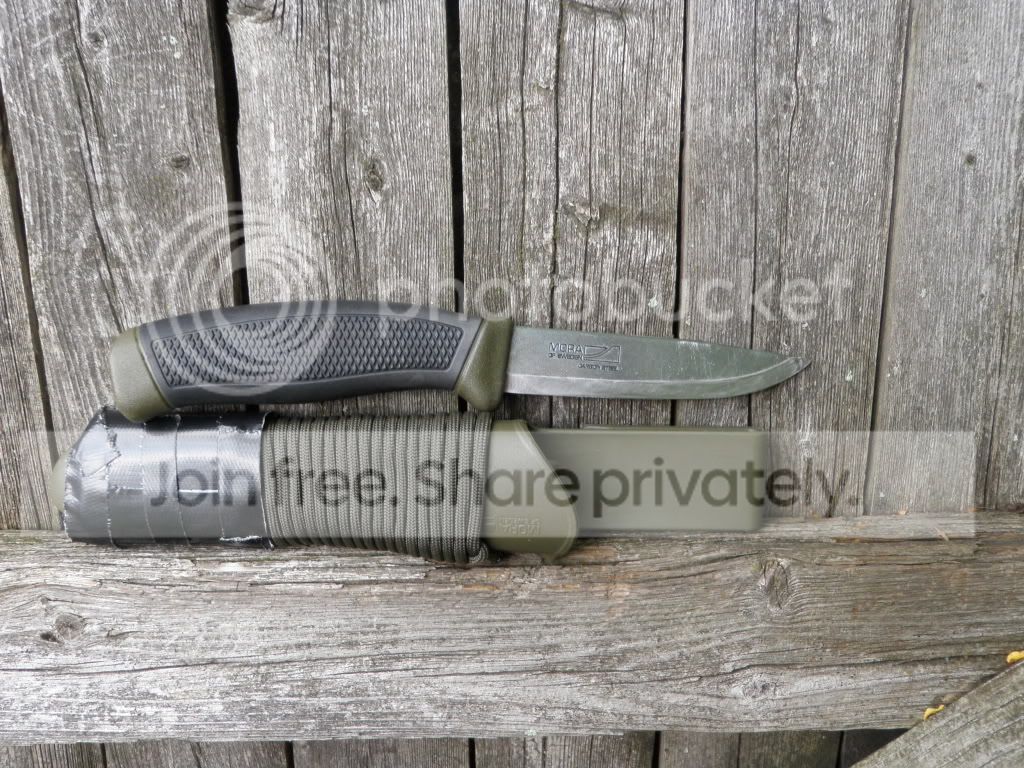
However, carbon steel perform great, and often offer better values, but depending on how and where you use your knives, it may be better to get stainless. Plus, stainless knives stay looking nicer after use.
Dude you will not be disappointed in Mora...just won't happen. They are easy to sharpen, carbon and stainless, carbon just a little more so. They are crazy sharp. They micro-bevel very nicel at 30 degrees in the field without compromising the scandi geometry. Sure, fancier knives will always interest you. But you'll end up like me, with a Mora in every junk drawer, toolbox, tackle box, work bench, and even in the kitchen.
I'll be 90% of the people the world over who really need a knife, would never need anything other than a Mora. Super steels have a place too and I have some of those (CPM S30V, VG-10 right now...CPM 3V some day) but I will always have a Mora handy.
I'll be 90% of the people the world over who really need a knife, would never need anything other than a Mora. Super steels have a place too and I have some of those (CPM S30V, VG-10 right now...CPM 3V some day) but I will always have a Mora handy.

- Joined
- Mar 8, 2008
- Messages
- 26,283
If you want a longer tang just look at the new TopQ All-Around, Companion, and Bushcraft Force.