Most if not all files have soft tangs. If not you would likely break it off when using it. I would assume that the files are held by the tangs in a rack of some sort, and dipped in brine with the tang never going in and being quenched. Rick, I talked to Nicholson years ago, and was told that they still use the same steel as they did during the 1860's. Seems like everyone who talks to them gets a little different story. I have read two different analysis reports and both said basicly 1095 with a little extra carbon. Having worked with both for blades, I would tend to agree with the analysis. Both acted very similar, but the 1095 got a little harder, and required a higher temper heat. Now that could possibly be from a finer grain than I was getting with 1095. I really don't know, but they make excellent blades.

-
The BladeForums.com 2024 Traditional Knife is available! Price is $250 ea (shipped within CONUS).
Order here: https://www.bladeforums.com/help/2024-traditional/
You are using an out of date browser. It may not display this or other websites correctly.
You should upgrade or use an alternative browser.
You should upgrade or use an alternative browser.
Question about re-tempering old files
- Thread starter Happy Face
- Start date

- Joined
- Jan 6, 2005
- Messages
- 9,680
That's cool LRB. I was told that they stopped buying overseas in the late 1800's and the remaining stock finally dwindled off in the the early 1900's It wasn't called W1 but was very similar in compostion. (It was from Sheffield England) This was about the time that North America's steel quality was improving. Nicholson went with US suppliers (1095) and never looked back.
Shoot me an email and I'll send you the old document I have.... really interesting stuff.
Rick
Shoot me an email and I'll send you the old document I have.... really interesting stuff.
Rick

Nathan the Machinist
KnifeMaker / Machinist / Evil Genius
Moderator
Knifemaker / Craftsman / Service Provider
- Joined
- Feb 13, 2007
- Messages
- 19,552
Two observations:
One, this is such a cool forum. Good quality people here. I think, at least to some extent, Kevin Cashen has achieved his goal in that solid metallurgical knowledge is fairly well disseminated across us unwashed heathens.:thumbup:
Two, sadly, Nicholson files is moving their operations off shore. This wasn't because their current operation was unprofitable (it was profitable) but because new management saw an opportunity to beef up their bonuses in a move that will probably eventually wreck the brand. Offshoreing, when it keeps the cost of goods down, can be a good thing. When it is for temporary profiteering at the expense of an excellent old American brand, it is a sad thing. So many really good brands are junk now. Going forward, I wouldn't just assume that a Nicholson file is necessarily good steel.
Three (yeah, I thought of another observation) I think we all have a lot of respect for Dan, I know I do. Occasionally even really awesome folks misspeak.:thumbup:
One, this is such a cool forum. Good quality people here. I think, at least to some extent, Kevin Cashen has achieved his goal in that solid metallurgical knowledge is fairly well disseminated across us unwashed heathens.:thumbup:
Two, sadly, Nicholson files is moving their operations off shore. This wasn't because their current operation was unprofitable (it was profitable) but because new management saw an opportunity to beef up their bonuses in a move that will probably eventually wreck the brand. Offshoreing, when it keeps the cost of goods down, can be a good thing. When it is for temporary profiteering at the expense of an excellent old American brand, it is a sad thing. So many really good brands are junk now. Going forward, I wouldn't just assume that a Nicholson file is necessarily good steel.
Three (yeah, I thought of another observation) I think we all have a lot of respect for Dan, I know I do. Occasionally even really awesome folks misspeak.:thumbup:
- Joined
- Jul 13, 2009
- Messages
- 21,855
That's cool LRB. I was told that they stopped buying overseas in the late 1800's and the remaining stock finally dwindled off in the the early 1900's It wasn't called W1 but was very similar in compostion. (It was from Sheffield England) This was about the time that North America's steel quality was improving. Nicholson went with US suppliers (1095) and never looked back.
Shoot me an email and I'll send you the old document I have.... really interesting stuff.
Rick
I'd love that document.
Please email to the account in my profile
I have made a bunch of file knives in my spare time. I primarily utilize horseshoe rasps, but also use big, thick files suited for metal removal. I DO NOT use current production knives, but, rather go with the old vintage stuff...40-50 years old if I can find it. Turn of the century stuff? Great! That being said, I love Nicholson and have not had a bad one yet. Heller is great, Save Edge too. I stay away from Belotta files, as they are from Brazil and quality control is not as good at the red, white and blue stuff.
To start off with I heat the file to non-magnetic and quench the tip in water...yep, water. At this point in time I am only testing the file for suitability as a knife. After the too-rapid water quench, I then attempt to break off only the first 2" or so of the tip. I strike it with a hammer while the edge is hanging over my anvil. If it is "good" steel, it will break like glass...absolutely just snap off with no effort at all! You will see the fine grain structure that confirms this file is a good one. If it is a bad file, the sharp blow from the hammer will only bend the tip over the edge of the anvil like a wet noodle....throw the file away...no good.
Then I put it in my forge, heat to non-magnetic and let it rest/anneal in a bucket of vermiculite over night. She will then be soft and can be cut, ground, etc with no problems. After I have a blade, then we heat to non-magnetic in the forge for a little over two minutes once non-magnetic is reached....two, three minutes will do. I then edge quench in oil heated to 140 degrees. I use Brownells Tough Quench and use a thermometer to check the temp before edge quenching. Following the quench I temper in my oven at 400 degrees for two hours until I get a nice "straw" color on the blade...might need two temper cycles to get the straw color.
Following this, I grind and polish to finish out the blade and attach the guard and handle. I usually do a satin finish, which seems to work best with this steel. It will take a mirror polish, no problem....satin just looks better IMO.
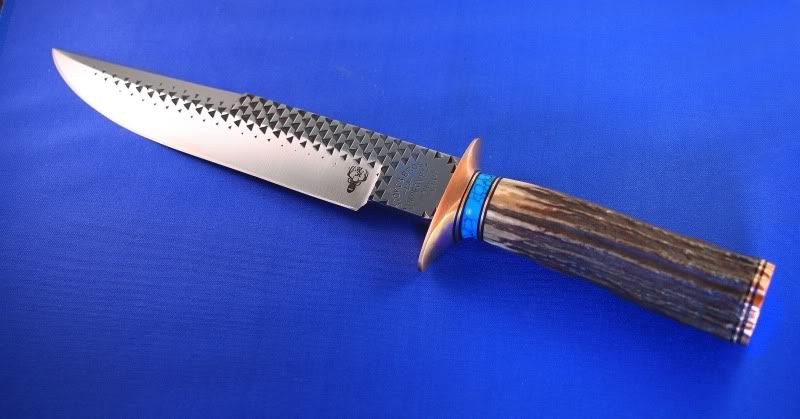
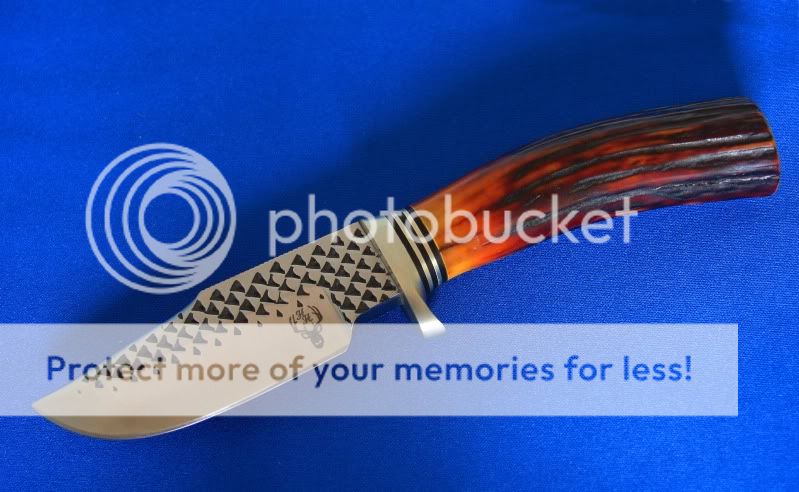
Here are some of my file knives and how they turn out. Good luck!
To start off with I heat the file to non-magnetic and quench the tip in water...yep, water. At this point in time I am only testing the file for suitability as a knife. After the too-rapid water quench, I then attempt to break off only the first 2" or so of the tip. I strike it with a hammer while the edge is hanging over my anvil. If it is "good" steel, it will break like glass...absolutely just snap off with no effort at all! You will see the fine grain structure that confirms this file is a good one. If it is a bad file, the sharp blow from the hammer will only bend the tip over the edge of the anvil like a wet noodle....throw the file away...no good.
Then I put it in my forge, heat to non-magnetic and let it rest/anneal in a bucket of vermiculite over night. She will then be soft and can be cut, ground, etc with no problems. After I have a blade, then we heat to non-magnetic in the forge for a little over two minutes once non-magnetic is reached....two, three minutes will do. I then edge quench in oil heated to 140 degrees. I use Brownells Tough Quench and use a thermometer to check the temp before edge quenching. Following the quench I temper in my oven at 400 degrees for two hours until I get a nice "straw" color on the blade...might need two temper cycles to get the straw color.
Following this, I grind and polish to finish out the blade and attach the guard and handle. I usually do a satin finish, which seems to work best with this steel. It will take a mirror polish, no problem....satin just looks better IMO.
Here are some of my file knives and how they turn out. Good luck!

james terrio
Sharpest Knife in the Light Socket
- Joined
- Apr 15, 2010
- Messages
- 22,618
Two, sadly, Nicholson files is moving their operations off shore.
I've bought several new Nicholsons in the last few weeks and they were all made in Brazil. Seem to work just fine so far, but it worries me.
Godogs, those are gorgeous :thumbup:

DanGraves
Knifemaker / Craftsman / Service Provider
- Joined
- Mar 5, 2006
- Messages
- 2,700
Well I have learned a few things. What I said was nothing more than what I was taught at the ABS school in Washington Arkansas by a mastersmith 15 yrs ago. Since then I have also learned that not all mastersmiths say the same thing. I looked at them as some sort of God like figure and took notes with yerning to make a good knife. I remember that he took a file and broke it and passed it around to show the grain. It was sandy looking. He then normalized the file and did the same thing after a quench in water (smooth grain). Now I dont know but maybe he had heated it to a high temp. before he broke it the 1st time. Anyway, I have learned here to keep my mouth shut from here on.
- Joined
- Jan 6, 2005
- Messages
- 9,680
Dan, we are all learning here... throwing around ideas and opinions. I am only a beginner and the more I study metallurgy, the more I realise how little I know. I don't think there is a single topic where folks won't have a difference of opinion. You are a wealth of knowledge... to keep that to yourself would be a disrespect to the folks who helped you to get where you are today.
Rick
Rick

- Joined
- Apr 17, 2009
- Messages
- 627
Hi Happy Face. It doesn't sound like you have the equipment to normalize X3 then re-heat-treat the blade fully, so we can just talk about tempering here. So, to learn a bit, take the first suggestion of tempering to 400 in your oven for an hour and let cool. Do it again two more times at 1 hr each soak. Grind your blade, sharpen it and start cutting. Cut knots in pine, strike into Elk antler. Know how to do the famous "brass-rod test?" See what happens with your edge. My bet is that the edge will very easily chip. Also, keep a notebook and log exactly what you did and for how long and with what type of file.)
Temper it again at 425 X 3 for 1hr each. Re-sharpen and re-test. I'm guessing the suggestion for tempering at 450 is going to be about right. This is the only way you are going to know for sure using your files - in your oven - in your shop. Let us know how it went and then we can go from there.
-M
Temper it again at 425 X 3 for 1hr each. Re-sharpen and re-test. I'm guessing the suggestion for tempering at 450 is going to be about right. This is the only way you are going to know for sure using your files - in your oven - in your shop. Let us know how it went and then we can go from there.
-M
I found these youtubes at http://www.britishblades.com/forums/showthread.php?122480-My-new-knifemaking-video-series.../page2&highlight=michael+morris and maybe there is an answer to all these questions here:
http://www.youtube.com/watch?v=DupWsV-iiys
http://www.youtube.com/watch?v=SlsQrQ3aLuQ&feature=related
http://www.youtube.com/watch?v=hvdViLhNuT8&feature=related
http://www.youtube.com/watch?v=DupWsV-iiys
http://www.youtube.com/watch?v=SlsQrQ3aLuQ&feature=related
http://www.youtube.com/watch?v=hvdViLhNuT8&feature=related

- Joined
- Aug 27, 2004
- Messages
- 2,529
Hi Happy Face. It doesn't sound like you have the equipment to normalize X3 then re-heat-treat the blade fully, so we can just talk about tempering here. So, to learn a bit, take the first suggestion of tempering to 400 in your oven for an hour and let cool. Do it again two more times at 1 hr each soak. Grind your blade, sharpen it and start cutting. Cut knots in pine, strike into Elk antler. Know how to do the famous "brass-rod test?" See what happens with your edge. My bet is that the edge will very easily chip. Also, keep a notebook and log exactly what you did and for how long and with what type of file.)
Temper it again at 425 X 3 for 1hr each. Re-sharpen and re-test. I'm guessing the suggestion for tempering at 450 is going to be about right. This is the only way you are going to know for sure using your files - in your oven - in your shop. Let us know how it went and then we can go from there.
-M
Good solid advice there. Everyone has to start somewhere and with a little sound advice, a little study, and a lot of trial and error, you can eventually get most things figured out.
Hang in there and give it a try. Its a long, long journey, but it sure is fun.
Robert