Question about Viking daggers/swords...

Phillip Patton

Knifemaker / Craftsman / Service Provider
Joined
Jul 25, 2005
Messages
5,382
...I'm making a dagger with two pieces of damascus for the core. I'm wondering which is the more historically accurate type of construction: using pattern welded material for the edge, or solid steel for the edge?
I've seen it both ways, but I seem to remember in Ewart Oakeshott's books that most of them had steel on the edges, and patterned steel in the cores.

Thanks,
Phillip
 
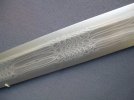
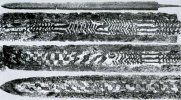
Here's a reproduction in a british museum and some originals !
 

Attachments

  • Viking-1.jpg
    Viking-1.jpg
    58.7 KB · Views: 137
  • Viking-2.jpg
    Viking-2.jpg
    75.2 KB · Views: 134
I'm guessing 900-1000 ? There was a History Channel program that showed one of the very few blade makers still using the old techniques .Fascinating to watch like going back in a time machine !
 
that is the very thing that aroused my interest in blades... the fact that in the ages before we were "civilised" there were true artists in metal plying there trade sans computers and belt grinders and that relics from that age are still held in such high regard.
oh BTW mr patton be sure to post a pic when you get done :)
 
Here's a reproduction in a british museum and some originals !

Cool pics, but they don't really help me make up my mind. I guess it's up to me whether I use damascus or plain steel. Hmmm. For simplicity sake, I'll probably just go with plain steel. :D

docdredd, I will definitely post pics, IF I am successful. :) So far so good.
I've got the cores welded, twisted, and welded together. Next step is welding on the edge piece. That'll be fun. :rolleyes: Especially the tip area. :barf:
 
Phillip,
it's my understanding that the pattern welded cores purpose was to support a steel edge, the steel of the day not being dependable for the whole blade.
big fan of your work by the way, Id love to see what you come up with.
 
Phillip,
it's my understanding that the pattern welded cores purpose was to support a steel edge, the steel of the day not being dependable for the whole blade.
big fan of your work by the way, Id love to see what you come up with.

Yes, that's my understanding also. I'm just wondering aesthetically speaking, which do most people prefer. :confused:
 
Well, I decided to go with 1084 for the edge piece. The cores are 1084 and 15n20.

Here's a sneak preview.

Ground to 240 grit then etched:

doublecore2.JPG


The pattern will change as I grind in the edge bevels. I was going to fuller this blade, but I think it's too narrow. What do you all think? It's about 1-1/8" wide.
 
The legends I've read speak of the pattern in the fuller. I am hoping to make a viking damascus blade before Ashokan which will (hopefully) have twist patterns in the center and flat random on the edges.
My very limited experience with bloom steel tells me that there would be some pattern to the whole blade just from consolidation, but the edges would be steeled, and the core would be a pattern mix of steeled and wrought. I want to see whatever you end up making when it's done!

-Page
 
The originals did a lot more twisting but you'res is a nice pattern. I would think a fuller would be ok provided that it was no wider than 1/4" and it would depend on whether the blade was thick enough.
 
sweet blade. It's amazing how many times I have to explain that the norse DID fold metal a thousand years ago- and there are people out there who simply refuse to believe that the vikings had steel instead of pig iron.
 
The cores were patterned with the twisting and could have contained differential makeup due to chemistry differences, different levels of phosphorus has been found. The edges were of piled construction or mechanically refined bloomery steel, This would have given them a look like wrought iron or random pattern welding.
 
Well, I decided to go with 1084 for the edge piece. The cores are 1084 and 15n20.

Here's a sneak preview.

Ground to 240 grit then etched:

doublecore2.JPG


The pattern will change as I grind in the edge bevels. I was going to fuller this blade, but I think it's too narrow. What do you all think? It's about 1-1/8" wide.

This will be nice. Good tight twists. When you grind, there will be the pattern you're looking for. Definitely do a fuller IMO!
 
Looking at the picture, I can tell how you twisted them up and it is the way I preferred to do it if I could get a way with it even though it is not traditional. Your, and most of mine, chevrons reverse direction after the straight-line sections, this works well for ease of symmetrical twisting and evening out the pattern on the opposite side of the blade if one layer of core bars are use, however the vast majority of original ancient pieces always had the chevrons running in the same direction, much more difficult to do and requiring incredible skill to keep things even and symmetrical. The opposite sides often matched due to the fact that two layers of core bars were used. I have done a few the old way and it challenge me quite well. Those old Migration Era, and early Viking age pieces were not just simply welded together, they were on a magnitude of welding that almost no other culture ever reached, though the guys making the kriss blades in the east came real close.

If you want it to look more like a Saxon period blade similar to what has been found in areas like Kent I would grind little out of the middle and allow the straight herring bone to remain. If you want to have a look more like those from the continent, Merovingian or Germanic, grind a fuller and bring out those star bursts.
 
Back
Top