Question: Framelock lock face

Joined
Nov 19, 2014
Messages
2,633
Hi all,

I got my first framelock knife (Southard Tolk).

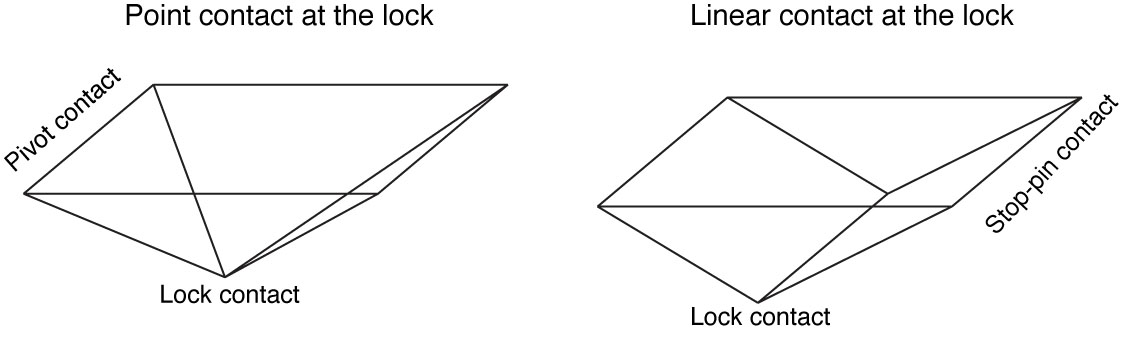
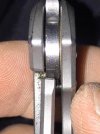
When I looked at the contact between the lock bar and the blade, it looks like the Ti lock bar secures the blade only with its edge.
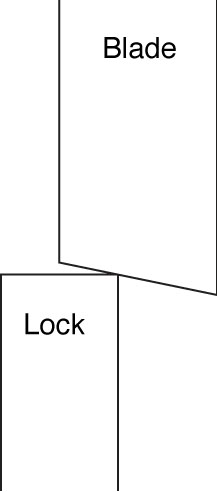
I can't take a picture of it, so providing an illustration.

My question is whether this is normal, or something I should be concerned of.
Lock.JPG


I would appreciate your opinions.

Nevertheless, the blade is locked solid, and there is no play. I also tried the STR's lock test, and it withstood the pressure well.


Miso
 
Yes, very normal and within time and use it may set up with more of the frame lock positioning itself further along the knife.
 
For the best strength, in theory, the lock face should only contact the blade at one POINT, i.e. it's not intended that the lock face contact with the blade should be along its entire surface. The opposite in fact It should only touch in a very small area....one point, not a lot of contact area. Exactly as your sketch shows.

Perhaps someone can explain the structural physics of this better than I can. I know it all relates to the pivot/stopbar/lockbar 'triangle' for maximum strength and rigidity.

EDIT: I think I saw an illustrated explanation of this buried somewhere in the "blade" or "blade shapes" section of the Emerson web site.
 
Last edited:
I don't know the physics either but I have a custom Emerson CQC-15 that looks just like that. I know that Ernie's philosophy is the "triangle" type interface with one point of contact. I've had two other custom Emerson's with the same type of lockup, no issues from either of them
 
For the best strength, in theory, the lock face should only contact the blade at one POINT, i.e. it's not intended that the lock face contact with the blade should be along its entire surface. The opposite in fact It should only touch in a very small area....one point, not a lot of contact area. Exactly as your sketch shows.

Perhaps someone can explain the structural physics of this better than I can. I know it all relates to the pivot/stopbar/lockbar 'triangle' for maximum strength and rigidity.

EDIT: I think I saw an illustrated explanation of this buried somewhere in the "blade" or "blade shapes" section of the Emerson web site.


I guess this is the web page you mentioned.
http://emersonknives.com/get-know-knife/

But to me, it still seems counterintuitive......


Miso
 
Should it be a point or a line (side) for the contact?

Miso

In theory, a point...but don't eat yourself up over it. It's probably fine even it it looks like the whole 'line' is making contact. The Southard is a good knife.

I guess this is the web page you mentioned.
http://emersonknives.com/get-know-knife/

But to me, it still seems counterintuitive......

No, it's the page RevDevil links above.

Note Item 3 in the "correct" vs. "incorrect" lock relationship toward the bottom of the page. Evidently having contact on just a 'point' of the blade surface provides greater strength/performance than having full contact with it.

Yeah, it's counter-intuitive and a few people may be learning this for the first time. Only theory I can think of is that a lot more force is applied to a 'point' as opposed to the entire face when in use (pure physics) thus holding the entire setup more securely....or at least it's better for the knife to be this way. It could also be that more surface contact equals more wear over time too.

After discovering this a long time ago, I closely examined some of my higher-end folders and it seems to hold true in their manufacture as well, although with tighter tolerances on some it can be hard to see that only a point is making contact as opposed to along the whole lockface.

I'm sure there's a slew of theoretical physics to it that, as I said, can be explained by someone else far better than can I.

EDIT: Point is, don't sweat it. If the knife performs, it's fine. Over time and with use you may get enough travel to make you feel more secure in the lockup. You have a good knife and the diagram you used is as it should be. Use it and enjoy.
 
Last edited:
In theory, a point...but don't eat yourself up over it. It's probably fine even it it looks like the whole 'line' is making contact. The Southard is a good knife.


No, it's the page RevDevil links above.

Note Item 3 in the "correct" vs. "incorrect" lock relationship toward the bottom of the page. Evidently having contact on just a 'point' of the blade surface provides greater strength/performance than having full contact with it.

Yeah, it's counter-intuitive and a few people may be learning this for the first time. Only theory I can think of is that a lot more force is applied to a 'point' as opposed to the entire face when in use (pure physics) thus holding the entire setup more securely....or at least it's better for the knife to be this way. It could also be that more surface contact equals more wear over time too.

After discovering this a long time ago, I closely examined some of my higher-end folders and it seems to hold true in their manufacture as well, although with tighter tolerances on some it can be hard to see that only a point is making contact as opposed to along the whole lockface.

I'm sure there's a slew of theoretical physics to it that, as I said, can be explained by someone else far better than can I.

EDIT: Point is, don't sweat it. If the knife performs, it's fine. Over time and with use you may get enough travel to make you feel more secure in the lockup. You have a good knife and the diagram you used is as it should be. Use it and enjoy.


EChoil,

Thank you for the explanation.
I am pretty comfortable with the lock security of my Tolk.
I am just curious.


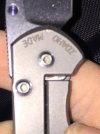
What I am comparing here are two types of putative contact at the lock.
Lockface.JPG


To me, the configuration on the right seems more secure than that on the left, if all three contact sites are perfectly executed.
Since the pins and the cut faces of the blade can be virtually perfectly straight and flat, the contact lines at the pivot and the stop-pin could be almost perfect.

In contrast, the lock face of the blade is ground with an angle, it might be little difficult to make a perfect line contact there.
If not perfect, the blade may have a play.

But a point contact can be made much easily, and with the perfect line contacts at the pivot and the stop-pin, the left configuration can be both secure and play-free.

I think that a line contact would be ideal both in the strength and limiting wear.
A point contact would cause more wear because the force is concentrated to a small area.
We can see this kind of wear on the blade face where a detent ball runs.

So my guess is that the point contact is more executable without having a blade play.

Please chime in.


Miso
 
EChoil,

Thank you for the explanation.
I am pretty comfortable with the lock security of my Tolk.
I am just curious.


What I am comparing here are two types of putative contact at the lock.
Lockface.JPG


To me, the configuration on the right seems more secure than that on the left, if all three contact sites are perfectly executed.
Since the pins and the cut faces of the blade can be virtually perfectly straight and flat, the contact lines at the pivot and the stop-pin could be almost perfect.

In contrast, the lock face of the blade is ground with an angle, it might be little difficult to make a perfect line contact there.
If not perfect, the blade may have a play.

But a point contact can be made much easily, and with the perfect line contacts at the pivot and the stop-pin, the left configuration can be both secure and play-free.

I think that a line contact would be ideal both in the strength and limiting wear.
A point contact would cause more wear because the force is concentrated to a small area.
We can see this kind of wear on the blade face where a detent ball runs.

So my guess is that the point contact is more executable without having a blade play.

Please chime in.


Miso

Depends on how microscopic you want to get.

If you want to be literal, a "point" is infinitesimal and something one can chase forever. Depending how deep you go into the molecule, at some point that point becomes a line....I don't know.

Maybe Mr. Emerson covers this more in some of his writings in here. Or a metallurgist or two may come along.

Frankly it's beyond my knowledge of architecture at this point. I only know it works.
 
Depends on how microscopic you want to get.

If you want to be literal, a "point" is infinitesimal and something one can chase forever. Depending how deep you go into the molecule, at some point that point becomes a line....I don't know.

Maybe Mr. Emerson covers this more in some of his writings in here. Or a metallurgist or two may come along.

Frankly it's beyond my knowledge of architecture at this point. I only know it works.


That is not what I meant.
Looking at the lock contact site of my Tolk, I realized that the lock bar touches the blade at its corner rather than its side.
So, it looks more like a point contact you described.

Then, out of curiosity, I wondered if the lock bar should hold the blade with its entire side.
That was what I tried to illustrate and compare.

Anyway, another potential benefit of a point contact is to minimize lock stick.


Miso
 
That is not what I meant.
Looking at the lock contact site of my Tolk, I realized that the lock bar touches the blade at its corner rather than its side.
So, it looks more like a point contact you described.

Then, out of curiosity, I wondered if the lock bar should hold the blade with its entire side.
That was what I tried to illustrate and compare.....

Referring back to the Emerson illustration and Figure 3, the WIDTH of the lock bar, maybe; the LENGTH of the lock bar, no.

As I mentioned, on some of the better knives the rise of the lock bar off the blade may be almost imperceptible.

Don't forget that some of this can relate back to the curvature the manufacturer built into the blade's lock contact surface (the 'wear-curve,' so to speak), both laterally and spherically. Both surfaces impact the theory you're discussing here, not just the lock face. It's the shape of both surfaces that actually determines the "point" of contact.
 
Last edited:
:D But wait ! There is more! There is also Terzuola's modification of the Walker's lock where the lock face of the blade is actually curved...
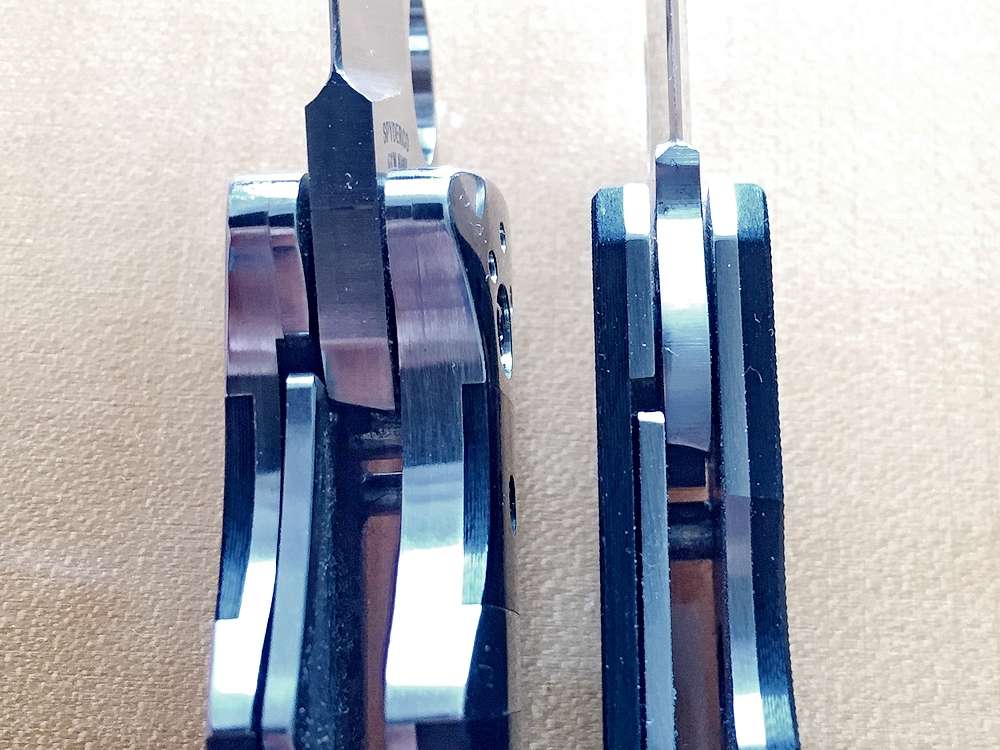
Vallotton on the left, FOX terzuola on the right:

Z8w5F8.jpg
 
ImageUploadedByTapatalk1446173392.432074.jpg
ImageUploadedByTapatalk1446173405.389310.jpg
As seen I n the top pic, a quality knife should have the lock bar cut out at an angle so as to mate with the blade tang with all overlapping surface area. In the bottom pic, it is theorized that only the bottom, farthest part from the pivot, or from this angle, the rightmost points of the lock face and tang should meet.

IMO your knife is not made ideally, but it will
pass.

Edit: That's one gunky looking Sebenza! Haha.
 
Thank you all for interesting points.

First of all, I want to make it clear that I am not concerned with the lock of my knife.
I am just curious about what would be ideal.

Now there are two sets of opinions.
On one, the contact area between the blade and the lock bar should ideally be small.
I guess the Emerson web site backs this.

On the other, the contact area should be large, and the two faces should be parallel when engaged.
The pictures of a Sebenza archieblue posted support this idea.

Intuitively, I would agree with the latter but not sure.
Could any physicists or knife makers chime in?


Miso
 
Back
Top