Question on anvils.

Joined
Apr 28, 2012
Messages
6
So as the title suggests I have a question related to anvils.

Right now I've been using a piece of railroad track as an anvil all the while keeping an eye open for a real anvil, most of the ones I've found are either cast iron or the seller is wanting a price higher than what I can pay.

If I were to go to a metal company and get them to cut several lengths of steel and then I stacked them and had them welded would that make an acceptable anvil?

Or would I be better with my rail road track?
 
Unlikely that a composite anvil will result in very substantial savings in my opinion. Metal for making the hardface plus the mass steel plus welding supplies and a highly skilled welder could add up fast. Access to scrap and welding up yourself might change equation. Good luck
 
You could order a large block of 4140 from a steel supplier. It wouldn't be hardened, and wouldn't really be cheap. It would be flat and heavy. A 100 block will make a usable anvil. It could be hardened by a metal shop or by Peter's, but that would add to the cost.

It is best to just keep an eye out for a proper anvil to turn up.
 
So unless I can get the steel cheap or free it's better to just stick with my railroad track.
 
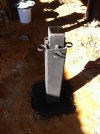
Ive been using a piece of railroad for a anvil but last week i took a 4' piece of track and stood it up vertical. I only have a small spot to forge on but the difference is incredible. I can move some metal 20 times faster than with the flat piece of track. I will be using the t section of the track for different applications. If you have access to a longer piece that you can stand on end you might be happy with it.
 
Yes, a section of RR track on end puts all its mas under a very small area. It will work much better that way. Many folks stick it in a bucket of cement. Getting a 4X3X7" piece of 4140 and welding it on the top of the end will make a very suitable post anvil. It could be a block of any steel, but 4140 works quite well.
 
Yes, a section of RR track on end puts all its mas under a very small area. It will work much better that way. Many folks stick it in a bucket of cement. Getting a 4X3X7" piece of 4140 and welding it on the top of the end will make a very suitable post anvil. It could be a block of any steel, but 4140 works quite well.
So is there anything specific that has to be done, other than welding it? I'm assuming that a mig welder is going to be acceptable since it's what I own.
 
I've played around with building an anvil, and it's doable. A PITA, but it's doable. I did a test piece and after figuring the time, effort, trouble of heat treating that big of a chunk of steel, I figured it'd be easier and cheaper to just buy a decent one. I used to have a makeshift anvil years ago that I welded a hard face too, a 3/4" piece of spring steel, multiple passes of 7018 around the beveled edges. Worked well till I needed to use heavy blows, then the welds would crack. I watched a couple of youtube videos about building one up and welding the face on with a 3/8" spacer in the center to allow for nearly 100% weld penetration vs just the edges. I did a small test piece and it worked. If i was to do it I'd use a gas shielded MIG though, not a stick or flux core machine. And then your left with heat treating a couple hundred pound chunk of steel. Heating to critical isn't the hard part, getting enough water flow to quench is the problem. I built a post anvil from a 12"x4"x4" piece of 4140 and a 55 gallon drum of water didn't harden it, I wound up mixing up 35 gallons of super quench to get it to harden properly, and I only heated about 1/3" of the end to critical. Anyway, it's great for blade work and very solid sitting in a larger tube filled with sand and wedged in place. I figure I've got about 200$ in the post anvil, including the materials to make the super quench.
 

Attachments

  • IMG_0665.jpg
    IMG_0665.jpg
    40.7 KB · Views: 14
Back
Top