Question on Osoraku-Zukuri Tanto Blade Shape

Joined
Nov 20, 2008
Messages
10,188
Hi Guys,

I just got some of Aldo's W-2 (hehe), and I want to try my hand at a Japanese style blade. I like the idea of the Osoraku-Zukuri shape, but after quite a bit on online reseach haven't been able to find a picture which really shows the shape clearly. If someone can post a picture of this style of blade which clearly shows the shape I'd appreciate it.

One more question, why did the old time Japanese makers fold monosteel blades? What advantage did they gain? Would folding a monsteel even show layers? And finally, do we modern makers need to fold a monosteel blade?

Thanks Guys,

Dave
 
Their steel making methods had lots of inclusions especially silica from the iron bearing sand they used. The hammering out and folding process spread out , broke up the inclusions and made the steel more homogeneous.
Modern steels are already homogeneous so folding them does nothing to improve them !
 
I can only comment on the monosteel bit, Dave. I would imagine that even the homogenous steel back then had some impurities and defects. The more the steel is drawn out folded and reduced, the more these "defects" get spread out and become less of an impact on the steels performance. I'm not sure if the Japanese looked for pattern by the way of damascus, as they did in the beautiful hamon lines. I'm sure the ancient Japanese smiths would have loved to get a hold of the highly refined homogenous steel available today. I bet there would be less emphasis on differential heat treatment and more on tempering. Just an opinion.... the Japanese did the best anyone could, with what they had at the time. It just keeps getting better and better with modern metallurgy.

Rick

ETA: Mete beat me by 1min..... bah.
 
you guys are great. Thanks for replying so quickly. the reason I asked the questions about folding monsteel is I thought pretty muchthe same as your replies, but just wasn't sure.

The Osoraki-zukri blade shape is one of the pointest blades the Japanese made; from what I've been able to determine, it's a fairly rare style of blade. I asked the same question over in the sword forum, so maybe they can assist.

again, thanks

Dave
 
Look for Carlo Giuseppe over there for help with photos and info on the style. If he's still around, he's a fount of knowledge.
 
Hi Guys,

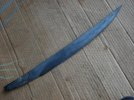
I found a decent picture of the type of blade i was looking for. It's a tanto, blade approx. 15", made by John Smith.

Dave
 

Attachments

  • Osoraku-Zukuri tanto.jpg
    Osoraku-Zukuri tanto.jpg
    60.1 KB · Views: 151
One of my favorite shapes:
http://www.ksky.ne.jp/~sumie99/ns8.html
http://image1.shopserve.jp/www.munemasa.co.jp/pic-labo/1212-102-850.jpg
http://forums.dfoggknives.com/index.php?showtopic=16015

To really get the effect, make it come to a fine point, like a fillet knife. The kissaki should go all the way to the center of the blade.
One reason this is an uncommon blade type is the difficulty in the togi.
An alternate style is having the blade taper from the saki to the yokote, and then reverse taper a bit back toward the machi.
 
Last edited:
Thanks Stacy

That's some good stuff. I also appreciate the advice. One question, in the picture I've attached, it looks like a layered grind, for lack of a better term. Do you know what it is, and can you clarify?

Dave
 

Attachments

  • tanto grind.jpg
    tanto grind.jpg
    11.5 KB · Views: 94
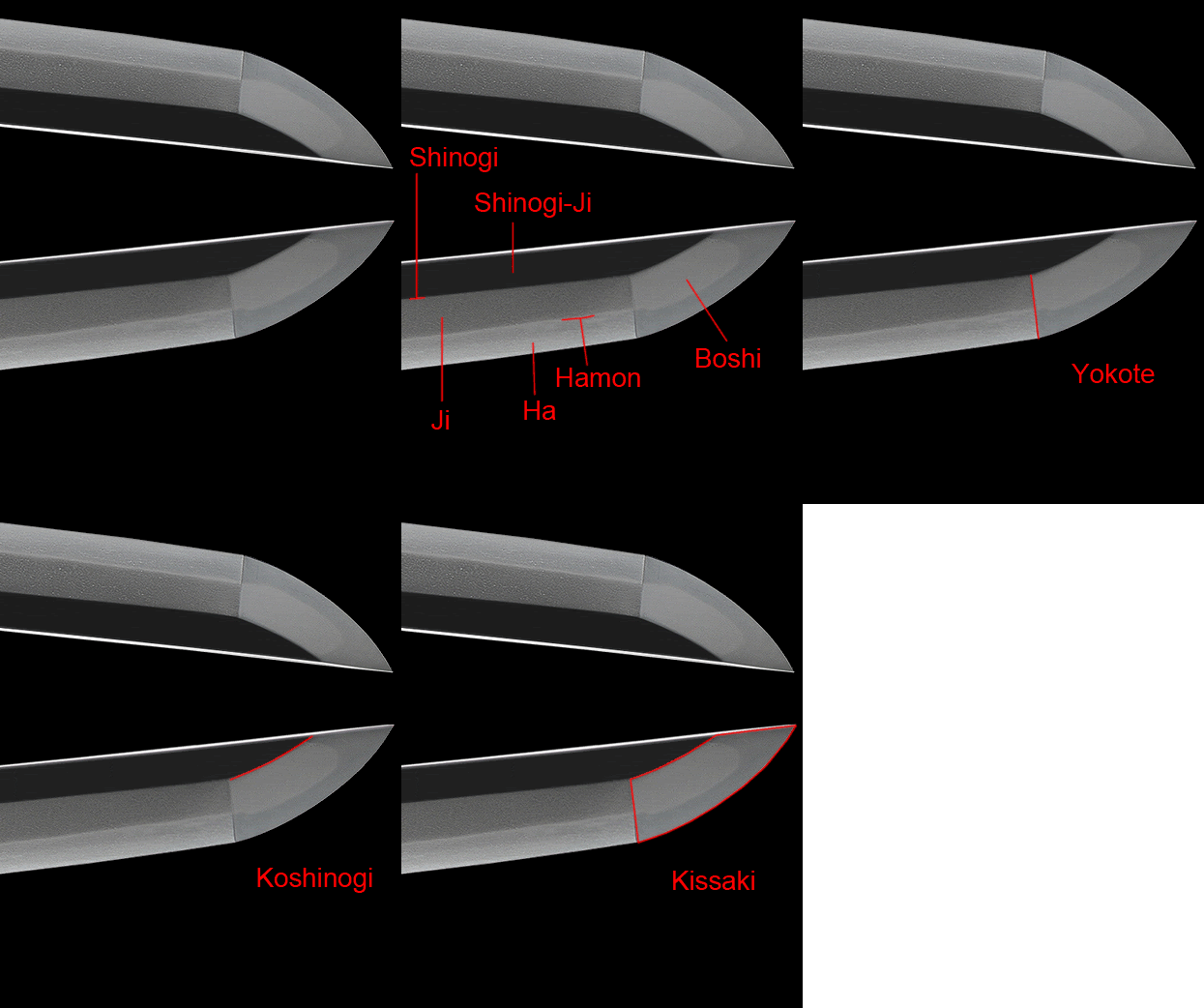
I think you are refering to the Yokote(ridge line) that separates the Kissaki(tip) from the rest of the blade. It signifies where the upsweep of the tip begins. Some makers do not accentuate this. I haven't really dabbled in japanese blades much but pick up things here and there when hanging out around Wally Hayes' shop.
 
Last edited:
Ahh, Rick, sure, that's what it is, and that's what Stacy was talking about. Aaron, appreciate that link.

Thanks

Dave
 
Yes that is what you are seeing.
On most blade polishes, the kisaki ( tip) meets the ha (edge) at the yokote (junction line) about 1" from the saki (point). This isn't too hard to polish as a crisp line. On an osaraku blade, the junction is such a small angle change that it takes a skilled togishi ( polisher) to get it right. As rick said, many just polish the whole edge as one continuous surface. This is not a bad look, although not truly osaraku. Many who like the look, and want an easier project, make a blade that looks like a fillet blade with a nakago ( sword tang). The sides are usually hira-zukuri ( full flat or full convex grind).
 
Thanks, Stacy, that clarifies it nicely. I'm going to start this weekend, got new belts, new steel, what could be better. Still, it will probably take me a month of Sundays:)

Dave
 
By the way, if the terminology ever confuses you, there's a lot of documentation out there. I like this little diagram someone came up with (don't know whom to credit for it):

Yokote.gif
 

Attachments

  • Blade 001.jpg
    Blade 001.jpg
    28.9 KB · Views: 53
  • Blade 002.jpg
    Blade 002.jpg
    27.1 KB · Views: 53
  • Blade 004.jpg
    Blade 004.jpg
    24.5 KB · Views: 55
Last edited:
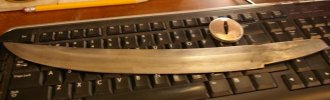
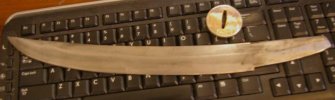
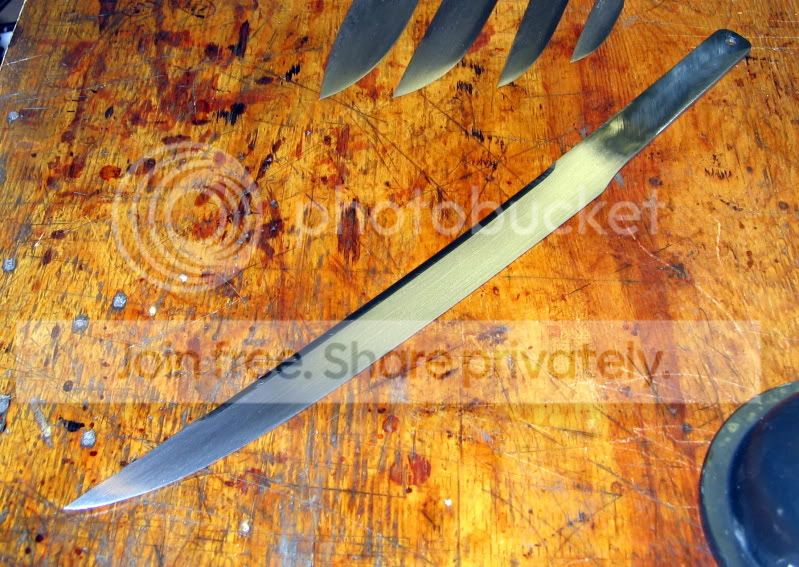
Inspired by this thread and ready for HT. As you can tell I am not attempting the traditional Yokote line... and the Kissaki isn't as dramatically drawn out as some in this thread. It's my humble interpretation.

IMG_0114-1.jpg
 
Nice ,Rick.
Now put an osage orange handle on it and call it an
"Osage-a-raku" fillet knife

A tip for a more dramatic look in osaraku-zukuri is to draw a low arc on a piece of paper - about 1/2" height in 20" cord is enough. Use that as a check on the spine when curving the blade in forging/grinding. You want as even a curve as possible, not just a rise in the tip. This looks a more "Japanese" look. Also, make sure the tang follows the same curve. The edge of the knife should be a smooth curve too, getting wider toward the middle of the blade then tapering a bit toward the tang.
 
Thanks Stacy.... nice name.....Ha!

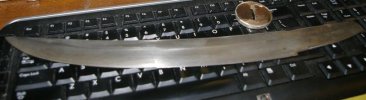
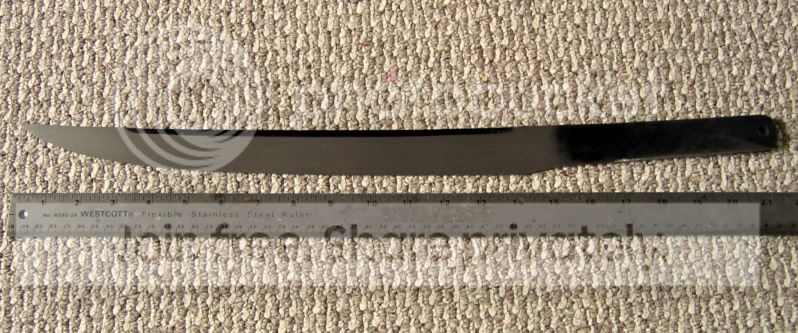
I am not doing the traditional Tsuka mount either. I will do my leather backed hemp wrap. Here is a scale reference shot...

IMG_0118-1.jpg
 
Back
Top