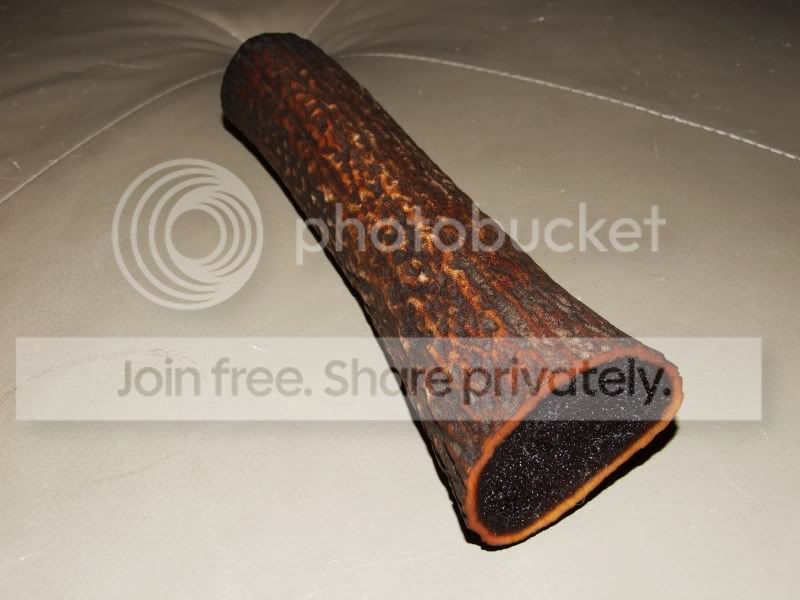
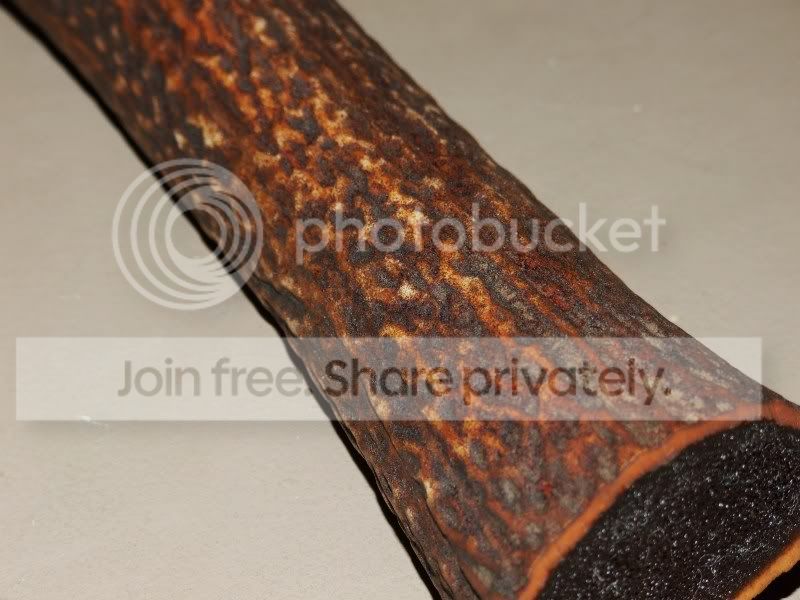
Question relating to dying antler

Joined
Apr 17, 2003
Messages
5,283
I have read about using Potasium Permanganate but the people discussing it never have images which show how the antler will look like after treatment. I got a nice piece of Red deer antler with a light brown in the shallows but would like it to be darker while retaining the lighter parts...anyone got images of some antler treated with the Potasium Permanganate method? even recommendations.

Would be greatly appreciated as I want to get to work on the handle of a project i'm currently on. :thumbup:
 
I use it a good bit and it will darken it to a rich chocolate brown....it will scare you at first because it will come out purple...not to worry...it turns brown. My friend dyes literally tons of it at the time and he always told me to use distilled water in the process and keep the antlers in the dark for two weeks while drying for what its worth.

Do your dying outside as well!

Good luck.
 
I have read about using Potasium Permanganate but the people discussing it never have images which show how the antler will look like after treatment. I got a nice piece of Red deer antler with a light brown in the shallows but would like it to be darker while retaining the lighter parts...anyone got images of some antler treated with the Potasium Permanganate method? even recommendations.

Would be greatly appreciated as I want to get to work on the handle of a project i'm currently on. :thumbup:

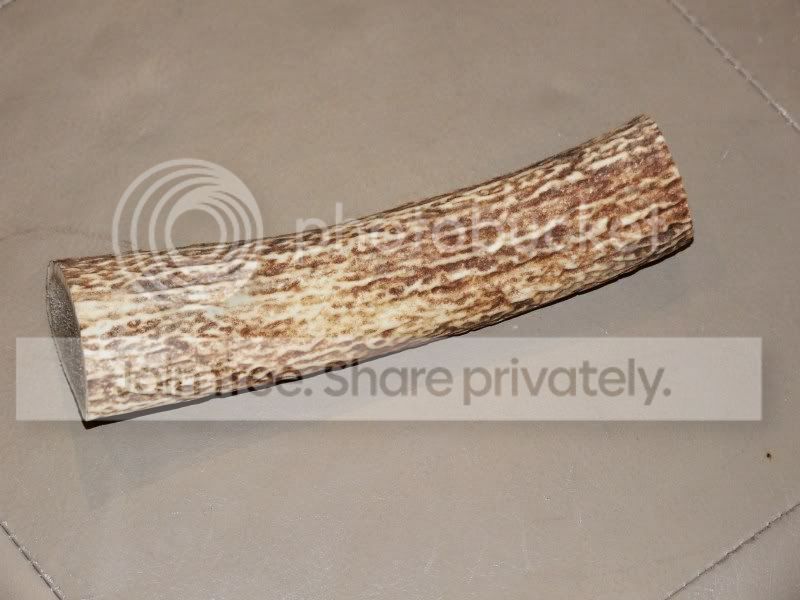
Here is on for that was done with Potassium Permanganate.
000_1163.jpg


This was a shed, bleached white when I started. I had so much popcorn (bumps) that I was afraid it would be totally uncomfortable as a handle. I first started with oil based Rustoleum Black that was left from something I sprayed with my air rig. The paint was thinned like water with mineral spirits and it had Japan drier in.

I put a coat of it on and kept rubbing till the antler would accept no more. After thoroughly drying. I buffed off a lot of the bumps on the antler this left a lot of new surface and after sanding with progressively finer grits I coated with Potassium Permanganate. I let dry thoroughly and then buffed lightly with a greenie pad, which will lighten the color in the areas that are being buffed. Then I sealed the whole thing in CA (superglue).

See it's kind of like doing a painting; you do your background first. The black is in the lowest areas and the Potassium Permanganate is on the higher areas.
When I get ready to use this antler I think I will lightly sand again. The higher areas will come back to white thus creating another color to the antler handle.

A word of caution when using Potassium Permanganate wear gloves as anything it touches turns purple then brown. In other words it is wash and wear!
 
Thanks for the input guys! I have had the piece of antler in dying for 3 hours now in a PP mix of about half a teaspoon and the part lowest in the mix is already a black colour with the base a darkish brown...will likely take it out in a few hours time to dry, not sure if I need to cut this piece of antler down but if i do I'll be able to photograph how deep it penetrates.

I have taken a before shot and will take an after shot as well to show a PP treatment.

PS. I have never sealed my antler but wish to try it as this knife is for heavy outdoor use...whats the best way to do the superglue seal? I can only get it in rather small tubes and I'm guessing stateside you can get it in larger quantities to submerge?
 
Robert: The PP does not dye the antler..it burns it. PP is an oxidizer. Three hours is probably too long. The black will not come off. Typically you need to dissolve PP to saturation in distilled water. Then place antler in solution, swish around for a couple of minutes and take out. At this time the antler will appear purple...do not worry...as it dries it will turn brown. Let it dry, buff and or polish. If you want it darker, repeat. Once black it is too far gone unless, or course, you want black.
 
Robert: The PP does not dye the antler..it burns it. PP is an oxidizer. Three hours is probably too long. The black will not come off. Typically you need to dissolve PP to saturation in distilled water. Then place antler in solution, swish around for a couple of minutes and take out. At this time the antler will appear purple...do not worry...as it dries it will turn brown. Let it dry, buff and or polish. If you want it darker, repeat. Once black it is too far gone unless, or course, you want black.

You still may be able to polish the surface and lighten. I have never tried soaking. I apply with a throw away brush and I usually achieve color by repeated coats. Polish slowly after drying and you may be able to achieve light and dark brown areas on the antler, depending on the amout a given area is polished.
He is correct in that it is an oxidizer that is why it can't be shipped by air anymore. Since the accident that brought down the plane in the Everglades a few years ago.
As for the superglue I flooded the piece with coats of slow drying superglue and I had one of those foam brushes soaking in acetone. The acetone acts as thinner for the superglue. Fingernail remover that is the acetone based will work also. You have to work fast because of the CA and the acetone will begin to make the foam brush soft quick, but it is one and done anyway. Use the acetone to spread the CA over the entire piece and throw away the brush!
 
Robert: The PP does not dye the antler..it burns it. PP is an oxidizer. Three hours is probably too long. The black will not come off. Typically you need to dissolve PP to saturation in distilled water. Then place antler in solution, swish around for a couple of minutes and take out. At this time the antler will appear purple...do not worry...as it dries it will turn brown. Let it dry, buff and or polish. If you want it darker, repeat. Once black it is too far gone unless, or course, you want black.

I had it in 5 hours in a diluted mix as recommended by a local smith whom supplied this piece of antler to me (also a member of this forum)...I have used antler previously but left it as nature handed it to me, but considering this piece was already pretty bland in colour I think its come out great for a camp knife intended for use.

There is distinct contrast already after it being out for 1 hour and a scrub with a green scouring pad has revealed white on the higher parts of the texture. The part deepest in the mixture is a dark brown/almost black but I like how the colour varies so much down the piece of antler.

Anyhoo here are the pics-

BEFORE:
DSCF5581.jpg


AFTER:
DSCF5588.jpg


DSCF5586.jpg


:thumbup:
 
Antlers are naturally exposed to the elements. Stag has been used as knife handles for hundreds (if not thousands) of years. Why would you need to put a protective finish on it?
 
Greetings,
Where can you purchase Potasium Permanganate from?

Dennis

pharmacies carry it too, a few dollars will give you a lifetime supply.

Antlers are naturally exposed to the elements. Stag has been used as knife handles for hundreds (if not thousands) of years. Why would you need to put a protective finish on it?

look at antler that doesnt and has been exposed to the elements for a year, it'll be bleached and sometimes has gone brittle...I normally dont worry as i havnt had a problem, but the other knives I have with antler handles wernt exposed to the elements at all.
 
Stag became a popular handle material because it is durable without treatment.
Bleached antler can be successfuly dyed. Just soaking it in PP or dye does not produce natural-looking color.
 
Stag became a popular handle material because it is durable without treatment.
Bleached antler can be successfuly dyed. Just soaking it in PP or dye does not produce natural-looking color.


So I got to ask do you mean STAG when you say stag because all antler is not the same? I generally ass u me (you know waht they say about that word), that when folks say antler they are not talking Stag as that is a different animal to me.
Some antler is more pithy than others and once an antler has laid and bleached and is beginning to get checks I do not feel it is stable without a sealer such as CA to close up and seal the little cracks. It certainly will pick up hand oils and dirt easily without it! However I must admit I have never used real Stag before, my experience has been mostly with Whitetail and Mulley antlers.

Dyeing is something I do when I feel that the particular knife calls for it. If a piece has enough color left to it I won't mess with dyeing, and certain knives look better with an all bleached or white antler handle to me.
So I am open for learning a new trick Bill . You want to share your process for successfully dyeing antler?
 
Last edited:
Sure. Stag is antler, BTW. Some is better than others.
One method I use is to color the deeper ruts with simple black Magic Marker. I then use brown leather dye on a Q tip to selectively darken the higher areas. Once the coloration is to your liking, seal the colors with clear spray acrylic. This is to keep the colors from leeching or fading. Sand the high spots to remove the coloration, then buff. Most dyes will penetrate deeply, so apply the dye very sparingly. A coat of paste wax to finish.
 
Funny thing about people saying the dyes will go deep seems like a false or exaggerated statement from my experience playing around with PP as a dying agent to this piece of antler...where I made the antler almost black with PP, light sanding revealed the white again and it has a very natural/antique look to it, the contrast is similar to a whole antler with natural color I have been saving for the right project.

The dye jobs some smiths do I personally don't think they look very natural, they look good but exaggerated off the color they would have had naturally.
 
Potassium permanganate is not a dye. Regardless-the more porous the stag is, the deeper a dye or stain will penetrate.
 
Back
Top