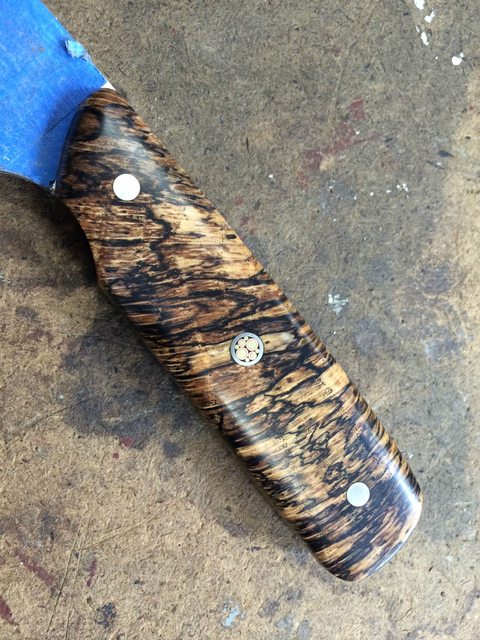
Questions about end grain spalted wood

Joined
Dec 7, 2008
Messages
7,187
I have always been nervous about cross cut, end grained wood for handle material.
My thinking is that by cross cutting the wood it makes the wood as weak as it could possibly be.

But....I have seen some of the makers here do some beautiful handles using end grained spalted wood that has been stabilized.

So my questions.....
If you are a knife maker who has made several knives using end grained spalted wood on your handles, what did you think?
I know finishing end grain can be a PIA. Is the look worth the extra effort/risk to you?

I would be afraid to use thin scales of end grained wood because you can snap them with your bare hands.
So.....do you use liner material? .....keep the scales thicker? .....or just hidden tang knives?

Any input is appreciated.
Thanks, Mark
 
for what its worth, the only knife I ever had returned was due to cross cut spalted birch. It looked great but cracked. It is far to weak for a using knife IMO. If you can take a scale and break it like a kit kat bar it isnt really suitable. But it looks cool as hell thats for sure
 
Mark, the large number spalted maple I have had the privilege of using is like a ROCK.
Since the stabilizing agent can travel laterally from side to side through the end grain, it just gets 100% saturation.
Sometimes it's almost like working a solid piece of plastic.
The first two here are end-grain Spalted Pecan:


Followed by a set of four I did from end-grain spalted maple:


And I had no fear whatsoever doing one with scales on a frame handle:

 
Glad Karl spoke up. I never thought of this and just bought some real nice spalted maple end cut that I'm about to send off for stabilization. My thought was if the penetration is 100% then it should be close to a block of resign, yeah?

Man Karl those are some beauties. I love spalted wood with a lot of color variation and sharp 'fungus' lines :D I like them all but am really partial to that last one, great looking piece.

-Clint
 
I'm hoping my experience will be the same as Karl's. I just had a batch of the stuff stabilized. Can't wait to use it on a knife.
 
I was sure Karl would show up in this thread!!!
His are some of the best looking end grain handles i have ever seen :thumbup:
I also agree on his reasoning about resin penetration with this kind of cuts.
 
Karl,
You came to mind when I was thinking about this type of wood.
I sent in a handful of spalted pecan pieces to get stabilized so I will have to see how they turn out.
 
I'd trade you my left leg for a big batch of this. Spalted white teak, seemed very solid.

quQ98kNl.jpg
 
I sent a piece of end grain spalted maple to be stabilized and it looked great. This was for some neck knives and I cut the scales kinda thin but when it came time to attach them I just couldnt do it. I snapped one of the pieces and while it was stronger than natural wood it still snapped pretty easy.

I think 1/4 or thicker would probably have no problem but the 1/8 ones I cut just seemed to weak.
 
I have had some end grain stabilized, and the look was good ... the durability was bad. It just won't hold up well.
 
I don't think there is one dedicated answer to the quality of end grain spalted woods, but more about the individual piece as they are not all created equal. Some cuts make it thru the heat portion of curing just fine and some cuts develop fine checks. It's the nature of it. The thinner one goes the shorter the holding grain and weaker it is. One way to overcome thin scales is gluing (laminating) to a backer for added strength before working. Some species tolerate end grain use better than others (all else being equal). I've infused lots of end grain Karelian birch and it's beautiful to work with. I have a lot of end grain pale moon ebony that cracks as I look at it so won't even try it.
 
What spalted said. If you want thin scales, you have to stabalize a thicker piece, attach them to the tang and THEN thing them out, otherwise you run too high a risk of breaking them
 
I had WSSI do some end grain spalted maple and spalted persimmon. It looked good, and drilled and sanded fine, but on fillet knives too much of it cracked in final finishing or in use.

My end grain black palm is cut at about 35-45° to get more strength. It cracks far too easily if cut straight across the end grain.
 
I have some end grain pecan that I had stabilized.
Some looks ok and others not so good.
I believe the problem I have is the wood was too far gone before getting it stabilized.
Meaning, soft, punky areas.

I will still clean them up to get a closer look at what I have.
 
I would have a real hard time convincing myself to trust end-grain anything as a knife handle. It just doesn't make sense. There's a very good reason why every kind of wood for uses from houses to gunstocks has been carefully selected for straightness of grain for, pretty much forever: Because it's much stronger that way.

It just seems like a bad idea from the get-go... maybe because I raised by/around carpenters and cabinet-makers... why the heck would you cut wood exactly the wrong way? Sure, you're gonna have it stabilized, and sure, anything that figured/burly/crotchy/spalted is weak to begin with... but why choose an even weaker cut right off the bat?

There are lots of other very beautiful wood options for high-end knives... I'll stick with them.
 
James,
I came from a cabinet making background so I tend to think the same way as you.
But......
I have seen some great results with end grain blocks.
That is why I wanted to ask those with hands on experience.
What I have gathered from this thread so far.....sometimes it will work, other times not.
Depends on the quality of the wood and how it is used.
 
on fillet knives too much of it cracked
I can imagine the blade flex on a filet knife might have something to do with that. It may have been less of an issue with a thicker tang.
 
some of the exotics actually have quite strong end grain, like wenge or gaboon ebony,but it does come down to thickness and natural checking during the process. some carving woods have little to no grain at all, but do tend to be softer, generally. using a liner as a stiffener while working with it is kinda brilliant,imho
 
Back
Top