Questions about Trying to Make Custom Scales

I'm sorry but I cannot agree with your statement that "G10 dust can hang in the air for a lot longer than a day or so.". I know that it can be easily agitated, and can be a health problem.

I also understand why yourself or anyone would choose not to work with glass or carbon fiber materials on a daily basis.

Essentially we are in agreement.

cheers,

Mike

Mike,
You can agree or whatever makes you happy.
I know of one friend that passed on from breathing knife maker related dusts and one Ed Caffery MS that just had a bout with a lung cancer caused by years of knife making dusts, Not just G-10 They pulled Ivory, Micarta and steel dust out of the biopsies from his lungs and this happen with him wearing a respirator most of the time, according to him.

Once again i think of the saying, that Youth is wasted on the young. I say all of this because I hope that when all of us are older that we don't develop COPD or lung cancer or any of the other problems that can come from knife making.
 
Davis is a nice town. Went to UCD many years ago. Are you in the dorms, apartment, or a house?

I would think that poly styrene would be a bit sensitive to heat build up. I'd use some decent practice material, you are investing a good bit of time and energy to make. If they come out, then you have some nice looking scales to use until you make your CF ones. Have you though about using wood as a practice material. You could find a local cabinet shop or similar place in town and see if they have some hard wood scrap. You might be able to get some decent hard wood.

I don't know if Davis has a recycled building materials center/store. When I worked in the City (SFO), there was a place that I found all sorts of great hard wood scraps and flooring material. I've gotten hard maple, walnut, oak, and ipe there for minimal cost and more than enough if I mess up a set or 2.

Safety is very important. Do not ignore the warnings that others have posted. Don't for get eye protection.

When I drill counter sunk holes by hand (yes, I've done it with one of the "eggbeater" drills) I drill the counter sink hole first. That way I can get the smaller drill lined up in the center of the counter sink hole, otherwise you are relying that the larger bit will follow the smaller hole. Try it on some scrap to see what works best for you.

Do you have some files? I use them a lot for shaping, they will give you better control than the Dremel for fine or precise work.


Ric
 
Thanks for the suggestions. I don't know where to buy wood here in Davis but I could look for some maybe. The eye protection I will be using is just Safety Goggles that I used for Chemistry Lab.
For the countersink holes, the original knife scale has countersink holes that are flush, most drill bits are tapered so I'm wondering if its ok to leave a tapered hole or is there another way to create a flush countersink.

I picked up a flat file from Ace yesterday and will probably get a rounded file when the time comes. As for practice materials I can use G10 as well as it is relatively cheap but I definitely want to practice on something before I move on to the carbon fiber.
 
There must be some cabinet shops or kitchen restoration shops. they always have different kinds of scrap around. If you drive walk by any dumpsters by construction sites, isn't there a wood shop or carpentry shop for maintenance on campus?

You should be able to come up with some freebie materials at one of those places.
 
Ace should have wood. It may be in one of the other buildings. Check the flooring section too, flooring makes nice handles too.

Flooring and cabinet shops often have scraps that they sell for low cost, or may be give them to you.

I use drill bits to counter sink all the time. Never had a problem. I wouldn't worry about it.

Ric

Saw one of the UCD Women's swimming coaches at a swim meet down here today.
 
Thanks for the response, the main Ace in Davis probably does indeed have wood. But the Ace I'm visiting is the small version near the opposite side of downtown where the main Ace is (they don't have nearly as much stuff). I just realized that one of the holes I need to drill is a 7/32 inch one so I will probably have to use a power tool as rotary size drill bits do not go to such a large size, but I'm also thinking of drilling a small hole first and clamping the original scale to the custom and I will just drill it out using the original scale as a barrier. I get the materials tomorrow so I will have one G10, one Micarta, and one Carbon Fiber scale to work with. Anyways I can't wait to start working even if I fail!
 
Sylafari, go to the goodwill and get herself a 5 dollar hand drill... it'll make your life easier. :-D
 
The materials came in and I didn't know that the scales were shipped in sets of two, this surprised me and caused me to first work on carbon fiber because I had 2 scales so I just blinded myself with a stupid reason and got to work.

Well after 2.5 hours of work this is where I'm at.
I didn't take pictures of the steps because working with carbon fiber and taking pictures probably don't go together well and I'm glad I didn't.

I clamped the original scale to the carbon fiber plate and than cut off with a Dremel Diamond Wheel portions that could be cutoff easily. Than I proceeded to use the Dremel sanding drum and sand til there was a bit of excess material between the original scale and the carbon fiber. I than tried to file it down but the file I had wasn't coarse enough and took out very little material. So than I proceeded to use the sanding drum again and this is where my first errors occurred. When I use the sanding drum I try to keep it flush but I sort of try and not damage the G10 scale. This would cause it to be slightly off angle so my custom scale's edges aren't perfectly flat, they are slightly angled towards the right. It's a very small distance but what it means is the right side of the scale is a tiny bit smaller than the left side and when I test fitted it to the original knife it doesn't match perfectly flush. I sanded it with a file and than with 220 grit sandpaper.

The biggest error I made was when I was using the edge of the file I accidentally ripped into the G10 scale on the thumb rest area (the edge of the file is much much faster at moving material than the sides unfortunately and it is easier to apply more force on an edge). This caused a tiny nick and so I had to use the sanding drum to drill out the tiny chip in the carbon fiber. So my thumb rest is now slightly larger and will show a bit of the titanium frame beneath.

Overall, I can't say I'm terribly disappointed. I expected a colossal failure but I think I have a scale good enough to be used at least. But tomorrow is the tough part, I have to drill the holes into the scales. My plan is to clamp them onto the workstation I have for the Proxxon rotary tool and than alight the drill bit. Than I will drill through. But we shall see. But enough with the chatter, here are some pictures!

At least they look similar!


The tiny chip I was talking about on the G10 which forced me to make the thumb rest even larger for the carbon fiber scale.
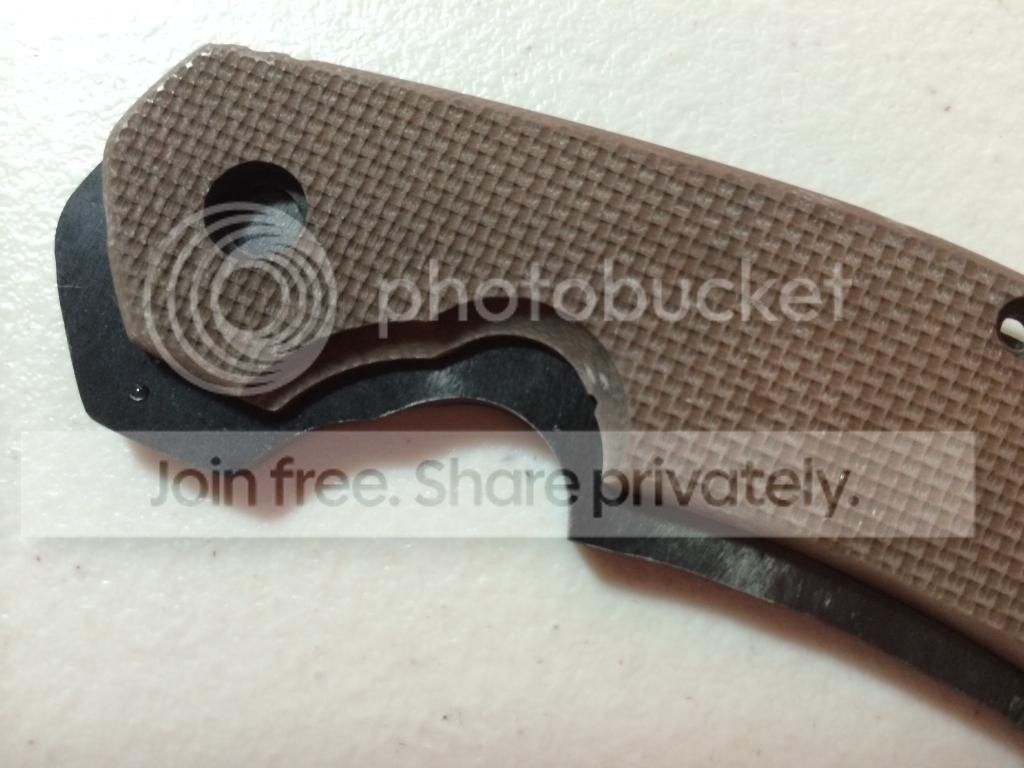
 
I just realized that I have to also thin out the scale. I need to trim about 1/32 inch off. I'm assuming 220 grit sandpaper sanding it flat would take too long. Would 100 grit or even 60 grit be better? Also I just realized I could shave the angled side off and it would bring back the balance (though probably not all of it). And for those wondering where are the carbon fiber patterns, this piece of carbon fiber happens to be marbled carbon fiber so I have to sand it to get the pattern to show. Thanks in advance.
 
I won't give you any sanding advice on this, but I will comment that you need to make sure you have the scales aligned properly. On most all laminates and impregnated scales, like G-10 and CF, there is an "OUT" side, and sometimes a direction of then pattern. Don't make the newbie mistake of having one side the opposite of the other. On any scales with a pattern or grain, it is a good idea to make the inside with the word "IN" and an arrow toward the front.
 
Back
Top
