Quick Question About Recurve Grinding

Joined
Aug 4, 2015
Messages
28
Hey guys, my next knife, I'm planning on doing my first recurve knife. I'm grinding with a relatively small belt sander and all i have is a flat platen. What would be the best way to grind the recurve portion of the blade? (half round file on a jig isn't out of the question)
 
I don't know how other guys do it, but I split a 2x72" belt lenghtways, so I'm grinding with a 1X72" belt. The narrow belt allows me to follow the curve easily, obviously, this method mandates slack belt grinding the "appleseed" edge.(It's also great for shaping wood knife handles). I'm interested in hearing how other guys do it, as I'd like to improve my ability in grinding recurves.
 
While I'm not a fan of the recurve, I do see the visual appeal, and that leather on the platen idea is top notch for that.
 
Joe Mandt.jpg
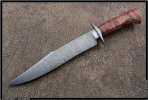
This is the only recurve blade that i have ever made and as you can tell, it is not very radical. What I have been doing with curved clips is using Nathan's curved 36 and 72 inch platens, the 72 on this knife, to set the "inside" curve of the clip and then rolling the blade over to the appropriate angle to grind the "swedges lengthwise. Spot in every time. I wish that I had also bought a 48 incher for this very purpose for grinding the clips of medium sized knives. The 72 can bee too subtle in some cases and the 36 too much. IIRC, I think that I also used the 72 incher to set the initial "inside" curve of the edge too. Because this is a big knife with a gentle recurve and an FFG, I seem to recall that I was able to grind the bevels in the regular fashion.
 
Last edited:
I use a 14" mill bd file on a jig. Not too fun but it works. Check out the thred on the Z-FiNit Bowie I started this morning. That knife was formed by stock removal using this method
 
Here's some recurves I've ground over recent years. These are all flat, but hollow ground recurves work on the same principle. These were all ground on a regular, flat 2" wide steel platen. The edge of the platen was used to feather the grind along, this works nicely if you shine a light in low and from the side towards you, so you can watch the grind side of the blade coming off the edge of the belt. The ability to continually see where material is coming off will let you, with practice, accomplish almost any grind you could think of. The fuller on the kukri pictured last was ground this way too, which allows bending or curving a fuller if wanted.


jN53OD4OhDTly-WFczNF_pEkEyIQrwU_UpO_knuEHTb9-_8DT5_IpM_VAKvgWKGWA6wRPaN8y8MDZQ=w1366-h768-rw-no


JfUYPKzvS160uqyM9Ma7y-PtRdXQ0i3W8PfPo79Cx3lY0xj92ibMAn5Qde8FqgGt7h64QKwLm17gKA=w1366-h768-rw-no


ExTLxJVU215k1VbTlw-ao3NGHoJ1f3hiZrmBYtWfWOHw7AgFFjrmKWm9i9kvigVgC10YjzPWI-x-Zg=w1366-h768-rw-no


J_lmRDj5cWIfT6t0shA5dfOZqgtXZT4kdZfhJ-Vwc9fD-HufvXh815ft9lo28ezSJ4A4TUL9NGvBcg=w1366-h768-rw-no


muyUvoTDGdMcAe5DRXK1VZwqaq5AQUFnGW6S9fCyRboVuik1JRh3vAuNg6k0YZCM3-5ThD_r90TcZw=w1366-h768-rw-no
 
Here's some recurves I've ground over recent years. These are all flat, but hollow ground recurves work on the same principle. These were all ground on a regular, flat 2" wide steel platen. The edge of the platen was used to feather the grind along, this works nicely if you shine a light in low and from the side towards you, so you can watch the grind side of the blade coming off the edge of the belt. The ability to continually see where material is coming off will let you, with practice, accomplish almost any grind you could think of. The fuller on the kukri pictured last was ground this way too, which allows bending or curving a fuller if wanted.


jN53OD4OhDTly-WFczNF_pEkEyIQrwU_UpO_knuEHTb9-_8DT5_IpM_VAKvgWKGWA6wRPaN8y8MDZQ=w1366-h768-rw-no


JfUYPKzvS160uqyM9Ma7y-PtRdXQ0i3W8PfPo79Cx3lY0xj92ibMAn5Qde8FqgGt7h64QKwLm17gKA=w1366-h768-rw-no


ExTLxJVU215k1VbTlw-ao3NGHoJ1f3hiZrmBYtWfWOHw7AgFFjrmKWm9i9kvigVgC10YjzPWI-x-Zg=w1366-h768-rw-no


J_lmRDj5cWIfT6t0shA5dfOZqgtXZT4kdZfhJ-Vwc9fD-HufvXh815ft9lo28ezSJ4A4TUL9NGvBcg=w1366-h768-rw-no


muyUvoTDGdMcAe5DRXK1VZwqaq5AQUFnGW6S9fCyRboVuik1JRh3vAuNg6k0YZCM3-5ThD_r90TcZw=w1366-h768-rw-no

Follow what Salem said. It's right on.
 
I couldn't bring up Phillips pictures. I sure would like to see his leather jig. What I have done on my 10" wheel is place many layers of 1" tape on my wheel and then use the 1" belts. I will try 1/4" next time.
Frank
 
I couldn't bring up Phillips pictures. I sure would like to see his leather jig. What I have done on my 10" wheel is place many layers of 1" tape on my wheel and then use the 1" belts. I will try 1/4" next time.
Frank

Now that would be interesting Frank! How would you split them evenly down to 1/4 though? I know usa knife maker sells a belt splitter but it just splits it in half...
 
Here's some recurves I've ground over recent years. These are all flat, but hollow ground recurves work on the same principle. These were all ground on a regular, flat 2" wide steel platen. The edge of the platen was used to feather the grind along, this works nicely if you shine a light in low and from the side towards you, so you can watch the grind side of the blade coming off the edge of the belt. The ability to continually see where material is coming off will let you, with practice, accomplish almost any grind you could think of. The fuller on the kukri pictured last was ground this way too, which allows bending or curving a fuller if wanted.


jN53OD4OhDTly-WFczNF_pEkEyIQrwU_UpO_knuEHTb9-_8DT5_IpM_VAKvgWKGWA6wRPaN8y8MDZQ=w1366-h768-rw-no


JfUYPKzvS160uqyM9Ma7y-PtRdXQ0i3W8PfPo79Cx3lY0xj92ibMAn5Qde8FqgGt7h64QKwLm17gKA=w1366-h768-rw-no


ExTLxJVU215k1VbTlw-ao3NGHoJ1f3hiZrmBYtWfWOHw7AgFFjrmKWm9i9kvigVgC10YjzPWI-x-Zg=w1366-h768-rw-no


J_lmRDj5cWIfT6t0shA5dfOZqgtXZT4kdZfhJ-Vwc9fD-HufvXh815ft9lo28ezSJ4A4TUL9NGvBcg=w1366-h768-rw-no


muyUvoTDGdMcAe5DRXK1VZwqaq5AQUFnGW6S9fCyRboVuik1JRh3vAuNg6k0YZCM3-5ThD_r90TcZw=w1366-h768-rw-no
Can everyone see the pictures? I'm getting x's.
 
Now that would be interesting Frank! How would you split them evenly down to 1/4 though? I know usa knife maker sells a belt splitter but it just splits it in half...

Belts aren't that tough to split. You don't really need a belt splitter, just a razor. Just cut lengthwise a few inches and then pull it apart from there. It's gonna want to come apart lengthwise
 
Back
Top