RA in AEB-L oyster knives

Joined
May 3, 2008
Messages
1,436
I live in a coastal area, so oyster shuckers are a dependable seller, and a great way to use up scraps of stainless that I don't need for paring knives or folders.

Usually they go in a pouch and get heat treated just like the chefs' knives, but with a 750f temper- what I'm wondering is, what do I lose by skipping the subzero stage of the HT, in something like this that doesn't need a real cutting edge, but needs all the toughness it can have?

Got no other stainless to HT this week, so that hour and a half trip to town for dry ice isn't sounding so good.
Thanks for any input!
 
I think with an oyster knife you'll be OK to not worry about RA from AEBL or any steel for that matter!
 
I think with an oyster knife you'll be OK to not worry about RA from AEBL or any steel for that matter!

Kinda thinking that way, but there's such a wealth of experience and understanding here, and I'm prone to miss small and important things if they're not part of my routine...Thanks
 
I now make all my oyster knives in AEB-L. I have Peter's do them for Rc58 and temper for high toughness. I don't worry about RA, as any extra would probably be a benefit, not a detraction.
 
Looked to see what Chuck posted, somehow thouht it would be steel related.
However, not disappointed.

Hoss
 
Our Lynnhaven oysters are finally coming back. At one time they were considered the best in then world. As a boy, they were coating the shore of the inlet ... then pollution and overharvesting destroyed the beds.
 
Mmmmm....Drayton Harbor Oysters, Taylor shellfish farms, Blau....oyster heaven here.

One of the things I miss about moving away from Steamboat Island 11+ years ago...One of my best friends still lives in Shelton though.
He's been pestering me to make him an oyster knife out of some Damascus (he's aware of the potential rusting problem so no need to comment:rolleyes:), and was wondering about making one with a shallow S-shaped blade (when looking down the blade from the point) to help fit some of the contours, have you tried this?
I'd love to see some of yours.
~billyO
 
It is easy to overthink something as simple as an oyster knife. It is a very simple wedging knife that does not need or want sharpness, extreme hardness, or fancy shapes. It should be about 3/4" wide and 2.5" to 3" long. I bend all my tips down at a slight angle (last inch at about 20°) to give the curvature your friend wants. Fancy steels and fancy wooden handles are not a plus ... just a distraction. I used to make them all from.065" CPM-S35VN, but switched to AEB-L in .07" thickness. So far, out of a couple hundred in that steel not one has failed.

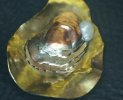
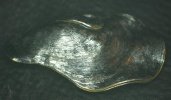
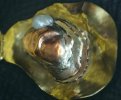
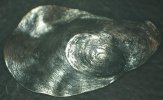
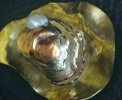
Here are photos of a great oyster. Handmade and hand engraved in sterling, gold, copper, bronze, and pearl. Notice the little oyster on the back of the shell. This was a gift to a friend knifemaker who also loves oysters.:
 

Attachments

  • Oyster 011.jpg
    Oyster 011.jpg
    67.3 KB · Views: 16
  • Oyster 007.jpg
    Oyster 007.jpg
    51.8 KB · Views: 19
  • Oyster 009.jpg
    Oyster 009.jpg
    51.5 KB · Views: 19
  • Oyster 012.jpg
    Oyster 012.jpg
    56.3 KB · Views: 15
  • Oyster 008.jpg
    Oyster 008.jpg
    47.9 KB · Views: 17
Last edited:
As a "why not" project many years back I did do this knife:

The world's most expensive oyster knife.
Stainless damascus in lace pattern, Australian burl handle, MOP and mokume guard and MOP butt cap. Makers mark scrimshawed on the guard edge.
 

Attachments

  • K03364-Apelt Stacy E-002.jpg
    K03364-Apelt Stacy E-002.jpg
    49.9 KB · Views: 37
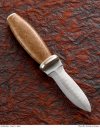
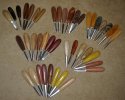
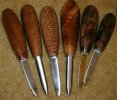
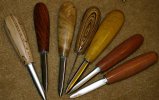
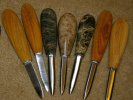
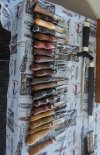
I just found some shots of my oyster knives. These were the S35VN ones. Most of these are straight blade or have a small angle tip. The group on the show table are the AEB-L ones with angle tips.
 

Attachments

  • Oyster Knives 001.jpg
    Oyster Knives 001.jpg
    75.2 KB · Views: 36
  • Oyster Knives 003.jpg
    Oyster Knives 003.jpg
    76 KB · Views: 29
  • Oyster Knives 006.jpg
    Oyster Knives 006.jpg
    72 KB · Views: 26
  • Oyster Knives 004.jpg
    Oyster Knives 004.jpg
    79.3 KB · Views: 32
  • DSC00645 (662x1024).jpg
    DSC00645 (662x1024).jpg
    48.6 KB · Views: 34
Last edited:
Thanks for the examples, Stacy. I haven't started yet as I'm still trying to dissuade him from the Damascus idea (although I may just do it to see how it stands up with care).
Hope I didn't hijack this thread...
~billyO
 
With that high a tempering temperature is probably fine anyway, and even if not, it won't hurt.
 
Notice the fat handles. Grip is 80% of what an oyster knife is all about in use. The blade is just a wedge to open the shell. The handle is the lever that works the wedge.
Some are slightly flattened and some are pretty round. People have different grips on shucking oysters and they like different shapes. I make a few of the standard commercial broomstick handles for the ladies, but the fat and flattened ones sell 9-1 over the smaller handles.

I use the seconds from knife wood and the cut-offs from turning projects for oyster knife handles. The best woods are naturally oily and dense wood. I just sand these to 800 grit and give a good buff. Others are stabilized wood. No matter what you use, it will get dulled from use. Places like Woodcraft sell six-pack bundles of exotic turning stock that are really nice. When they are on sale, I usually buy a bundle or two. They often have 10# bargain boxs of exotic wood that is a real deal. It is great for turning and knife handles.
 
Back
Top