Random Thought Thread

BTW, Moorik Moorik
If you can a way, try watching the 3 seasons of that show. It’s had various Bladeforums members on it, including numerous folk from right here in the CPK thread.
Listen, that’s a good idea. I knew about it, but somehow never got around to actually watching it.
I’ll start in the next few days.
Man, if I’m being honest, I’m even a bit embarrassed, lol. Seriously, I only dove deep into the forum and all these details after I already got a CPK knife🤔

No joke, I first saw the Field Knife on eBay. I knew absolutely nothing about. The design just hooked me, and the steel — 3V. I was specifically looking for a knife of that size in that steel.
Lol, I just randomly came across it and bought it.
Only later did I find the video where Nathan chopped a chain with exactly the same knife.
And I was sitting there like, you know, I hadn’t chopped any chain links with mine, or nails or anything crazy hard — except maybe bones or testing edge retention by planing something really tough.

I watched that video (the most popular one, I think) and thought:
«Wait, my knife can literally do that?»
And then I found the forum… and it all went from there. 🙄
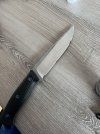
IMG_8521.jpeg

In the photo, the cutting edge sometimes looks like it’s damaged.
No, I just polished it down to 0.1 micron.
I think I’ve resharpened it about 30 times?
Just for fun.
Even when I didn’t need to.
And I’ll admit, after watching the video I did the same thing — grabbed the first nail that came to hand and chopped it with the knife.
Then I thought,
“I need more knives like the ones this guy on the video makes.”
Yeah, and only after that did I find the forum.
I was so clueless that I didn’t even understand where to buy them 🤔
I somehow figured out how to get one shipped across the world, but realizing that people actually buy and pre-order them here on the forum came much later for some reason 🤔

(By the way, I didn’t understand it at all. Nathan very kindly explained it to me by email, and then Jo did too.
I just didn’t get the mechanism — like, how exactly to buy them on the forum, haha. I simply had no experience with these kinds of forums.
Because I was slow to understand, I was really persistent, and both times they explained it to me with extreme patience that I needed this forum, lol.)
I think my story in this sense is full of shame, awkwardness, and being a total nuisance, lol.
At least it’s fun to look back on now.
Because I’ve accepted my cringiness and am even a little proud of it — after all, by mastering this forum I learned a ton of skills: language, shipping, communication, people, culture, and even made friends from the forum, lol, who’ve helped me in real life.
 
There might be close to half an inch difference in sori from one extreme to the other in the run. I pinned some blades together and found some that were a close match. Most of them were pretty close but it was not difficult to find a pair that were basically the same.

Fun fact, the sword was designed with quite a bit of sori, knowing from experience that it would partially straighten in heat treat. This was not me and Dan's first rodeo.

The handle scales are made a little bit longer than the nominal dimension in CAD to accommodate the growth of the material.

Historical blades would develop more martensite in the edge than the spine, and since martensite is less dense, the edge would expand more than the spine and curve the blade backwards.

During the violent water quench, the sword initially whips forward as the edge contracts as it rapidly cools (it cools faster because it's thinner) but then as the whole sword cools and the edge starts to expand from martensite formation, this is where you develop that iconic blade shape. The spine of the blade cools above the nose of (slower than) the martensite-austenite curve and forms a denser ferretic structure. ←this sounds cool but it's actually bad, imo

My swords will cut those swords in half.

The Delta protocol also involves a relatively rapid quench. But it's not a water quench. But more importantly, the alloys in the steel such as manganese and chromium retard the movement of carbon out of the martensite (actually, still austinite, face centered cubic, at this point) so the martensite transition temperature is very retarded (much like the developers of the Delta protocol).

Since we are quenching rapidly and going directly into a deep cryo, the material is not developing significant retained austinite, which would normally mitigate dimensional changes. This is a critical component of the Delta protocol because we would have to decompose RA by tempering up at the secondary hardening hump, which would relax the matrix around certain very important structures that help pin slip planes, negating their effect. So, while one of the happy accidents of the Delta protocol is enhanced corrosion resistance (because there's not a carbon chromium reaction gobbling up your free chromium) one of the unfortunate side effects is significant dimensional changes, which become obvious in a sword. As we are cooling and forming martensite (the body centered cubic hard stuff) we are forming full martensite, to the absolute best of our ability, a nearly complete conversion.

But it happens at different times and it happens in the edge first because it's thinner so it reaches these temperatures faster so it expands, stretching the still austenitic (and highly ductile) spine. When that austinitic spine catches up and converts it also grows, pushing the edge down, creating a reverse sori.

And thus, our swords move around and also my hair falls out.
This kind of information and level of detail is probably one of the coolest things you can come across.
Just like that — by simply asking a question or starting some random topic.
Damn…
 
There might be close to half an inch difference in sori from one extreme to the other in the run. I pinned some blades together and found some that were a close match. Most of them were pretty close but it was not difficult to find a pair that were basically the same.

Fun fact, the sword was designed with quite a bit of sori, knowing from experience that it would partially straighten in heat treat. This was not me and Dan's first rodeo.

The handle scales are made a little bit longer than the nominal dimension in CAD to accommodate the growth of the material.

Historical blades would develop more martensite in the edge than the spine, and since martensite is less dense, the edge would expand more than the spine and curve the blade backwards.

During the violent water quench, the sword initially whips forward as the edge contracts as it rapidly cools (it cools faster because it's thinner) but then as the whole sword cools and the edge starts to expand from martensite formation, this is where you develop that iconic blade shape. The spine of the blade cools above the nose of (slower than) the martensite-austenite curve and forms a denser ferretic structure. ←this sounds cool but it's actually bad, imo

My swords will cut those swords in half.

The Delta protocol also involves a relatively rapid quench. But it's not a water quench. But more importantly, the alloys in the steel such as manganese and chromium retard the movement of carbon out of the martensite (actually, still austinite, face centered cubic, at this point) so the martensite transition temperature is very retarded (much like the developers of the Delta protocol).

Since we are quenching rapidly and going directly into a deep cryo, the material is not developing significant retained austinite, which would normally mitigate dimensional changes. This is a critical component of the Delta protocol because we would have to decompose RA by tempering up at the secondary hardening hump, which would relax the matrix around certain very important structures that help pin slip planes, negating their effect. So, while one of the happy accidents of the Delta protocol is enhanced corrosion resistance (because there's not a carbon chromium reaction gobbling up your free chromium) one of the unfortunate side effects is significant dimensional changes, which become obvious in a sword. As we are cooling and forming martensite (the body centered cubic hard stuff) we are forming full martensite, to the absolute best of our ability, a nearly complete conversion.

But it happens at different times and it happens in the edge first because it's thinner so it reaches these temperatures faster so it expands, stretching the still austenitic (and highly ductile) spine. When that austinitic spine catches up and converts it also grows, pushing the edge down, creating a reverse sori.

And thus, our swords move around and also my hair falls out.
So your stuff is retarded got it

😎🫡🥸😬🤓🤡💀
 
Fun personal fact;

I originally ordered 2 K18s to try using with double sword forms.

The K18 scared me enough to not do that (despite the fact some of the twin sword forms use double edged swords; specifically Chinese Jian).

I now only have 1 K18, and it’s quite enough.

I DO have 2 K20s, and those work quite nicely with twin Dao (Chinese saber) Sword forms. I asked Nate if he could match the pair as closely as possible, as that was my intended usage. I not only cannot see any difference in curvature, but both of my K20s are within less than one ounce difference in weight 😍

I've been thinking of tracking a sword down to practice my sword form that I'll be required to present for my black belt test in the coming years.

I might just have to use a cold steel. 🙄😐😮‍💨😒

I wish I had ordered a retarded one.
 
I've been thinking of tracking a sword down to practice my sword form that I'll be required to present for my black belt test in the coming years.

I might just have to use a cold steel. 🙄😐😮‍💨😒

I wish I had ordered a retarded one.
Don’t get Cold Steel katanas.

The Hanwei Practical katanas are at least somewhat decent for lower priced options.
 
Back
Top