re purposed steel

Joined
Jun 30, 2017
Messages
9
Howdy Folks.
Got a question that only can be answered by committee...
I am an old dumpster diver from way back and made knives out of anything i could get an edge on. Some good , some bad but had a ball every time. My question is what is the best re purposed steel for knives?

Looking forward to the replies...
Doug
 
In all honesty, it's more expensive to use salvaged steel than buying a new bar. Unless abrasives and tooling are free and time is no factor

That said if I had to pick something, it'd be a sawmill blade. Big enough piece to be worth getting tested (which makes it a known steel) and in a comparatively easy to deal with form.

But really though, steel is the cheapest part of a knife
 
Re-pourposing steel is best left for those with years of experirnce in the forge. That said, in answer to the question:

Large saw mill blades ( 36" and larger) that do not have carbide or replicable teeth are usually L6 or similar steel.
Leaf springs are reliably hardenable - but may contain microcracks. - treat like 5160
Harrow springs are almost always usable steel of the upper 10XX type. - treat like 1090
Large coil springs are almost always usable - treat like 5160.

Old ( 100 years or more) anchor chain is usually wrought iron, and makes great guards and butt caps.
 
Actually, Stacy, I think that IS the right answer to the question. If someone is hellbent on using salvaged steel, they have to learn how to test that steel to determine its usability and requirements. The 'neo-tribal' guys are all about this, and some do it well, while others are hackers. The guy doing the salvaging gets to pick which one he wants to be...

Some of the most amazing makers I know of can use 'found' steel. David Mirable and Tai Goo come to mind. They both also have background in GOOD steels, and have a long foundation of what it takes to make a good knife. Because they understand what to start looking for, they know when to reject something that won't work. That comes through trial and error, and requires knowing what you're looking for to begin with.

I have a hell of a lot of patience, but this is just one thing I'm not interested in being patient about. If this is your gig, good luck with it - but remember, only you get to pick which one you get to be, artist or hacker!


Re-pourposing steel is best left for those with years of experirnce in the forge. That said, in answer to the question:
 
Thanks Gentlemen...

I come from a long line of farmers and they never threw anything away. I cant grow anything but I still got the re purpose gene.
I am not an artist but I would like to make the best tool possible. So far I have used 1084, 1095 , O1 and 5160 with mixed results. That being said I enjoy the process more the the finished product.

Thanks for all the valuable information.
Doug
 
Stacey, I'll have to differ with you on one thing there. I have used large sawmill blades in the past, exactly the sort you describe. All the ones I've had tested (probably half a dozen different ones of various shapes, sizes, and age) came back in the 1070-1080 range. I've never seen one actually be L6.

It's easy enough to make a great knife from them, I stopped doing it mainly because cutting up and dealing with a big pre hardened piece is a pain, and adds in several other steps. It ended up being cheaper to buy even relitivly expensive steel such as precision ground A2 than use the free sawmill blades once I factored in time and abrasives
 
Don Hanson W2 that was intended to stamp out auto body panels? ;)
I do prefer that! ;)

But we have made thousands of knives from old sawmill blades with Very Good results.
Most of these blades test out to be 8670 or 1070-80, never had one act L6.

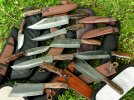
Here's a recent pile of Steam Mill Hollow knives from old saw steel.

blade2017.jpg
 
Last edited:
I remember a post last year when someone with direct sawmill blade experience said they were 8670. Industrial bandsaws are 15n20. I like both steels a lot.

If there was an apocalypse, I'd hoard old files (W1/1095 or similar) coil springs from high end cars (5160/9260 or similar), harrow teeth (I've got hundreds of them along the fence line), bandsaw blade steel (15n20) and sawmill blades (8670.)

I've got a grader blade sourced from the cabin that acts like W1 with the testing I did. The hardness starts dropping off if I austenitize above 1460/1470f. It's shallow hardening, and won't get full hardness in canola oil. It gets Rc67 when I quench in DT-48.
 
I've heard a lot of people mention 8670, yet the ones I've used tested as 1070 and 1080

Could be a matter of age perhaps?
I don't think I've cut up a blade less than 50-60 years old, some probably much older than that.
Some of the handsaws will be blister steel if you go back far enough, so I'm sure there's been a few updates to sawblade steel over the years. Yet another issue with junkyard steel, two of the same items can be totally different alloys.
 
I'd guess half the saw mill blades we've use are similar to 8670, other half 1070-1080. This is an educated guess at best, testing with heat treating and etching. Surprising to find some of them have little, or no nickel. Bet most companies had their own recipe.
 
Last edited:
Similar to files I guess. They were all similar but slightly different. Some 1095, some W1, some W2. To make it even more complicated, Nicholson and black diamond have both used all 3 over the years.

I've heard (but can't confirm) that there are plain 1070 bandsaw blades out there as well.

All of these things are easy enough to make a serviceable knife from. But without a lot of experience getting maximum performance is likely to be an issue
 
Geoff, yes the files are a good example.

I've had smaller band saw blades with no nickel, & some with a little, but not enough for good contrast in damascus. So these would have been like 1070
 
That would fit with what I've heard. 1070 is quite common for a lot of smaller hardened steel items such as small springs, music wire, spring tempered flat stock, ect
It makes sense they'd use something readily available in thin strip form for smaller blades
 
Well I stand corrected. Modern music wire is indeed 1085. You got me doubting my sources, so I double checked the spring tempered flat stock. The material currently available is 1095.

This just goes to show yet again the issue with old pieces of steel, and outdated literature. I've got an old book that lists both of those as 1070. I don't use them frequently enough to have noticed that's no longer accurate.
If the specific piece of steel you bought doesn't have an available spec sheet you really don't know what it is, as I just inadvertently demonstrated.
 
Back
Top