"Real" Henckels Folders

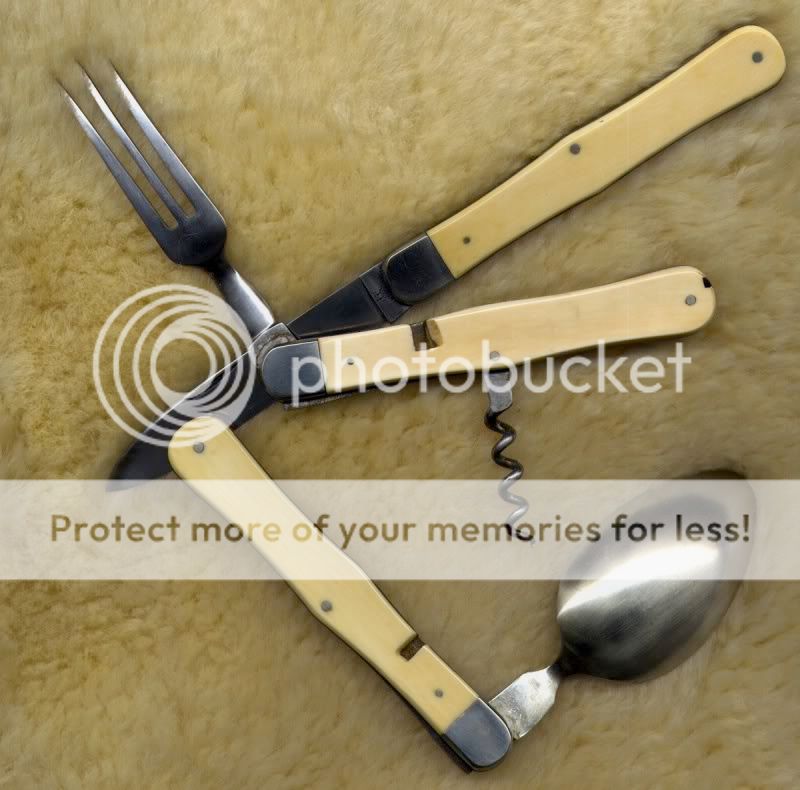
Not all the way closed, but this scan shows the other side with the notch that the spoon folds into when closed.

Henckelhoboslot004-1.jpg


Couple of factory photos that I've shown before, but what the heck:

Hammer forge;

henckelshammer006.jpg


Grinding room;

henckelswheel005.jpg
 
I bet most of the Grinders couldn't stand up straight after a few years on the job. Maybe they saw being permenantly hunched over as an asset, it put you into the "ready position" for work.
thanks for goin' "oh heck" Mike.
roland
 
Somewhere (here no doubt) I've seen pic of grinders lying on their bellies in Sheffield I think? And what are the standing guys doing?
 
This was used to remove corns from the feet. A simple knife made of only 5 parts: Handle, Blade, Back spring and 2 pins. The handle is a single piece of Ivory with a groove cut to fit the blade and tapered back spring. And 2 pins to hold the knife together. It's very sharp!.
CORN%20FT.jpg
&
CORN%20FCE.jpg
&
CORN%20BKSG.jpg
&
CORN%20OPN.jpg
 
Barry, don't know if it's only my computer, but all i see is 4 red X's. Anyone seeing the pics ?
roland
 
I see them now. Barry, I have that same knife but with French celluloid scales. It does have milled liners. Wicked, thin and sharp blade on it. I like the big swedges on the blades.
 
The new MSN format makes you "allow all to see" it used to be automatic & I keep forgetting to allow! they should be there now.........sorry, Barry
 
Nice Corn knife ! I have a few of these but not that one. I like them because what they really are is a scalpel, like Mike just said, very thin sharp blade. They often have ivory handles and not many people usually bid for them.
There must have been a lot of corns in the 'old days'.
roland
 
I have a large, very thick henckel's lock blade knife. The blade is about 1/4 inch thick and is released by a fulcrum bail. i will post pics as soon as i get a chance to take some..the handles appear to be jigged bone in the style of stag, or may be stag, or even delrin...It is a well made older knife
 
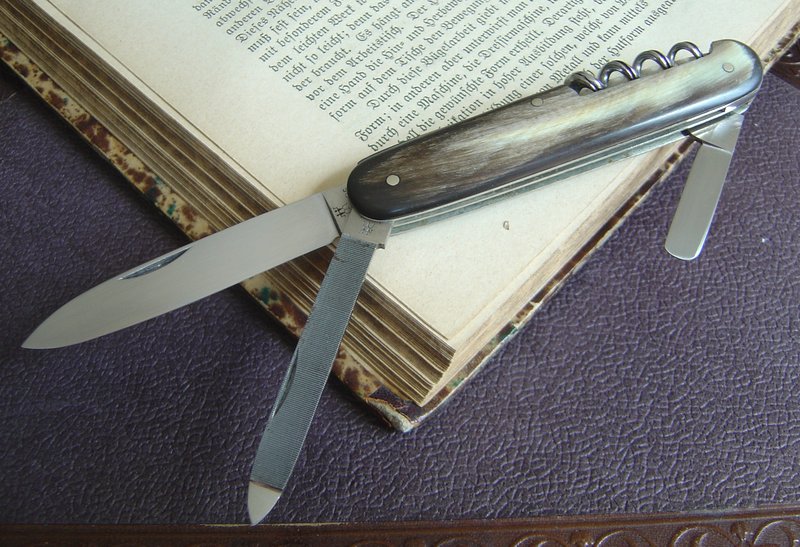
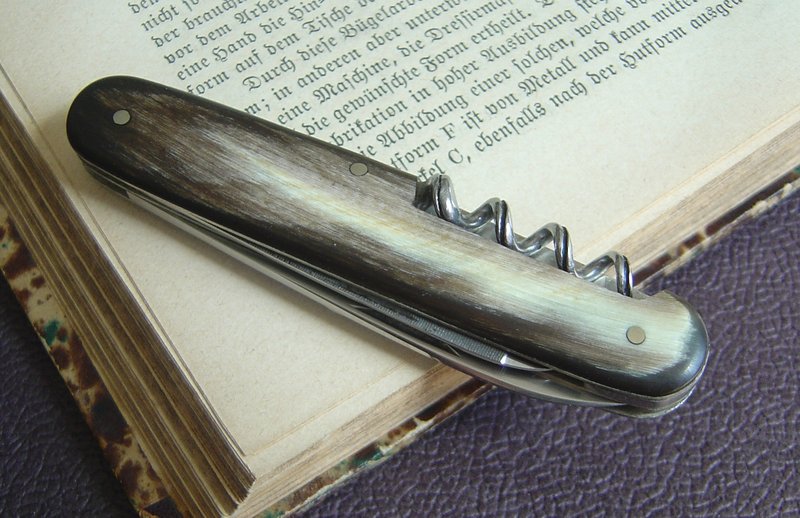
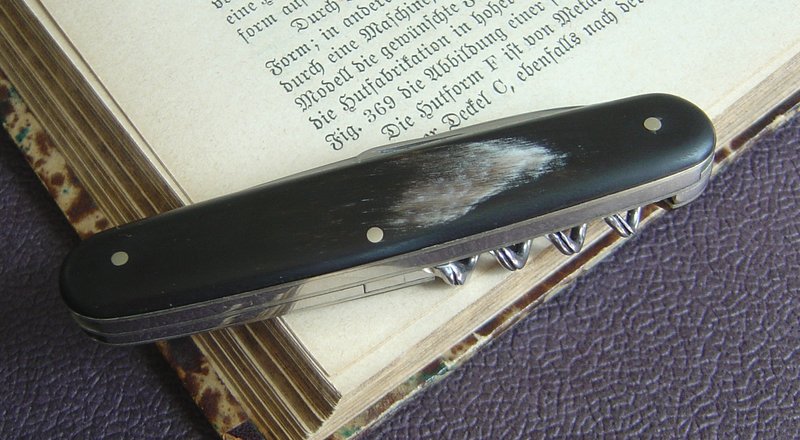
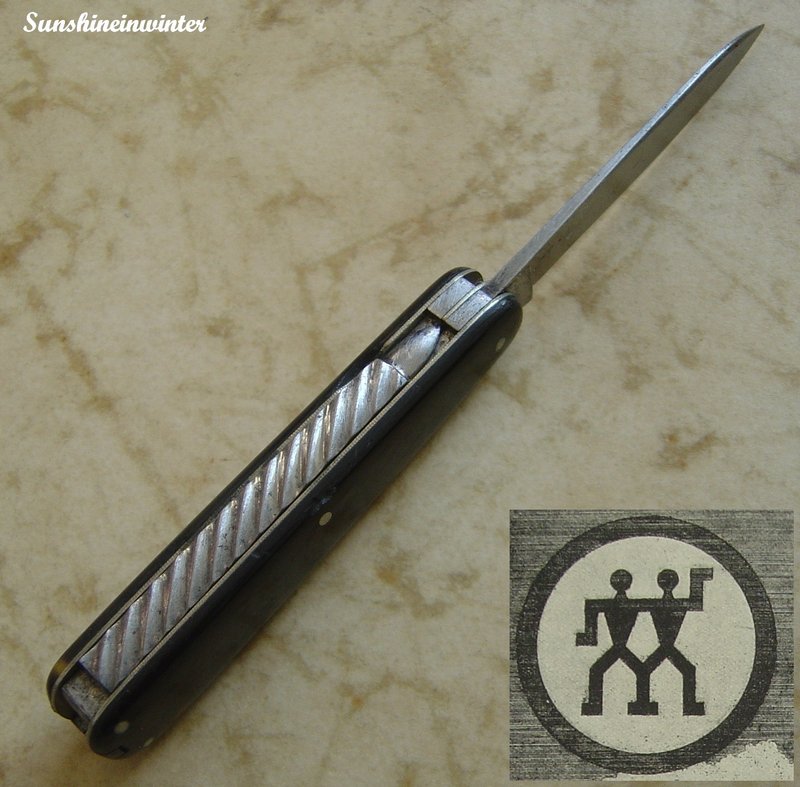
Here is a larger Gents knife with two blades, nail file and corkscrew and scales from horn. The small blade was broken and reshaped. I guess it's from the thirties. The blades are stamped "Nicht rostend" ("non rusting"), a stamping used for stainless blades prior to the invention of cryogenic heat treatment by Henckels and the introduction of the stamping "Friodur" in 1939.

8033686joo.jpg


8033692qsz.jpg


8033693zxs.jpg


I also own the book from 1931 mentioned by Mike Robuck, and luckily I can read German:). It's a lot of historical information. if you like I can tell you more (but beware of my English, i'm not a native speaker).

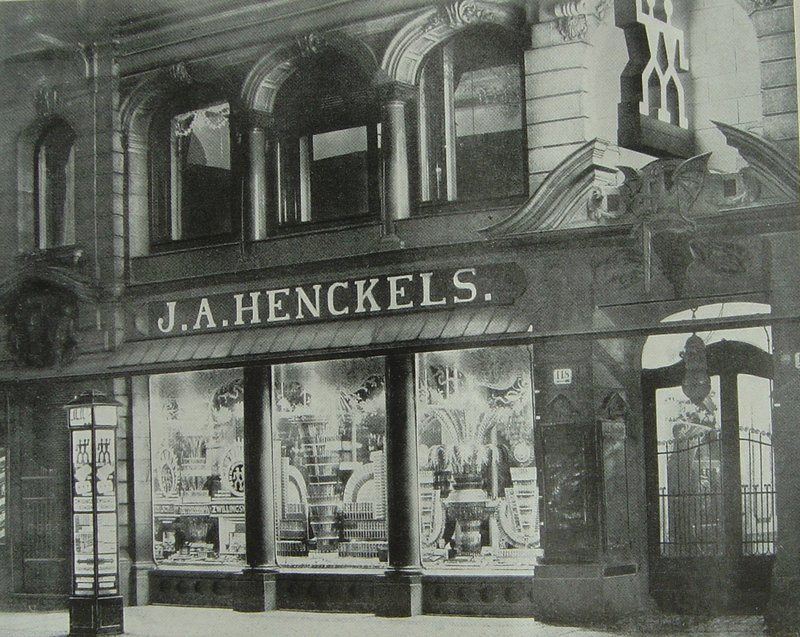
The Berlin show room of Henckels depicted here was located at Leipziger Straße. The street was destroyed for the most part by Allied air raids in WW II. What was left was later almost completely pulled down by the East German Regime.
 
Pete, looking forward to seeing your knife. If that's the lock I'm thinking of, it's pretty solid.

Sunshineinwinter, nice knife. Thanks for posting it. My contact info is here; maybe we could chat about that book sometime. :thumbup:
 
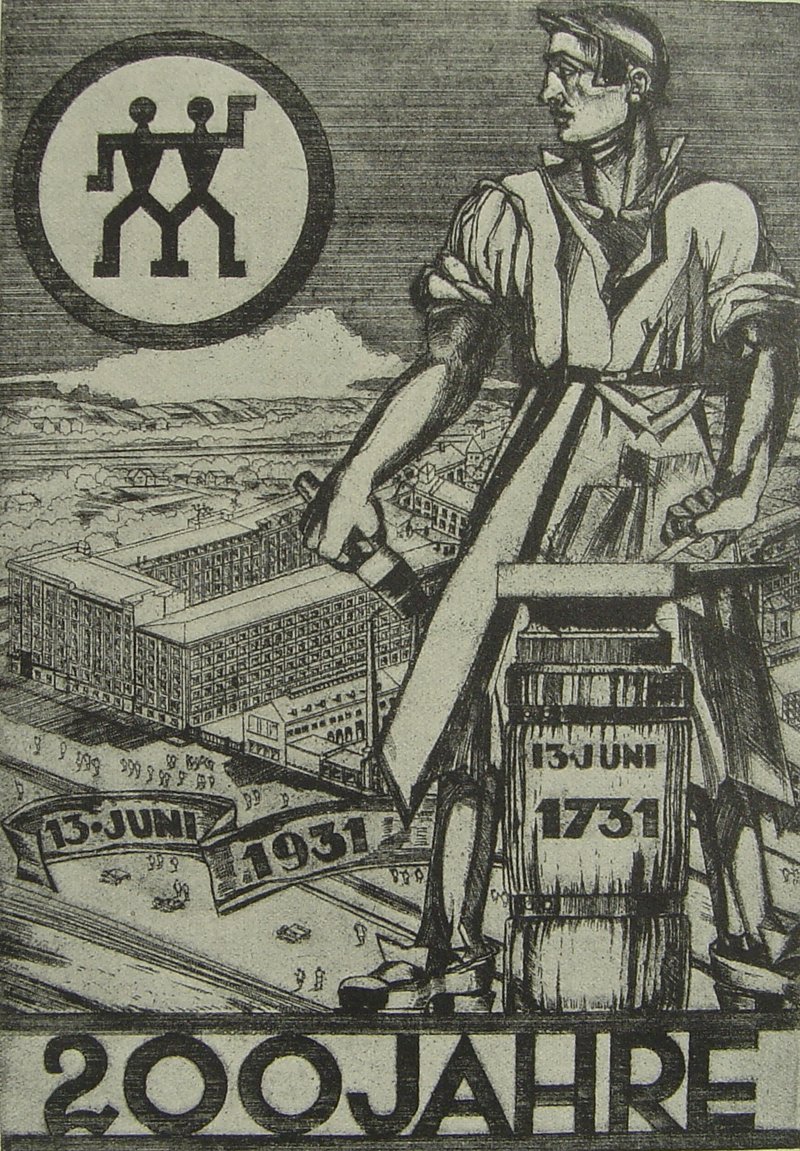
A summary of the content of the mentioned commemorative publication "Two Hundred Years" from 1931

8053099hdo.jpg


It starts with statements how important the satisfaction of the customer is, that Henckels had set itself this goal from the small beginnings in Solingen 1731 or later when Henckels opened a small shop in Berlin in 1818 with a few items only, how it later expanded and Bismarck himself bought a hunting knife there from Henckels at the time of the foundation of the German empire (1871).

This is an advertisement of Henckels in a Berlin newspaper in 1818 where pocket knives are advertised among other things:

8053105ifw.jpg


The name Henckels was already mentioned in the 15th century, the Twins became the official brand in 1731 and since is a guarantee for quality. The anecdote is told that when a delivery of knives arrived from Solingen that were not ground to the desired standards, J. A. Henckels threw them all into the Spree (the river that runs through Berlin).

Early on Henckels backed modernisation. Solingen was for a long time characterised by independent outworkers and water power. But Henckels steered a course in the direction of factory work, mechanisation, rationalization and steam power.

In 1867/1868 Henckels build its own cast-steel factory and in this way could produce its own steel.

In many cities Twin shops were opened (New York, Vienna, Cologne, Paris, Hamburg, Frankfurt, Dresden, recognizable by a special decoration of the shop windows.

Henckels in Berlin:

8053110onn.jpg


In the course of time the Twins became one of the best-known knife brands in the world.

Then the book goes into the quality of the Henckels products and the according prerequisites in more detail: The world wide unique feature of producing its own steel, tested in its laboratory. It is described how the products were tested: Scissors were dipped into lime to reveal imperfections, knives were bent, the grinding and cutting abilities examined with special tools, the sharpness of razors was tested with the help of blonde women's hair hanging in air (blonde hair is especially fine), pruning-shears were tested with the help of branches and nail-scissors with the help of quills.

The Twins steelworks also produced non-cutting steel goods.

The books ends as can be expected with a little bit of (not unjustified) self-importance: „This proud brand tells of German quality work in industrial europe as in steppes and wildernis, in the homes of highest culture as in plain huts.“

I hope I could give a certain impression of this historic publication.

 
Last edited:
Very informative. Thanks for the information. Well done!
 
Wow....this is a great thread....fantastic reading!, I notice the grinders in that photo as well-no ear muffs, even as a Car Painter for 25 years, with the air guns, compressors, sanders and especially the buff industirail deafness has got me ...ears ringing at night-or anytime when very quiet...imagine those guys :eek:
 
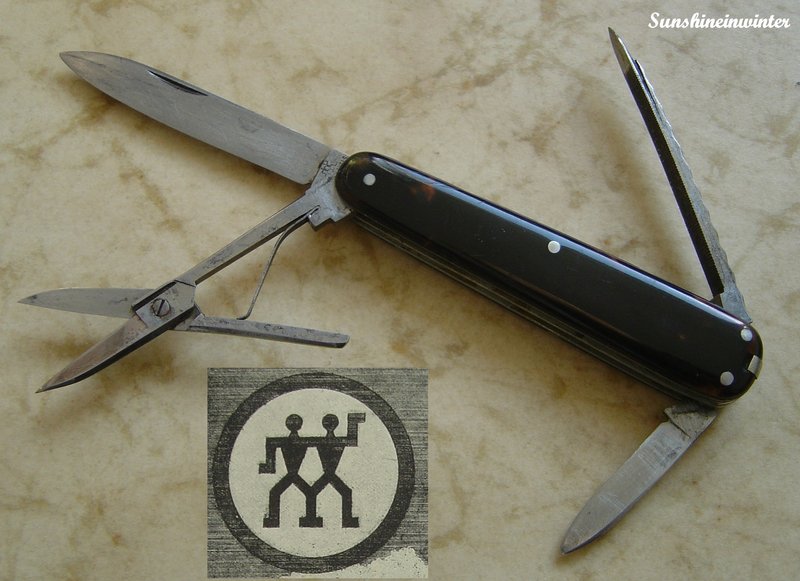
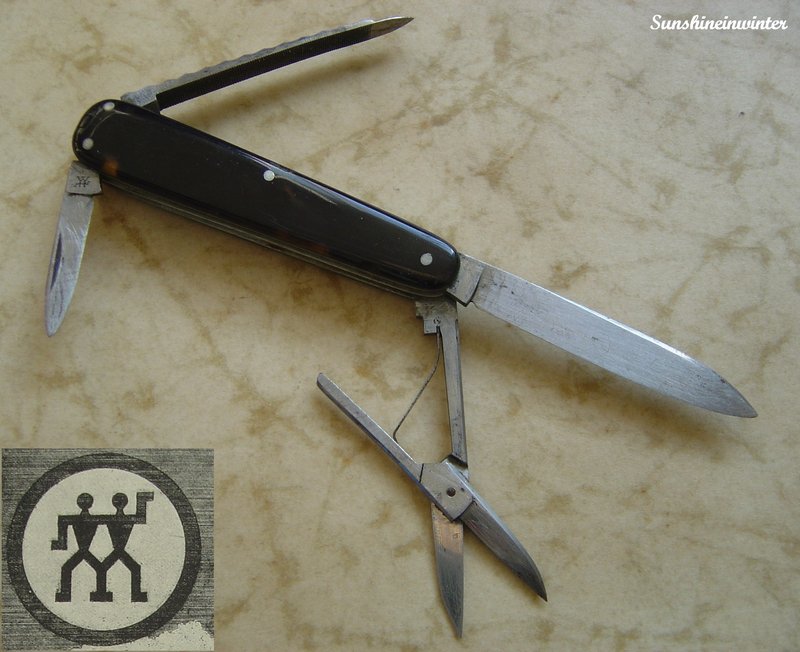
A nice elegant multi-blade is shown here. I think the scales are from real tortoise shell.

8058164qrb.jpg


8058165qie.jpg


Note the decorated nail file. Nothing too mundane not to be embellished in those times.

8058166uil.jpg
 
Back
Top