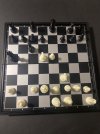
Remember playing them Vintage Board Games ~ and other Games and things ~

40K is definitely played on a “board”, just a lot more involved than most board games.

Me and my peeps have played many a game of D&D where we had physical representations on a board to help set the scene. It’s mainly mental, but we felt the models helped. It’s just hard AF to find model representations for some of the stuff you run into.

I say it counts, board or no. It’s still in the same spirit of things.
At one time I had a lot of miniatures. They were pretty expensive but now people can design and print one up on a 3D printer. There are entire cities and dungeons including castles sold in 3D print design plans now. Still gotta paint them though.
 
As kids we played most of these games back before the internet or personal computers. Risk was our favorite and eventually we had redrawn the board to cover an entire ping pong table, where 10 or more players would gather to war in multi-day marathons. People had a lot more time for interactive play back then; there were only 3 major networks, telephones were physically wired to walls, blue rays, dvds, vhs, cds, were yet to be invented, and if you wanted to play something you had to reach out to other people and physically get together.

N2s
we played army men with rubber bands, had a good friend that would come and spend summers at his grandfather's every summer, his name was Jimbo and our neighbor his grandfather Mr. Burns, had a fenced in front yard with cactuses and slate rock as pathways and earthy soil in-between it was a good terrain , we would each set up our army men positioning throughout and over the terrains of the cactus garden then picking a side and taking turns at shooting them over, whoever could shoot over the other's first would win ~ Jimbo later joined the Army as soon as he turned eighteen ~ only war board game that we've played was Battle Ship ~ and Risk that was actually a very old game, but we never ever seen it prior to only several years ago ~ thing about small towns and no internet is kind of a safe haven from everything you never knew existed and never missed - as well as news, you would get the local newspaper and that was the talk of the town - people were not caught up in everyone else's business as they are today with the monster that social media has created for the world ~ and no regulations people can spin fabricated story's and reach millions in a matter of seconds and people naturally respond to these comments - me try and distance myself from it change the channel and make better choices on what is allowed into my house ~ house being metaphorical ~
 
OIP.FoGmhI00fSpHlIV_5U8fQwHaFv

Vibes man.. vibes.

Board games were the way.
 
White to move and crush the Englund Gambit:

image.jpg
 
I used to play The Game of 20 Squares, the oldest board game which has come down to us.

View attachment 2125178

In 1928, Sir Leonard Woolley excavated five playing boards in a royal tomb in the Sumerian city called Ur. They were made between 2,600-2,400 BC (or BCE if you prefer) and were found with playing pieces and 4-sided dice but no rules. Boards were later found in Iran, Syria, Egypt, Lebanon, Sri Lanka, Cyprus, Crete, King Tutankhamen’s tomb, and the palace of Assyrian king Sargon II. It was played by all social classes.

In the 1980s, Dr. Irving Finkel found the game rules on a crumbling clay tablet in the British Museum and translated them.

View attachment 2125198

The tablet was written in 177-176 BC by a scribe named Itti-Marduk-balatu. Itti was an archaeologist who discovered and recorded the rules of this forgotten game, abandoned long ago for its derivative backgammon.

This is Assyriologist Dr. Irving Finkel in his curator's office in the British Museum. He still lives among us, but he dwells in a mental world long before the invention of the safety razor. He lent one of his ancient chess sets for use as a prop in the first Harry Potter movie.

View attachment 2125308

You can play The Game of 20 Squares online here:

https://royalur.net/

It was a gambling game with beer as the usual wager, but it could also be used in fortune telling and that I think is unique among board games.

These kinds of old english wizards impress me.

I remember watching a David Attenborough doc where he had a couple of his long-time friends join him in the field, all were older chaps (each a respective expert in their own niche)... there was this one quick cut of them together in the range rover staring out of the window just moving along. Something struck me about the combined brainpower, they were all still incredibly sharp... still making the right observations and pulling at the right threads. It was a nature documentary and they were a part of it.
 
Informative Trivia ~ The 52-card deck that we commonly use today was heavily influenced by the French suit system, which emerged in the 16th century. The French created a standardized deck around 1480, optimizing it for production. By the 18th century, this format became widely adopted, forming the basis for most card games. The 52-card deck was not invented by a single person but evolved over centuries. The earliest forms of playing cards originated in China before 1000 AD, and they spread to Europe around 1360. The standard 52-card deck we use today consists of four suits (hearts, diamonds, clubs, spades) of 13 cards each, with three face cards (King, Queen, Jack) and ten pip cards (Ace to 10). The number 52 is often associated with the 52 weeks in a year, and the suits represent the four seasons. The evolution of the deck was influenced by various cultures and regions, leading to the standardization we see today.
 
These kinds of old english wizards impress me.

I remember watching a David Attenborough doc where he had a couple of his long-time friends join him in the field, all were older chaps (each a respective expert in their own niche)... there was this one quick cut of them together in the range rover staring out of the window just moving along. Something struck me about the combined brainpower, they were all still incredibly sharp... still making the right observations and pulling at the right threads. It was a nature documentary and they were a part of it.
Just a few days ago had the game chess on my mind and out of my own curiosity, began researching the actual game chess, wanted to know more about it, its roots where it came from, was it always a board game of sixty-four squares with markers of one through eight and the letters {A} through {H} the information that came up was interesting and mentioned that the game chess has evolved from something much different, from a game that first used dice and involved caricature pieces and later evolving pieces that were elephants and other things that were moved and performed differently, there were roots from Persia and India etc. that was traced to the modern day game that we all know today, as Chess ~ Chaturanga (India, ~500 CE) The earliest widely accepted surviving chessboard is a carved stone board from the Indus Valley site of Lothal (in modern‑day Gujarat, India), dated to roughly 2300 BCE — far older than chaturanga itself. This object is often cited as the oldest physical board with a grid pattern plausibly connected to proto‑board games that later evolved into chess. {my mind wonders} ~
 
Vibes man.. vibes.

Board games were the way.


was doing some research on the Chinese Checkers game yesterday "curiosity" turns out the only information found on it states it isn't even Chinese at all, and it's a game that roots are German Origin ~ " thinking the name was self explanatory " it wasn't ~

The game was created in Germany in 1892 under the name "Stern-Halma," a variation of the older American game Halma. Like all Halma games, it shares similarities with checkers. The word “Stern” (German for star) refers to the board’s star shape, unlike the square board used in Halma ~

The name “Chinese checkers” came about in the United States as a marketing idea by Bill and Jack Pressman in 1928. Their company’s version was first called “Hop Ching checkers.”

In Chinese, the game is called Tianqi (跳棋; pinyin: Tianqi; meaning “jump game”). In Japan, a version known as the “diamond game” (ダイヤモンドゲーム) exists with slightly different rules.
 
I think I had a different childhood than most. 😆

View attachment 3089030
everyone's circumstances geography and up-bringing sure does play a huge part in the quality of people's lives ~ some good humor always helps too ~ so many people have been affected by other people's poor decisions ~ and on the other side of the coin so many people have been blessed by other people's good decision's generosity, compassion, ethics, morals, and kindness ~ good natured people ~
 
Last edited:

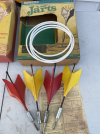
I grew up playing Jarts with older siblings. We had the non-slider versions, and later the sliders. I remember several (errant, of course) throws sticking in wood picnic tables and benches. They’re now illegal to sell from what I gather, even at estate or garage sales, due to safety issues.

Several years ago I came across a website that sold all the parts to assemble your own, they just couldn’t sell you a ready-to-throw dart.
 
Back
Top