Removing dye from bone or redyeing?

Joined
Jul 26, 2009
Messages
314
I went through a 'phase' of liking red bone scales, and I have a few slippies with red bone in my collection.
I have now completely gone off red and no longer carry these knives in my rotation.
It's a shame, because apart from the color, I really like these knives.

I like white and black bone. Is there a way to strip the dye from the scales, or redye them black?
I guess redyeing black would be more likely to work than completely removing dye, but white bone is my favorite.

I have swabbed some MEK over the scales on one knife, and the Q tip came away pink, but I'm reluctant to try soaking the knife in MEK overnight until I know if it will damage the bone.

Any ideas?
 
Use black leather dye. You won't be able to remove all the existing dye.
 
Yeah, didn't think so.

So what do I do? Paint it on? Soak overnight?
Is it ok to do this with the scales still on the knife?

Also, I take it this won't work if the bone is stabilized?
Is there a way to tell if I have stabilized or unstabilized bone?

Sorry for all the questions :D
 
Put it on with a Q tip. Let it dry. Wipe off any excess after it's dry. You may have to reapply it to get the color you want. Most dyed bone is not stabilized.
Alcohol or possibly WDv40 will remove any overruns on the knife. You'll have a mess for a while, but once it stops rubbing off, the knife will look nice.
Wear rubber gloves!
 
Thanks Bill, I'll give it a go and post my results.
One of the knives is a Magnum Bonsai canoe, so I'll try that first before I attempt to dye the nicer ones.
 
Well I tried leather dye but it only coated the surface like thin paint.
A swipe with alcohol and it came right off. It left a few purple streaks in the pores of the bone, but otherwise it was unchanged.

I am happy to report success by boiling the knife in Tintex clothing dye.
I put enough water in a saucepan to just cover the knife, and added a whole pack of dye.
I wasn't really expecting it to work, but I checked it after five minutes to see if there was any effect.
The bone was JET black!
I have tried rubbing alcohol, MEK and acetone, nothing will remove it, so I must have got reasonable penetration.
I guess boiling softened the connective tissue in the bone enough for it to absorb the dye.

I'm so happy to have worked this out. I can now buy knives that I would normally have passed up because I didn't like the color.
 
Hot water and RIT die can easily penetrate into plastic firearm or model car components, so I'm not really all that surprised that it performed well. Congrats on getting it to work!

You can get additional penetration by adding just a drop or so of Dawn dish detergent to the near-boiling water. When I've been dying magazines for my 10/22s, just a few SECONDS of immersion starts the colouring. More than about thirty seconds is TOO much if you want to leave the colour as semi-transparent where you can see through the clear plastic of the mag. It's amazing stuff.
 
I actually boiled the knife in water with dish soap first to get rid of any oil, but I didn't think to add it to the dye solution.
I actually dyed three more knives and it worked even without the degreasing step, but I'll certainly add a little dish soap next time.
I've now turned four knives I didn't really like into really handsome ones.
I've been looking for a peanut in black bone with no luck, but now I can just buy any old color as long as I like the jigging pattern :)
 
Awesome, isn't it? :D

All the soap does is to enhance the penetration of the dye by breaking up surface tension, but if you have them being dyed sufficiently already, there's no need to add it. If you run into one that seems particularly resistant, though, that might be a method you could try. It works on plastics as well, or pretty much anything else that can withstand the temperature, so you're not necessarily limited to bone scales, either.
 
I'm actually having some computer issues at the moment so I can't upload a photo. Well actually I can but it's extremely time consuming. I'll try my utmost to post one in the next few days.

Komitadjie, thanks for the dish soap tip, I had one knife that was a bit patchy, but now it's very very black!
I also dyed a plastic scaled peanut with success.

I think this is a big deal, because during my searches, I found a lot of people wanting to dye bone. I have done it successfully on six knives from three different manufacturers, so it looks like a universal solution.

Of course, the really big deal is that this can be done with the scales in situ, the dye does nothing to the metal parts.

Now I have to try to remember all the knives I liked but ended up not buying because I didn't like the color of the scales... :D
 
Last edited:
Incidentally, I'm overjoyed at finding out that this can be used to color plastic too.
I have built a tiny 64gb ipod by buying a broken ipod mini, ripping out the hard drive, and replacing it with a 64gb compactflash card.
I wanted it to be all black, and tried spraying the click wheel and end caps with krylon fusion spray paint, but it doesn't look very good, and scratches easily.
I think I'm going to buy another broken ipod mini, send the casing away to be anodized black, and use this dyeing method to dye the plastic parts black.
This has been a problem I've been trying to solve for a while now, so I'm pretty pleased :)
 
I've never seen someone try it on that before, but I know it penetrates lexan model car bodies and Ruger magazines with no problems whatsoever.

Ain't it awesome when you realize that you've just solved a lot of problems at once?
 
I expect it will, I initially tried coloring it with a sharpie and then wiping it off with alcohol to see if I could at least turn it grey, but it came out patchy purple. That would suggest it's reasonably porous.

Back on topic, I'm going to buy a couple of knives specifically to dye black, so I'll take photos of the process and do a tutorial.
Might be interesting to try different colors too...
 
Well, if the sharpie was able to penetrate, the dye almost certainly will! How even it will come out is open to conjecture, but it will certainly be an interesting test. That sounds like a very interesting conversion project, by the way.

I'll be interested in seeing the photos! And I've had good luck with red, blue, green and black on various plastics. I generally use RIT brand dye (because it's readily available here), but I would think that base colours would work well in almost any maker's line.
 
I have ~55gb of music, and I was sick of carrying around my huge ipod with fragile hard drive, so I decided to make my own :D
Now I have a very small ipod that holds all of my music and won't break if I drop it, and it should look pretty cool in black.

I wonder what would happen if you dyed green over red?
A lot of red bone knives are dark in the middle, fading to white at the ends.
I wonder if dyeing one green would give green scales darkening to black in the middle?
I need to buy more dye and more knives :D
 
Last edited:
Ok, here's a (bad) photo:


Uploaded with ImageShack.us

From left to right:

Rough Rider six blade stockman, checkered 'gunstock' bone- used to be dark brown

Steel Warrior lockback whittler, jigged bone- used to be black in the center, then light brown, and completely white near the bolsters, I guess to simulate burnt stag

Rough Rider boxcar whittler, smooth bone- originally black, shown here for comparison

Boker Magnum Bonsai canoe, jigged bone- used to be pinkish red fading to white by the bolsters

Rough Rider barlow, jigged bone- used to be amber. I dyed this one because it had mismatched scales

Rough Rider mini canoe/butterbean, jigged bone- used to be red

Rough Rider peanut, synthetic- used to be faux tortoiseshell


These are a few knives that I either changed my mind about (used to like red, no longer do) or got in trade and thus couldn't choose the color.
The exception is the RR boxcar whittler, which was black when I bought it, and is shown here for comparison.

I'm really pleased with how these turned out, especially the Magnum Bonsai canoe. That canoe was my experimental knife, the one I had performed all of my past failed dyeing experiments on.
Astonishingly, it survived all of those experiments involving harsh chemicals, and has taken the black dye so well that it now looks like a brand new knife! (apart from needing some polishing on the bolsters)

I was originally going to saw one of its scales in half to check how deep the dye penetrated, but I can't bring myself to saw up a (now) perfectly good knife.
 
Last edited:
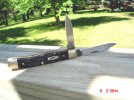
Jamesbeat, your knives look great!!! I have an old Case Small Texas Jack that I'd been playing around with for a while. Like you, I had tried the leather dye, with the exact same sad results. As soon as I read this thread I knew I had to try the "clothing dye in boiling water" trick. It works!

Attached is a not-so-great pic, but it shows the results nonetheless. (I wish I had taken a "before" pic so you could see just how ugly the scales were after my previous attempts, using various methods, of alternating between "color removal" and "color enhancement".)
 

Attachments

  • bone dye.jpg
    bone dye.jpg
    57.6 KB · Views: 179
Great post and advise. I had completely given up trying to change the color of knife scales. Now I know what works.

And James, those knives look great.
 
Back
Top