Removing foil Wrap

Joined
Jan 1, 2004
Messages
108
All instructions (even Admiral, who quote Koval Knives help) stress the importance of:
1. wrapping blades in foil and making air-tight (double wrap, no pin pricks, including a piece of paper, etc)., and
2. as quickly as possible, getting the blade into the quench oil - snip the foil and let drop into a basket (many articles say this is 'critical' and needs to be done really fast - saw one which said it needs to be done in a second or two).

So, can anyone advise me how to get the blade out of the $#@%* wrap quickly and into the quench?

Tried this with foil double wrapped ATS34 yesterday - not sure just how quickly I got the blades out, but certainly not just a few seconds. Lots of cussing on a Sunday!!!

Appreciate your thoughts.

Mike
 
I haven't personally performed any foil wrapped heat treating, but I read a post earlier about wrapping the blade in a simple brown paper before wrapping in foil. This paper will burn up, not only decreasing the oxygen in the environment, but also giving you a layer of carbon/soot to help the blade slide easily out of the foil pack.

--nathan
 
I haven't tried it myself, but what I've read indicated making an envelope wrap, not a form fitting sleeve, and just snip one end and slide it out.

-Page
 
Generally we snip them at the end as well and drop it out by the tang or pull it out with tongs. You could plate quench your ats in the packet if you were worried about it. No messy oil either.
 
ATS-34 is air cooled steel. Get yourself some 1" thick aluminum plates and plate quench, that way you can leave it in the foil until its cool.
 
ATS-34 is air cooled steel. Get yourself some 1" thick aluminum plates and plate quench, that way you can leave it in the foil until its cool.

I do what John does leave it in the foil , never had a single problem.
 
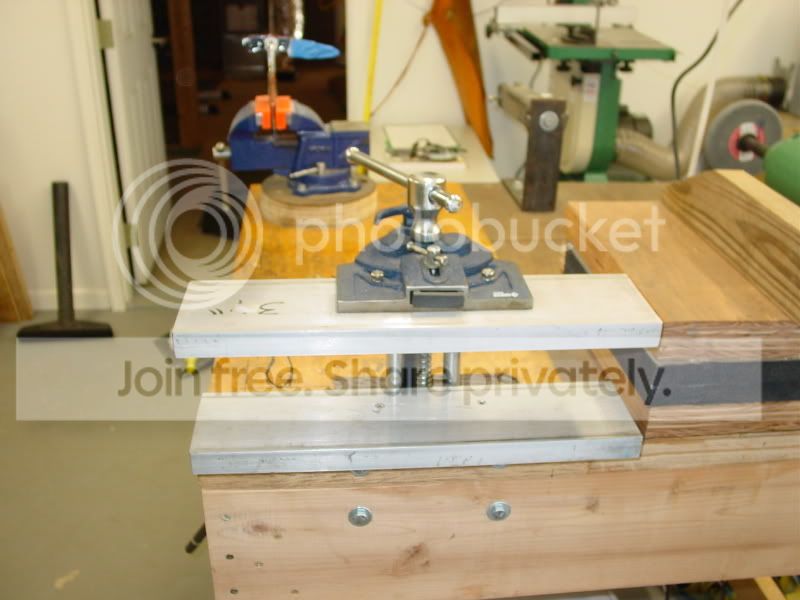
Here's my plate quench set up. I saw this set up on BF. I just mounted a wood workers vice with a quick release vertically. I attached two thick aluminum plates.
-John
shopanddogs008.jpg
 
Ever increasing numbers of makers are going to "plate quench" for air hardening steels !Quick, efficient ,simple for even the caveman types !! Lots of discussion here , search "plate quench ".
 
I dun think you need any oil to quench blades in with Air Hardening Steels (unless the cross section is exceeding 5" inches or more)...atleast for A2 anyways, otherwise just plate quench or cool in still air to 120'-150' degrees and then temper.

If you are using Air Hardening steels, I think it's very important when you take the blades out of the kiln in the foil wrap to wait till all visible red heat is gone before opening the envelope otherwise you're gonna cause more carbon loss to the steel. Otherwise just plate quench! and you don't have to worry about any of that.....unless you're doing a ton of blades at a time then you might need a few quench plate presses.
 
Great response - thanks guys.

Not to press a point, but I have been told that ATS34 is NOT a steel that can be air cooled - needs oil. There seems to be a lot of makers who think otherwise.

And that suits me fine.

Barker, that is an awesome setup - I gotta make me one of those - mostly I deal in 440C, which (I am assured) is air quenchable. Thanks for the photo. Is that 1" thick aluminum you have used?

And I have just bought a LOT of ATS34 (about 6pieces x 72 inches) from Admiral, cause they were out of stock on 440C. So that kind of plate quench will get a lot of work. My shop is kind of portable, but I can see setting that up on a WorkMate (folding tool bench).

Thanks again.
 
Yes, I got those plates off *bay for about $30 to $40. Drilled and tapped them. I use a fair amount of ATS-34 and always plate quench. The best thing is it minimizes warping. You should try some CPM 154. You will like it. On the vise make sure it is a quick release.
-John
 
John, if you're still there, one more question.

Why do you stress quick release?

I have heard nice things about CPM 154 -is it air quench?

Mike
 
Quick release is important to close the vise quickly. The plates need to come together very quickly while there is still an orange glow. You don't want to be there turning the screw to close the vise all day while the blades are cooling. And you want it open pretty wide to get them in there with the tongs. Time is of the essence. Not so big a deal to open the vise, but to close it.

Yes, CPM 154 is air quenched too. It is basically the American version of ATS-34.
 
If you're not plate quenching, you usually want to remove the steel from the foil in order to cool in circulating air. My understanding is that your foil could actually slow the quench of the steel in this situation.

You will not see significant decarb if you take the blade of out the packet directly out of the oven. Even on A2 and D2 the decarb and oxide layers are relatively thin. ATS-34 does little more than take a hue. Good thing about plates though - the blades come out almost as shiny as they went in.

I dun think you need any oil to quench blades in with Air Hardening Steels (unless the cross section is exceeding 5" inches or more)...atleast for A2 anyways, otherwise just plate quench or cool in still air to 120'-150' degrees and then temper.

If you are using Air Hardening steels, I think it's very important when you take the blades out of the kiln in the foil wrap to wait till all visible red heat is gone before opening the envelope otherwise you're gonna cause more carbon loss to the steel. Otherwise just plate quench! and you don't have to worry about any of that.....unless you're doing a ton of blades at a time then you might need a few quench plate presses.
 
Mike, as pointed out, ATS34 and 154CM are essentially the same steel. One can then check the Crucible HT instructions for 154CM and find that, indeed, it is an oil or forced air quenched steel. http://www.crucibleservice.com/datash/ACF13AF.pdf?CFID=1574180&CFTOKEN=70965548

I oil quenched ATS34 and 154CM for many years, battling that cursed foil to get the blade out quickly. I switched to quench plates, blade in foil, and it has given me the best as-quenched hardnesses ever for these steels. Scrounge yourself up some aluminum plates of decent size. While i have the same setup as Barker, many people just put one plate on the floor, place the blade pouch on it, lay the other plate on top and step on it.

CPM 154 heat treats the same way as 154CM.

Added: Leu Custom, you should read this to see where Udeholm calls A2 an oil or air-quench steel, also. http://www.bucorp.com/files/aisi_a2.pdf
 
If you're not plate quenching, you usually want to remove the steel from the foil in order to cool in circulating air. My understanding is that your foil could actually slow the quench of the steel in this situation.

When i'm talking about waiting till the visible red heat dissapears, it only takes a few seconds for this to happen, then cut open the envelope...not gonna effect hardness any and less likely the burn the hell out of yourself. :D
 
I just take the packet out of the oven with a short pair of pick up tongs, snip the end off with a big pair of scissors, and pull the blade out with another short pair of pickup tongs. I either put it between the plates, or quench it in Parks AAA.
I have never heard of the one second thing except for 1095 and similar carbon steels, which are not put in foil to start with.
Stacy
 
Back
Top