Removing grind lines

Joined
Nov 25, 2007
Messages
340
I ground two bushcraft blades this weekend. One of them is pretty nice and the other has lines from the grinder that I can see and physically feel with my fingers. I am not referring to scratches from the grit. These are actual very light grooves running from edge to spine where I may have slowed down or something. I have yet to figure out what I did to cause it. It's most likely due in part to me not used to doing larger blades or running a higher RPM.

To repair- some of the info I was reading says to mount a stone and hand sand the length of the blade to work the bevels back to flat that way. Is this what you guys do and if so what type of stone? Medium ish? Or, should I try to take it back to the grinder and pull the blade across at a little angle to catch the high areas?

One more thing. I don't have variable speed ability on my grinder and thought I needed to go faster so I purchased a larger drive wheel which bumped my rpm to 2350 from the 1850 is was using. I assume less speed would help, but it's a bear to profile at 1850. What do you guys like to run your rpm's at after let's say 120grit?? I could always run the faster wheel for the main stock removal then change wheels once I grind in the main bevels.
I could probably post a pic later after work. Don't know how good they'll show up though.
Thanks Chris
 
I'm an amateur and not a grinder pro but in that case I use a file instead of a stone and draw file it to even it out on each side.
 
Sounds like you got your blade a bit crooked against the edge of the belt and sanded a grove into the blade, just need more grinding to get it out, hopefully not too deep.

The RPM is not much help what is your drive wheel size, you can then calculate a feet per minute rate, that will tell us how fast you are grinding.

What belts and grit are you using, that may be the cause of excessive grinding time.
 
I'd use a belt sander if you have one..I had that issue and when used carefully, the sander can fix it up!
 
Sounds like you got your blade a bit crooked against the edge of the belt and sanded a grove into the blade, just need more grinding to get it out, hopefully not too deep.

The RPM is not much help what is your drive wheel size, you can then calculate a feet per minute rate, that will tell us how fast you are grinding.

What belts and grit are you using, that may be the cause of excessive grinding time.
I'm using the Purple 36 grits for major removal, then to ASM 50 grit to mostly finish bevels, then to ASM 120 grit , then to a 3m 220, then to trizact 45 then to trizact 30

4" OD = 1,850 RPM (was running when I got the machine)
5" OD = 2,350 RPM (running now)
6" OD = 2,800 RPM

Thanks Chris
 
Also, you can make a super simple jig for a belt sander that puts great and very consistent bevels on blades. Just a block of wood, a clamp to clamp the blade to the wood, and a screw that you can use to adjust the angle works great!! I suck at using a grinder for bevels, so that's what I do.
 
To make sure we all (me especially) understand your RPM, you have a pulley setup and by moving belt from pulley to pulley you get a different RPM on the drive wheel?

Just for guidance, with the drive pulley shaft turning 1850 RPM, your belt speed will be a tad over, say around 1900 SFPM or so.

With the 5" pulley turning 2350 RPM your belt speed is around 3,070 SFPM

With the 6" pulley turning 2800 RPM your belt speed is a blazing 4400 SFPM - that will throw some sparks!

With 36 (and even 50) grit you can turn some high belt speeds for fast cutting, but with those finer grits of 220 and finer (trizacts) you really need the slower speed. Even your 1900 SFPM is full fast for fine grits. Some of the experts might be able to use 220 faster than 1900 SFPM.

Ken H>
 
To make sure we all (me especially) understand your RPM, you have a pulley setup and by moving belt from pulley to pulley you get a different RPM on the drive wheel?

Just for guidance, with the drive pulley shaft turning 1850 RPM, your belt speed will be a tad over, say around 1900 SFPM or so.

With the 5" pulley turning 2350 RPM your belt speed is around 3,070 SFPM

With the 6" pulley turning 2800 RPM your belt speed is a blazing 4400 SFPM - that will throw some sparks!

With 36 (and even 50) grit you can turn some high belt speeds for fast cutting, but with those finer grits of 220 and finer (trizacts) you really need the slower speed. Even your 1900 SFPM is full fast for fine grits. Some of the experts might be able to use 220 faster than 1900 SFPM.

Ken H>

Ken H, that's some awesome information. Thank you very much for taking the time. I removed my smaller wheel and took the blade back out there and got her fixed up okay. Also removed my gloves which I think I'm going to start doing when I get to the finer grits. I'll try and post a pic of my wheel setup so you get a better understanding.
Thanks again Chris
 
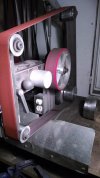
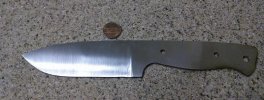
This is the side that had the grooves. Much easier at the slower speed. The wheel comes off with one set screw. I think I'll save the big wheel for profiling only. IMG_20141208_192025893.jpg
 
Chris - Glad I was able to help some. You have an interesting grinder - that big wheel at back is just hanging there? The drive wheel is direct mounted to motor? The tension wheel is at rear top.

Do you have a tach? OR - how do you determine RPM of drive wheel?

Ken H>
 
Ken, I bought it from AMK Tactical who makes them. Their machinists that make gun parts. Overall, I'm pretty happy with it, but I'm somewhat new to this game, and have never used the old standby's like burr king, bader... and so forth. Drive wheel on motor and tension wheel up top. The platen and hollow grind wheel are on one rotating assembly mounted at opposing ends attached at the middle via a pin and locking hub. When I want to switch between the two you pull the pin, loosen the hub and rotate 180. I can swap the platen and my 3/4" finger groover in about 60 seconds. It all operates pretty quickly.

As far as the RPM goes, those numbers were given to me by AMK.
 
Back
Top