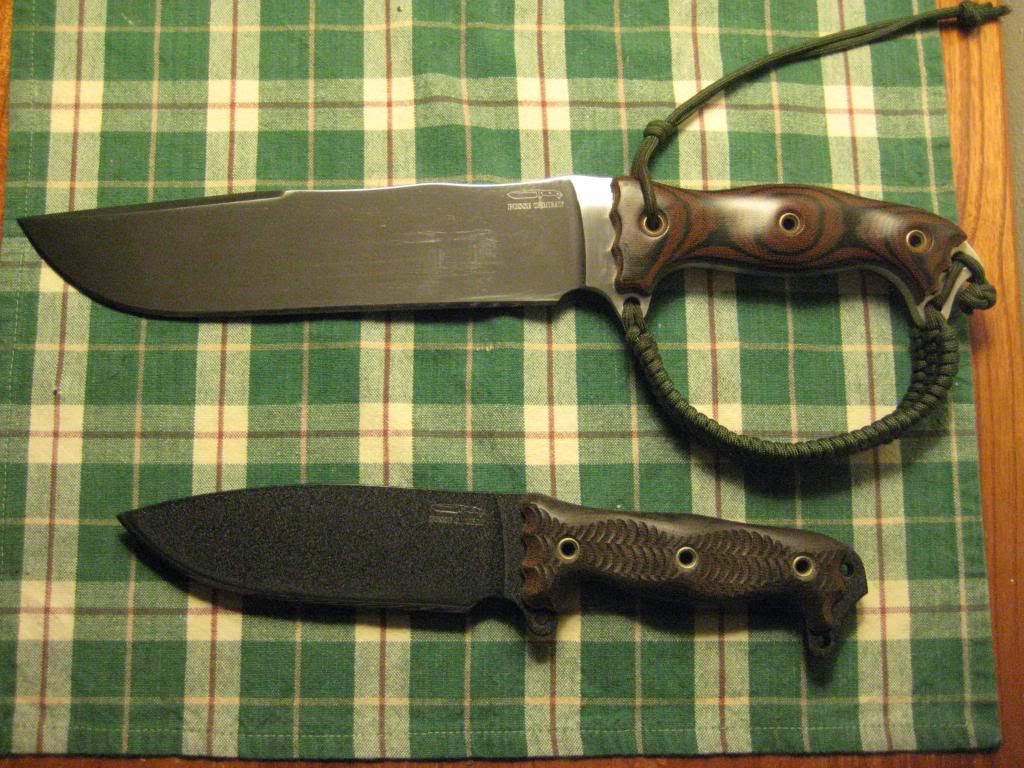
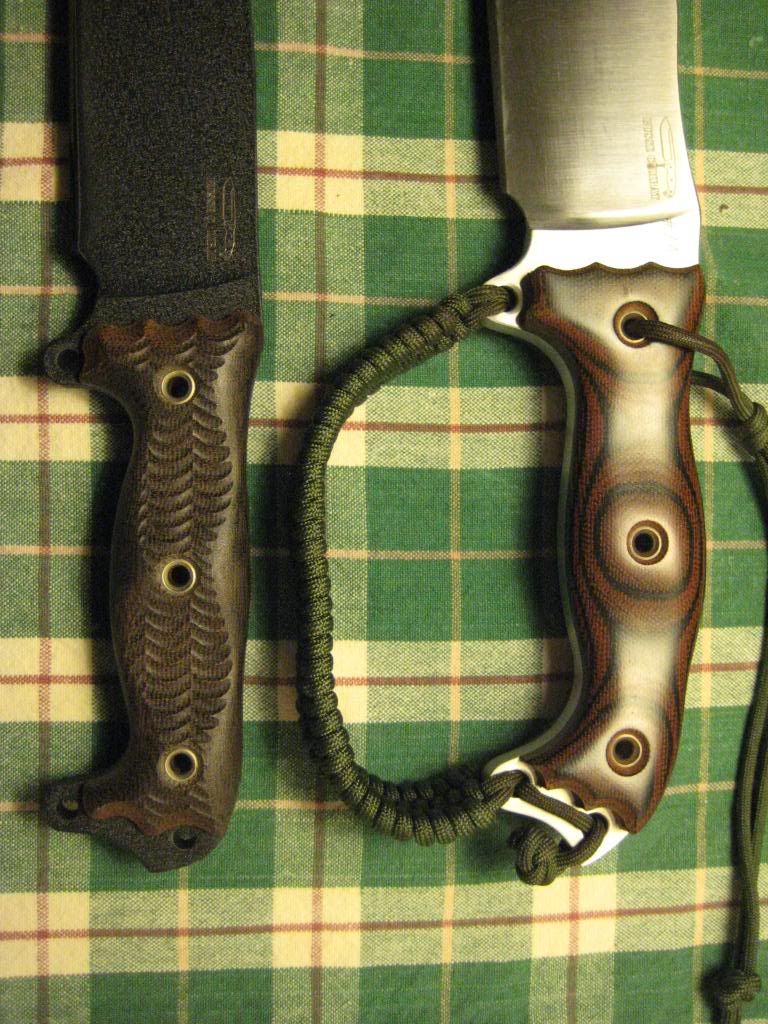
Removing handles..

Drilling it out isn't a problem, I got that covered, I was just wondering what creative ways you all were using to secure the blade. My plan was to just tape up the blade ridiculously good and drill it out while holding it with my other hand.

As you covered and many mentioned, plenty of blue tape on the blade is a VERY prudent way to go. You can fold a few layers of newspaper just over the edge alone to save some tape. But, don't cover the full blade with paper. You want the tape to stick to most of the blade.
Make sure the tip is well padded as well.

Clamping the blade well is also a very worthy precaution and helps center the drill as well.

There are a few good reasons for using a drill press rather than a hand drill.

A drill press has a work table suited for clamping a blade to - good for safetyh and for centering the bit.

A drill press allows you to lower the drill bit very slowly and in control to shave the metal slowly. Hopefully, you can control the bit to where it doesn't "Bite" and dig in. If a bit bites and digs in, that is where the object gets stuck to the bit and therefore the drill and tends to start spinning all attached objects. If clamped down well, the bit will either torque out the big bite of metal, the bit might spin loose in the chuck, spin the flared tube loose or the bit will break. Not all good options, but all better than spinning the knife.

If the flared tube spines loose it is hard to cut out. So, another reason to go slow. I recommend going with smaller bits and gradually increasing the size of the hole till you get to 1/4".

If trying to hold the knife by hand, most corded drills have a lot more torque than most men have grip strength. But, at least hand drills have a trigger that can be let go of pretty fast. However, using a hand drill is pretty hard to center. You might tend to cut one side of the flared head before the other.

*** Also, you don't have to cut the tube all the way into the tang and probably shouldn't as you don't want to cut any part of the tangs hole and change it's diameter. Just get the head cut off on one side of the flared tube and use a punch to punch it through the other.

Most people have wood/metal bits that are really designed for wood or for metal that doesn't have a "Pilot" hole. The hollow tubes act like a big pilot hole and so the edges of the bit tend to bite into the metal.

There are better suited bits for cutting metal that have an existing hole. Such bits shave off metal and less prone to biting then bits that cut into the metal like most twist bits.
Most home-owner use wood/metal bits have an aggressive cutting lip that slices under the material being cut. In metal, this causes the wedging that causes the bit to bit too deep and stick.

All this said, I am sure some people have just grabbed any ol' 1/4" bit, stuck it in a drill and drilled the tube right out. :o ..... But, it might not always go so well. There has been at least one HIGHLY mangled, mutilated, cut up hand for reference.

I can't find the picture, but many I am sure have seen it.

I can only imagine how many possible dangers could happen with a good heavy "OUT of Balance" knife spinning at about 1500 rpm or so. :eek:

Being so out of balance, a stuck blade isn't likely to stay attached to the drill very long either. :eek:
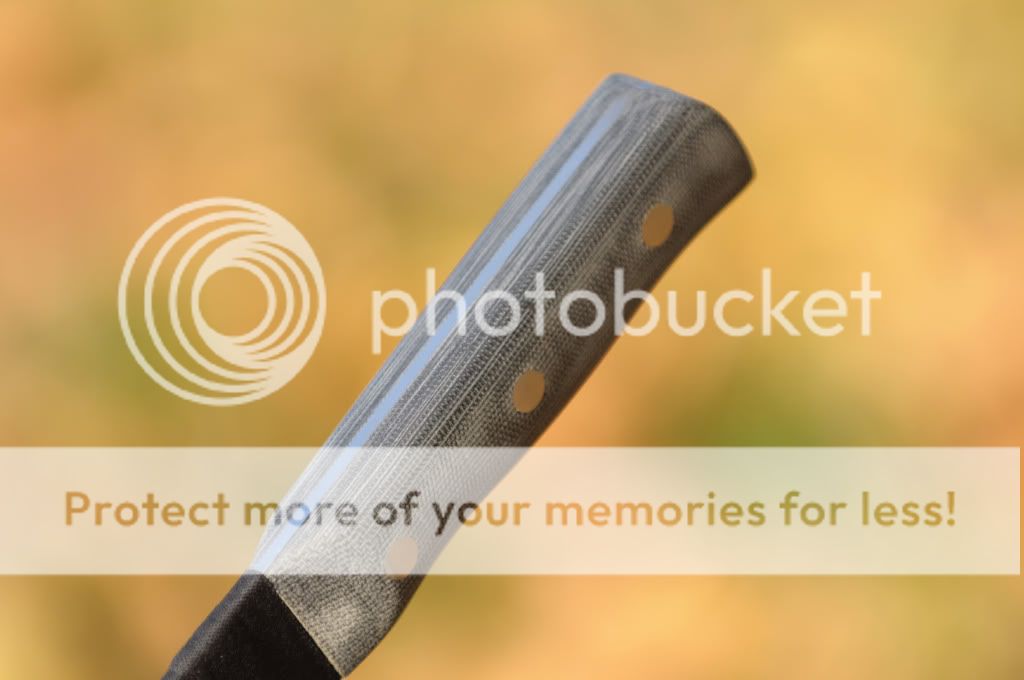
 
For the record, removing flared tubes is the easy part. In spite of all of the precautions that SHOULD be taken and considered to prevent injury, it really isn't that hard to drill out the tubes.

Reistalling the tubes if going back with flared tubes is a bit trickier. There are some threads showing a few methods to flare the tubes, tips and tricks, etc.

If you want to use bolts and the existing factory scales, you have to find a way to make the bolts work together with the factory scales as the factory scales have the holes chamferred for flared tubes. So, you have to either find bolts to fit the existing chamfer, re-cut the chamferring of the scales.... and maybe the hole size in the tangs, or customize bolts or something.

If you go with bolts, I am curious to know what you find that fits.

.
 
I am thinking these http://www.usaknifemaker.com/store/corby-style-bolt-large-25-shaft-312-shoulder-303ss-p-971.html

They have the 1/4" shaft that will work with the existing holes. Then just countersink a 5/16" inch hole for the shoulder. Tighten them down and grind them down. But, I would think to make this look right you would end up needing to bring down the mag handles with your sander and make them into hand shaped/smooth bolt style.


I don't think those Corby bolts will work with the factory Busse scales. I measure the chamferring on a handful of my Busse's to be from about 3/8" wide to almost 1/2" wide. If the head of the Corby's is only 5/16", it won't fill in the chamferring on the Busse scales. I guess you could epoxy the gaps, Black epoxy might even look decent. But, it won't look like your following picture:


They finish like this if you grind them down:
MF2.jpg

I would "assume" the above scales are custom made and custom cut to fit with Corby Bolts. I doubt those were original Busse Hollow tube scales.


Maybe someone knows of a bolt that will just line right up and be perfect for your FBMLE without any modification.

I would be curious.
 
I don't think those Corby bolts will work with the factory Busse scales. I measure the chamferring on a handful of my Busse's to be from about 3/8" wide to almost 1/2" wide. If the head of the Corby's is only 5/16", it won't fill in the chamferring on the Busse scales. I guess you could epoxy the gaps, Black epoxy might even look decent. But, it won't look like your following picture:


I would "assume" the above scales are custom made and custom cut to fit with Corby Bolts. I doubt those were original Busse Hollow tube scales.


I would be curious.

Yeah, I don't really know. I just figure since the tube fasteners are 1/4" these 1/4" shaft would work for the exhisting tang holes and handle holes. Then I was thinking you could countersink the Busse handles to the 5/16 for the bolt shoulders. I was not thinking of using the shallow chamfering used for the tube fasteners. I was thinking of making countersunk 5/16" holes and installing the handles with possibly liners to compensate for lost thickness when you grind down the handles to remove the tube fastener chamfering...along with other handle material.

It is probably a silly idea. But, just to clarify, I would not be using the chamfering for the tube fasteners.

Thanks for your thoughts:)

I made the pictured grips from a block of canvas micarta.
 
Yeah, I don't really know. I just figure since the tube fasteners are 1/4" these 1/4" shaft would work for the exhisting tang holes and handle holes. Then I was thinking you could countersink the Busse handles to the 5/16 for the bolt shoulders. I was not thinking of using the shallow chamfering used for the tube fasteners. I was thinking of making countersunk 5/16" holes and installing the handles with possibly liners to compensate for lost thickness when you grind down the handles to remove the tube fastener chamfering...along with other handle material.

It is probably a silly idea. But, just to clarify, I would not be using the chamfering for the tube fasteners.

Thanks for your thoughts:)

I made the pictured grips from a block of canvas micarta.


Well..... if you "Have" to use liners and grind away THAT much original Busse scale material, then countersink, etc., you might as well just start out with raw scale material (????) Seems about similar in cost in the end and time in the end (????) - ......unless you just want liners anyway. Then I guess you might as well do as you suggested to make use of the scale material that you have that is about half fitted at that point.

Neither option is a plug and play replacement.

I would still like to find a bolt that could be used without having to use liners or new scales and so much modification to the scales.

Minor modifications to the existing chamferred holes might be OK. But, based on the handfull of measurements I took, you would have to find a Corby bolt with a 1/4" shaft and about a 1/2" diameter head to be able to fit most Busse scales. Then since I have not seen any tapered Corby's, you would likely have to countersink a 1/2" straight cut hole into the Busse chamferred area to remove the taper.

Trying to get the new 1/2" cut perfectly lined up on the existing 1/4" center hole sounds challenging unless you have a special bit (????) I guess you might be able to center it on a drill press if you clamp the scales stable after centering the hole on a 1/4" chucked bit. Then change the bit to the 1/2" bit.

I have not seen a step bit from 1/4" - 1/2" in a single step bit. And step bits can be Expensive anyway.

You would likely have to use a Forstner flat cutting bit and self center the bit - I can only think of the method I mentioned above. Might be tricky to keep centered.

But, then you still have to find the 1/4" shaft to 1/2" head Corby anyway. So, .... :(

I measured some chamferrs as narrow as 3/8", some at about 7/16" and again, some almost 1/2". So, the only option that covers all is 1/2" headed Corbys - which I have never seen.

.

.
 
So why don't we just send this one to Garth for a smooth bolt/hand shaped mag treatment :)
 
Now HE is taking handles off!!
I gonna pound this bloke!! :mad:
:D

We are trying to reason with the big guy right now:D

Rolf's answer = Garth:D

I think in this case, unless someone knows of bolts that work without modifications Garth is the best route. My idea involves removing way to much of the handle material to smooth down to the bolts (I just looked at my FBMLE).

And if there were tapered bolts that utilized the existing chamfering I don't see how they would be anymore effective then tube fasteners. Maybe I am way off though.
 
We are trying to reason with the big guy right now:D

Rolf's answer = Garth:D

I think in this case, unless someone knows of bolts that work without modifications Garth is the best route. My idea involves removing way to much of the handle material to smooth down to the bolts (I just looked at my FBMLE).

And if there were tapered bolts that utilized the existing chamfering I don't see how they would be anymore effective then tube fasteners. Maybe I am way off though.


From what I can see and tell, it seems MUCH easier to just flare new hollow tubes back on - Unless a suitable bolt option can be found.

There are forum threads and posts around here showing how to flare hollow tubes. And quite a few have done it. Mostly just need a good heavy duty bench vise and fabricate a flaring die out of screws.

Or have somebody flare a tube for you that has a die and vise.
 
I think 230 is trying to get away from the tubes.

I'm actually looking to switch to something that can be replaced easily after I inevitably break them. I've just come to terms with the bolded text. :rolleyes:

I'm considering sending it in and just having Busse fix them and leave them alone, i'm just tired of shipping knives.
 
.
I use a sharp .25" drill bit in my drill press, hang onto the blade with one hand and use the arm feed on the drill press with the other, never had a problem!


.
:D


I'm not doubting your ability, but that just sounds a little dangerous to me
 
hey, just an idea.....i don't know, maybe silly, but here it goes..what if you use the corby bolts (using a step drill), sand them down ALMOST to the handle slabs, then cut a groove in the head of the bolts, and sand down a little more to meet flush. this way, you can use a flat head (or phillips if u want to cut 2 grooves with a dremel) to unscrew any time you like.
Would this even work? it seems like something i would try.
dave
 
Back
Top