Removing scale material

Joined
Oct 3, 2012
Messages
885
Since I've started this hobby, I've been using files bought from the depot. Today, a rare day off, I was doing some rough work on some new scales on for a kit, and after an hour of sweating and having not so much material come off, I figure that my file is clogged and I go to brush it off... Well it's brand new just popped out of the plastic....

I think I'm using the wrong files, it's labeled as coarse, anyways i digress...

Is there any other method of removing large amounts of material manually (I can't run a belt where I live)?

Or if there are better files that I could use, please point me in the right direction...
 
how do you have the material held? if you are not using a vice or do not own one...go get one, the more stable the piece is the less energy is wasted and the more the file will cut.. If you already are using one im not sure whats going on.
 
Depends on what part of the process I'm in, when I'm just doing the rough stuff, before I epoxy to the knife, I'm either clamped to my bench or in a vice. I should add, that this is also the first time I'm using pins, but I haven't even gotten close to that yet, I'm just trying to get the rough outline, not the contour and curvy bits yet.

This has just started to worry me because I'm fixing on ordering some steal to do some stock removal... if moving metal is going to be tougher than moving mircata... YIKES!!!
 
hmm thats really weird then, if you are working on profiling micarta why not just use something like a coping saw?
 
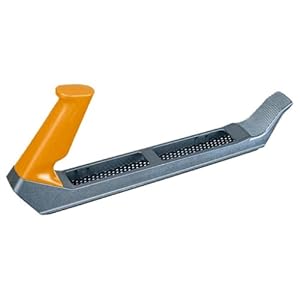
A coping saw will help you get your profile roughed in. Instead of files, try a wood rasp. A 10" half round should remove material in a hurry. For flattening a Stanley SurForm Rasp works well.

2092209503p


41tFyuGsydL._SL500_AA300_.jpg
 
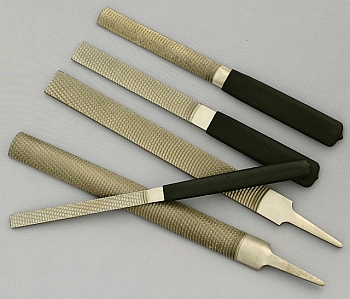
There are some relatively new files out there that I've had great luck with. They are called "carving files" or "cabinetmaker's floats". One company is making them now - Iwasaki. I'll post a couple of links below.

They are sort of like a combination of a file and a rasp. They remove material fairly aggressively, but leave a smooth surface like a file. They also come in three different levels of coarseness - medium, fine, and extremely fine. The also come in flat and half-round and in a couple of different lengths/widths.

I do all my scales by hand (e.g., coping saw, carving files, sand paper) and these have really made life simpler. I use the medium for hogging off material during the rough-out phase. Then I switch to fine for the shaping, and to extremely fine for the final pre-sanding touchups. They aren't cheap, but they are highly recommended.

TedP

http://www.fine-tools.com/carvingfile.html
http://www.highlandwoodworking.com/iwasaki-carving-files.aspx
http://www.woodcraft.com/category/2080472/iwasaki-japanese-files.aspx

mokutyo.jpg
 
Rasps are great, as are Magicut files.
But please, use a VISE, not a vice!
 
But please, use a VISE, not a vice!
Nice catch!! lol

I should have been more clear, I've already made my cuts with a copping saw, I just want to move large amounts of material on the outsides for a nicer contour (I'm wanting to skinny down the scales up toward the blade by about half the thickness... I was going to cut the angle but this brings up something else with this, cutting through the mircata felt like cutting though dense rubber, is this normal?

Anyways I'll try some different files, I think the last few that I picked up from the depot may not work as well as the ones that OzarkMatt and phillipsted listed.
 
Hey guys thanks for getting me headed/looking in the right direction. I had an hour to work on the scales today while getting setup I found a few things... Turns out I had some rubber jaws on my vice from who knows when, and In a failed effort to reduce noise I had put some rubber isolation feet on the mount. Once all rubber was removed and the jaws were replaced with the regular ones material started to move a bit more normally. I'm still concerned a bit with the brass pins. I'm gonna try ordering different files to see if that helps...

I guess this is what I get for guessing at how thick things should be =( they're almost twice the thickness lol.
 
My brother who makes arch top guitars and other instruments turned me on to a cupped metal disk with chunks of carbide on it for a 4 1/2" grinder. Removes material fast, also there are rasp burrs for end grinders. I love them for knocking off the bulk,, but be careful with them or they may just help you make a big mistake in a hurry. The coarse grit flapper disk will work also, but wear out.

Sorry to you guys who hate 4 1/2" grinders. I have lots of them laying around the shop all with different attachments on them.
 
Back
Top