
Repeated heat treatments on a 52100 blade and the results

Joined
Feb 24, 2000
Messages
1,952
I had another post on this subject, but decided to start a new one.
I made a blade of Aldo's 52100 steel, heated it to 1650 for 10 min. took out till it was black, heated it up to 1550 for ten min. took out till it was black, heated it to 1450 for 10 min. took it out till it was black, then heated to 1475 for 10 min. and edge quenched it in Texaco Type A oil. The blade did not harden. I reheated it to 1475 and quenched it in Brownell's Tough Quench. The blade did not harden. I reheated it to 1475 and quenched it in Parks 50. It did not harden. I re-heated it to 1450 and quenched in water. It did not harden. The RC reading was 52.

I got some help on this forum and was recommended that I heat to 1490 before quenching. So,

I made two more blades of 52100 and ran all three through the heat treatment again. 1650 for 15 min. 1550 for 15 min. 1450 for 15 min. then 1490 for 15 min. and quenched in Parks 50. This time they all hardened to a RC of 65.

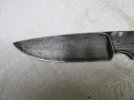
The interesting thing is how the original blade turned out. In the pictures it appears to have a number of small fractures. None are on the cutting edge. This probably happened during the water quench.

The other two blades turned out with no fractures.
 

Attachments

  • 001 (640x480).jpg
    001 (640x480).jpg
    43.9 KB · Views: 50
  • 004 (640x480).jpg
    004 (640x480).jpg
    40 KB · Views: 50
I would agree that the fractures are from the water quench. And for it not hardening the first time, I'm sure you did, but did you grind off all the decarb? I get low numbers on my 52100 until I grind past the decarb then get the numbers I'm looking for.
 
Aldo 52100 is 95% spheroidized. So here is my fwiw math - carbon in solution on your previous ht runs didn't hardened until later attempt. Vs carbon in solution for your new ht.

Your old ht:

1650F 10 minutes = dissolved ~40% spheroidized carbides/cementite.
1550F 10 minutes = + ~20%
below 1500F 10 minutes = + ~3% per attempt

So carbon in solution = ~ 0.05 + 0.89*(.63-1st, 0.66-2nd, etc..) = 0.05+(0.56, , ,) = 0.61, , , at water quench attempt, .68-.71%C carbon in solution which resulted with cracks. By 1490F attemps - carbon is solution close to .8%, which easily harden by quench speed 11seconds or faster.

Your new ht:

1650F 15 minutes = 50%; 1550F 15 minutes = 35%; below 1500F 15 minutes ... well, carbon in solution now is ~ 0.05 + 0.89 * (.5 + .35 + .05) = ~.85%C in solution <= yep aust is well saturated with carbon. Actually you can harden with aust temp 1450F - 1475F range at 7-10 minutes soak, quench in sub 10 seconds oil (warm canola or p50).

ignore below if you find your new ht ^ is working well for you.

  1. tool wrap blade
  2. 1650F 35-40minutes soak cool to black (need less soak time if you use higher temp). After this step, ~0.76%C are not in coarse spheroidized cementite form
  3. 1550F 5 minutes *
  4. 1500F 5 *, remove foil
  5. 1475F 7 minutes -> P50 or 130F canola (even TX TA will work too but might drop 1 or 2 rc).
Grind off decarb; Expect AQ hardness 66+rc


I had another post on this subject, but decided to start a new one.
I made a blade of Aldo's 52100 steel, heated it to 1650 for 10 min. took out till it was black, heated it up to 1550 for ten min. took out till it was black, heated it to 1450 for 10 min. took it out till it was black, then heated to 1475 for 10 min. and edge quenched it in Texaco Type A oil. The blade did not harden. I reheated it to 1475 and quenched it in Brownell's Tough Quench. The blade did not harden. I reheated it to 1475 and quenched it in Parks 50. It did not harden. I re-heated it to 1450 and quenched in water. It did not harden. The RC reading was 52.

I got some help on this forum and was recommended that I heat to 1490 before quenching. So,

I made two more blades of 52100 and ran all three through the heat treatment again. 1650 for 15 min. 1550 for 15 min. 1450 for 15 min. then 1490 for 15 min. and quenched in Parks 50. This time they all hardened to a RC of 65.

The interesting thing is how the original blade turned out. In the pictures it appears to have a number of small fractures. None are on the cutting edge. This probably happened during the water quench.

The other two blades turned out with no fractures.
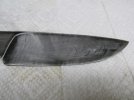
 
The same exact crack pattern on my very first blade! It was 52100 and i didn't know anything yet, imagine i quenched it in water....actually brine.
 
  1. tool wrap blade
  2. 1650F 35-40minutes soak cool to black (need less soak time if you use higher temp). After this step, ~0.76%C are not in coarse spheroidized cementite form
  3. 1550F 5 minutes *
  4. 1500F 5 *, remove foil
  5. 1475F 7 minutes -> P50 or 130F canola (even TX TA will work too but might drop 1 or 2 rc).
Grind off decarb; Expect AQ hardness 66+rc
Do you have any trouble with grain grow from soaking the blade at 1650 for 35+ mins?
 
There will be some slight "grain growth" at 1650F....but from what I have read, significant grain growth will not develop until around 1750F or better. But what little grain "growth" there is at 1650F, the subsequent cycling "shrinks" the grain smaller. Actually nucleating more grains in a given area/volume. Aus grain size is extremely easy to take care of....just cycle it above critical and maybe just below. But carbides are harder to tame, and the 1650F is really needed to break up carbides that are clumped together. And because the 52100 is extremely heavily spheroidized.
 
There will be some slight "grain growth" at 1650F....but from what I have read, significant grain growth will not develop until around 1750F or better. But what little grain "growth" there is at 1650F, the subsequent cycling "shrinks" the grain smaller. Actually nucleating more grains in a given area/volume. Aus grain size is extremely easy to take care of....just cycle it above critical and maybe just below. But carbides are harder to tame, and the 1650F is really needed to break up carbides that are clumped together. And because the 52100 is extremely heavily spheroidized.
I am 98% agreeing with you, Stuart :thumbup:

Do you have any trouble with grain grow from soaking the blade at 1650 for 35+ mins?
The 2% differ from Stuart's post because grain size as-shipped 52100 from Aldo is 150+um (probably between astm size 2-3). So after 35minutes at 1650F, there are 0.76%C + fine spheroidized carbides(original but shrunkened by temp+soak) providing numerous grain nucleation sites; however since most diffused carbon are atomic form so Zenner Pinning is weak. Still, after this step, grain size should be in 25-40um range. Subsequent steps more & more carbon taken combination form of fine fern/needle/sheave (mostly pearlitic) to nucleate (refine) grain.

Grain refinement outlined from my steps (yes, it 's just a slight mod from Stacy, Darrin, ... recipes) capable of producing grain as fine as astm grain size 12. Realistically with careful ht, you will get grain size 11 (~8um). Also keep in mind, additional repetitive 1450-1490 cycles will not provide extra refinement, except pulling more elements into grain boundary, weaken the interface (lower toughness). btw - I use this ht procedure as a baseline to compare against my radical/innovative :D ht params.
 
Bluntcut, thanks so much for taking the time to write up the HT information. The next 52100 blade I heat treat I will try your method. Thanks again!
 
Back
Top