Restoration project

Joined
Dec 25, 2005
Messages
77
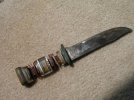
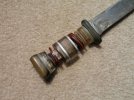
This is a knife that my sister’s fiancé would like to have me redo the handle for. I am planning to do it in leather. I have never done leather before so if anybody knows of a good tutorial I would appreciate it. I am going to buy a kit and finish it first to practice.

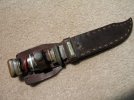
I also would like any information about the knife it’s self. I believe it was given to him by a grandfather. Does anybody know anything about it? The only marks are on the sheath.
 

Attachments

  • IMG_0947.jpg
    IMG_0947.jpg
    81.7 KB · Views: 116
  • IMG_0944.jpg
    IMG_0944.jpg
    81 KB · Views: 156
  • IMG_0945.jpg
    IMG_0945.jpg
    78.9 KB · Views: 139
What you have is a WW II theater knife. To restore the knife in leather I feel would be a crime. That is you would be erasing a part of history that one of the grand fathers may have rehandled himself. Do somemore research there are plenty of examples if you do a google image search for WW II Theater knives.
 
The handle probably looked very similar to this one found here
DSC00959.JPG


Jason
 
Ok not interested in committing a crime. I agree I would like to keep it authentic as possible. Where would I get the “plastic” for the handle?

Ok not interested in committing a crime. I agree I would like to keep it authentic as possible. Where would I get the “plastic” for the handle? How would you sand it and get all the scratches out?:confused:
 
I'm not a specialist, but i doubt they would have issued a military knife with trashy translucent plastic. To me, it's more a scout knife that lived a looooong life. Could you show a picture of the butt? If it's riveted like some military knifes and bayonets, it won't be easy to dismantle without damage. I hope it's simply screwed. If the first owner/user of the knife is not alive anymore, and thus you can't have his advice, i would think it's better to make it a strong and tough usefull knive, as it's be used and meant to be, and to give it a second life on perfect coherence of it's original fonction. Considering how the first owner/user treated the knife, that would be the best tribute to his memory and philosophy. Don't try to redo what the past and history stripped away, in my opinion. But the fiber spacer are still perfectly useful, and "recycling" them might be the little touch that makes it all. I think the leather stacked handle might be a good choice, but i never did one, and could not give you any advice. The only thing i tell you is: keep the guard and pommel! These parts are difficult to adjust, and would not be a good idea to replace them. Just a bit buffing, and they'll look great again. You could also do a stag handle, that's traditionnal too...
 
Madnum,

These types of knives weren't issued by any means, but rather they were built "in-theater". Many were cobled together with pieces of scrap that was readily available by the owners, and some were made by military machinests in camps or on ships to sell to others. That's what makes them a special little piece of history. These were made by soldiers for soldiers who were in the midst of the war.

--nathan
 
Ok not interested in committing a crime. I agree I would like to keep it authentic as possible. Where would I get the “plastic” for the handle?

Ok not interested in committing a crime. I agree I would like to keep it authentic as possible. Where would I get the “plastic” for the handle? How would you sand it and get all the scratches out?:confused:

A common source for plastic in WWII was plexiglass, often recovered from downed aircraft cockpit canapies, both allied and enemy alike. Aluminium, bakalite, rubber and any other durable material was salvaged form the air craft as well. As fas as brass for guards and pommels obviously there was no shortage.

Also with the wording on the sheath " North Africa 43" with a little more research may even lead you to know where and when the knife may have been.

"How would you sand it and get all the scratches out?:confused:"
:confused:Um??, How is it you as a question with the anwser in it and not see the anwser???

Use wet and dry sand paper from 120 grit and finer untill you get it clean and clear, use it wet you may have to go all the way to 800 grit.
 
Last edited:
I don't know who the current expert is on these sort of knives....

But, I feel very confident in the following advice.

Do nothing to the knife that you do not absolutely 'have' to do. Like you might give it a light coating of Renaissance Wax, if it is rusting, but other than that, do nothing.

Do not refinish the knife.

You likely have a real collectible in your hands, as such, collectors of those sort of knives want the character of the scars and use and abuse of the knife in it's present condition.

Don't even sharpen it.

Now, you may speak with a real expert, and they may have some very specific advice about specific things that can be changed, without ruining the value, but the safest bet is to do nothing until you are absolutely sure you know that your actions will not erase the history and character of the knife you hold.

Marion

PS - If you can find any documentation from your family, that document the knife, collect them now. Photos, diaries, letters, anything like that. Honestly, you potentially hold the stuff of Antiques Roadshow legend in your hands

PPS - If you want to do something, make a replica of the knife, this will allow you to work with the same type of knife, same materials, same style, etc, without taking big risks.
 
While it is a neat piece of Americana, I doubt it's "Antique Roadshow" material.
It is collectible only as an artifact, and much better examples are readily available for nominal sums, so I would think rehandling in in the spirit of the original rehandling would be OK. If it can be documented as belonging to a historical figure or place, leave it as an artifact.
 
While it is a neat piece of Americana, I doubt it's "Antique Roadshow" material.
It is collectible only as an artifact, and much better examples are readily available for nominal sums, so I would think rehandling in in the spirit of the original rehandling would be OK. If it can be documented as belonging to a historical figure or place, leave it as an artifact.

I don't know that it is anything.

But, I know that it always safer to be careful than to be careless.

I was simply trying to suggest being careful.

Marion
 
I collect theater knives, I find them very interesting. A lot of them were some guys first knife he ever made in some machine shop on board ship heading to war. If you can obtain any historical record of the knife I would leave it alone as said before. I think making a copy of it is a fantastic idea. If no history can be found and the guy wants it "restored"... replacing the rotted leather spacers in the original handle and light cleaning would be something to consider.
The "North Africa" could add considerable value even in the condition its in.
Mace
 
Back
Top