Restoration Project

Stacy E. Apelt - Bladesmith

ilmarinen - MODERATOR
Moderator
Knifemaker / Craftsman / Service Provider
Joined
Aug 20, 2004
Messages
38,493
Joe Allen gave me some knives and projects that Ron Frazier had not finished before he died. Joe really liked one, and today I restored and finished the knife . I will give it to Joe Friday, at Harrisonburg.
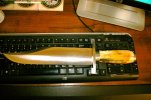
It is a HUGE Randall Bowie. The blade appears to have never been used, but it and the guard were rusty. Someone had coated them with spray varnish to protect them from more damage. Ron Frazier had started to re-handle the knife in fossil walrus, but had only cut a basic tang hole. I restored the blade and guard to a factory satin finish without taking away any of its character. I refurbished the guard, made a bolster and butt cap, fitted the walrus, and shaped the handle. The knife really POPS now, and I think Joe will be pleased with his Frazier/Apelt collaboration Randall.

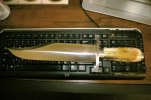
Here are two crappy shots of this monster sitting on the keyboard.
OAL - 16"
Blade Length - 10.5'
Blade Width - 2.25"
 

Attachments
  • Bowie and other 006.jpg
    Bowie and other 006.jpg
    60.9 KB · Views: 120
  • Bowie and other 009.jpg
    Bowie and other 009.jpg
    66.3 KB · Views: 148
Last edited:
Awesome work Stacy. I love restorations, getting close to being done on a Puma Pony that had been run over and pretty much destroyed.

That one is even more special, being a finished piece post humously.


-Xander
 
I've found that, in restoring firearms and furniture, there's a certain quizzical wonder in deciphering the original intended construction, and can invoke some strong nostalgic feelings--the combination of a piece's history, the maker, and the person who owns it can combine for a pretty potent potion that rarely fails to act upon the emotions.
Your pride in this one really shows, Apelt Sensei, one day I hope you do a WIP with a similar project so we can share in the journey, between shaping the fossil and building a handle proportional to such a massive blade, your insight as to how to proceed would be a worthwhile read--especially when tied with such a noble endeavor.
By the way, you're making an understatement when you say the blade pops, the clip's swedge is almost invisible at the thumbnail size, when the browser opens the extension viewer, it comes jumping out from the black keyboard like a streak of silver. It really is almost invisible when minimized, and the sudden appearance makes you jump back and give the blade second thoughts.

Two questions though:
When you say Walrus fossil, is it fossilized walrus tooth or Oosik?
And
Is it a takedown? The shouldered guard looks like it would interfere with sharpening, but adds a very defining element.
 
Nice job. The keyboard really brings into perspective what a large knife it is.

I have a Jody Samson dagger I'm about to start restoring for a friend. When working on something made by a master, it's always inspiring and humbling to gain some insight into the hands and mind that made it.
 
Fossil walrus is the knife-slang term for older walrus tusk. The more correct term is "Fossil Walrus Ivory". It can range from several hundred years old to thousands of years. Depending on the mineralization of the site and the age, it can take on some nice colors. This tusk is a newer fossil, and is probably 200-400 years old.
All oosik used for knives is fossil material.

Many confuse the term "fossil" with "fossilized" or "Petrified". A fossil is, by its name, "Dug Up" ( Latin word fossum = to dig, past participle is fossus = having been dug up). It can be a bone in virtually unchanged condition or a totally mineralized specimen ( Greek word petros = stone/rock, thus Petrified = made into stone). In paleontology, a bone is not usually called a fossil until it is 10,000 years old, but for ivory, once it is mineralized for a few hundred years most call it a fossil.
 
Really sweet work Stacy! Bringing a piece like that back to life and the story tied into it is really great!
 
Back
Top