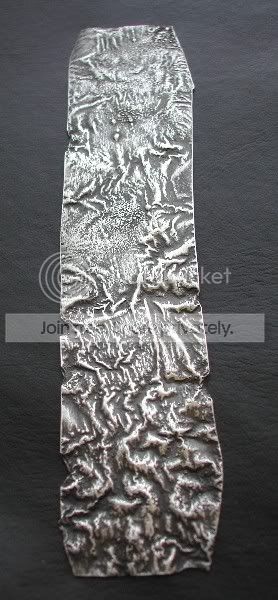
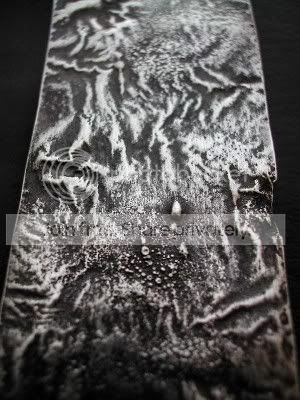
Reticulated silver

Tai Goo

BANNED
Joined
Apr 7, 2006
Messages
3,806
Here’s something you don’t see that much of on knives,... and that I haven’t done for a long while. It’s reticulated silver! I’m considering using it for some texture on a knife I’m working on.

It's a fun and interesting process.

Do you like the texture?

Reticulatedsilver003a.jpg


Reticulatedsilver010a.jpg
 
Nicely done. Definitely an acquired skill, controlling the heating. Do you use a tiny jeweler's torch or something larger?
 
I thought you were talking about a silver reticulated python !! It looks like a combination of heat and mechanical repousse .Keep going and show us the results.
 
With the correct silver alloy, it can be done entirely by heating. Heat once to draw copper to the surface on one side, creating an alloy gradient. The second heating causes the puckering as it expands chaotically due to the heterogeneity.
 
Mike is basically correct.

First it must be a silver/copper alloy, like sterling or coin silver. It tends to work best on about 20 gage sheet. The sheet is heated with a torch until the surface turns black by forming cupric oxide. The cupric oxide is pickled off the surface with acid, which leaves a thin white skin of pure silver on both sides. This process is repeated several times, until the surface will no longer oxidize black. Once the skin of pure silver is formed on the surface, the internal silver/copper alloy will melt at a lower temperature than the surface, and the sheet wrinkles, puckers and reticulates right within the threshold of the flow point. The size and adjustment of the torch flame has an major effect on how it turns out. I usually use a very small focused, hot, oxidizing flame, heat just a small area, keep the flame moving around, and be careful not to melt through.

Here's a related link.
http://www.hauserandmiller.com/fab/reticulation.html
 
Good explanation, Tai. Thanks, I understand it better now.

Do you heat the piece from both sides, suspended, or lay it flat on a soldering pad or something?

I bought a sheet of 80/20 from Rio Grande and have only had moderate success. First attempt ended in a blob, naturally.:o The second and then third attempts I got better control and was able to get a piece usable for my wife to make a necklace pendant, though nowhere near the reticulation you achieve. I heated one side only against a soldering pad using a Smith jeweler's oxy/ac torch with a medium-small tip (3rd smallest) and oxidizing flame. I find, though, that I still have much unoxidized copper on the surface after pickling.

Any suggestion on how to change conditions?

I'm sure practice, practice, practice is the biggest factor.

Thanks for any further help.
 
Mike, I heat both sides when I'm oxidizing it, (either laying flat or suspended), but only one when I'm reticulating. Both sides get pickled. Oxy/ac works best, but all I had this time was oxy/Mapp. I like to use the smallest tip I can, run it extra hot and oxidizing, and hold it an inch or two over the surface of the sheet.

The more times you repeat the oxidizing and pickling, the more dramatic the effect. I've had them where they raised up to about 1/8 inch in relief. Although I'm not sure that much relief would necessarily always be desirable.

I’m going to try and form this one into a hollow ferrule which gets a little touchy. It tends to be a little bit brittle and crack if you aren’t careful when you are forming it. This piece is coin silver 80/20 which does tend to be harder and a bit more brittle than sterling, but also tends to be easier to reticulate.

 
Very interesting !!... The Incas used to take gold-copper alloys and with successive heating and acid etching of the copper would end up with pure gold on the surface [not for reticulated though].They were masters of metalworking !!!
 
Very interesting !!... The Incas used to take gold-copper alloys and with successive heating and acid etching of the copper would end up with pure gold on the surface [not for reticulated though].They were masters of metalworking !!!

I think they called that alloy "tumbaga" (spelling ?), which is essentially the same alloy as shakudo.

The process is called "depletion gilding".
 
Thanks for the info,Tai. We've got some PMC to play with this weekend so I'll try the reticulation again, too.
 
That looks really cool!!
I'm new, so you must forgive my questions but what are you going to use it for??
 
That looks really cool!!
I'm new, so you must forgive my questions but what are you going to use it for??

I'm thinking about using it for a ferrule, which I have done before.

I just take the sheet after it's reticulated, bend it around, solder and chase the seam.
 
I'm thinking about using it for a ferrule, which I have done before.

I just take the sheet after it's reticulated, bend it around, solder and chase the seam.


"Aaaahhaaaa" said the blind man!! Now that will be really cool!!!!!
What type of solder are you using?

BTW, your work is amazing!
 
"Aaaahhaaaa" said the blind man!! Now that will be really cool!!!!!
What type of solder are you using?

BTW, your work is amazing!

Thanks.

... High temperature silver solder,... same kind they use in silversmithing and jewelry.
 
Back
Top